The Federal Reserve is on a tightrope with inflation still rising and economic data emerging from the shroud of a government shutdown. The issue on everyone’s mind isn’t whether the Fed will cut again in December, but what kind of reduction, and whether they’ll hold off altogether.
As hawkish voices within the Fed raise the heat, traders are discreetly reducing their bets on a December rate decrease, indicating rising tensions between the central bank’s “doves” and “hawks.”


Hawkish Voices Take Centre Stage.
Three key regional Fed executives, Kansas City Fed President Jeffrey Schmid, Dallas Fed President Lorie Logan, and Cleveland Fed President Beth Hammack, have all recently spoken in more cautious tones. Hammack plainly told the Pittsburgh Economic Club, “It’s not obvious that monetary policy should be doing more right now.”
Logan stated at a Dallas-Kansas City Fed energy conference that another rate cut would be difficult to support unless there is evidence of faster inflation or a more significant cooling in the labor market.
Schmid, however, pointed to deeper systemic concerns,
“I do not think further cuts in interest rates will do much to patch over any cracks in the labor market … stresses … arise from structural changes in technology and immigration policy.”
He claimed that more cuts might “have longer-term effects on inflation” and jeopardize the Fed’s adherence to its 2% objective.


Doves Push Back, But Markets Are Listening to Hawks.
Fed Governor Stephen Miran has made a public case for continuing to lower interest rates. In recent television appearances, he advocated for a greater drop than the Fed’s 0.25% cut in October.
Miran, who agrees with dovish economic views, has also spoken out in support of further easing.
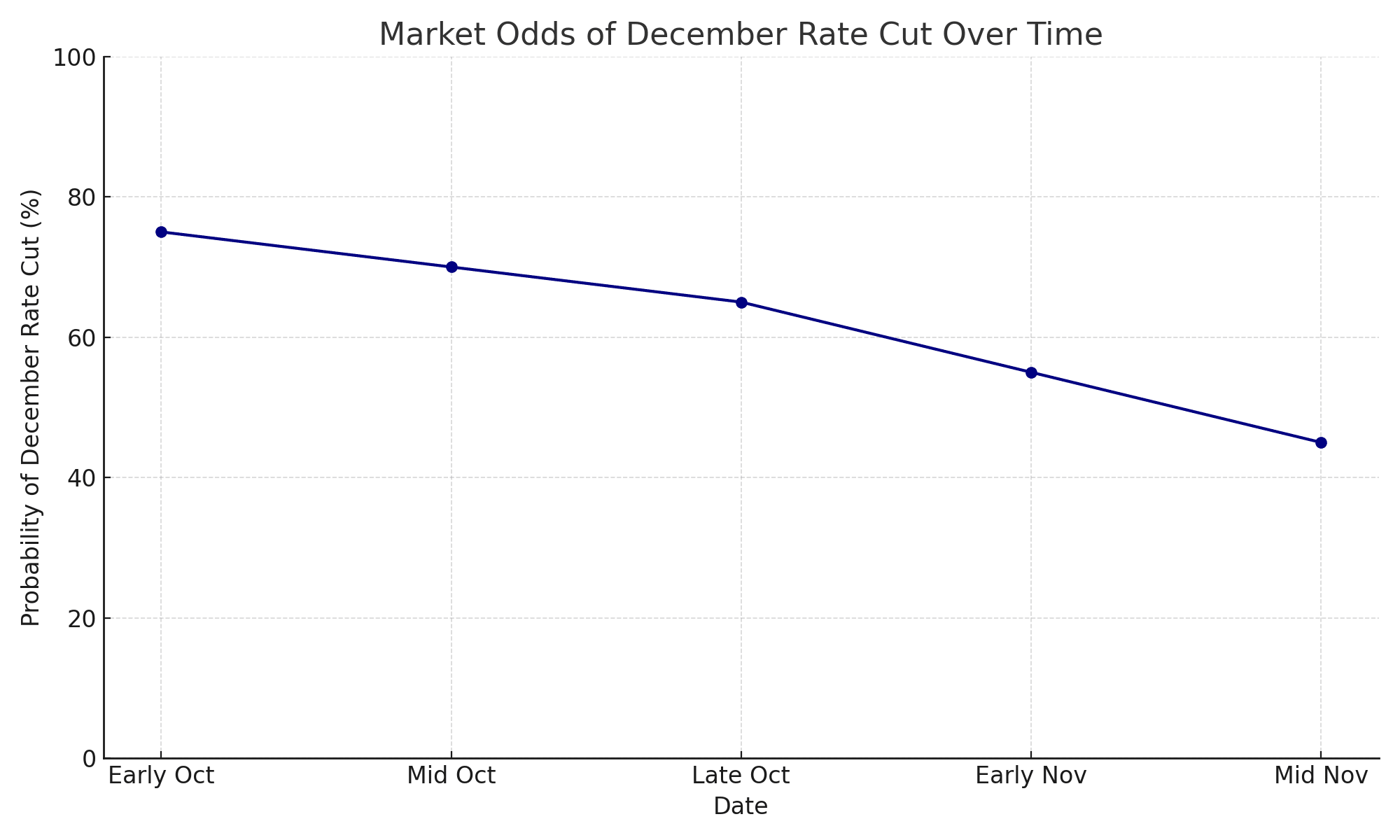
Despite that strong defense, the markets appear to be leaning toward the hawkish position. Short-term interest-rate futures, which are often regarded as the greatest real-time indicator of what traders genuinely expect, currently show a 60% chance that the Fed will not lower rates again in December. That’s a significant change from the previous day, when the chances were about equal.
A Divided Fed Increases the Stakes
The Fed’s profound divisions add to the drama of this moment. San Francisco Fed President Mary Daly, who was formerly a strong supporter of rate reduction, recently labeled a December decision “premature,” adding she is maintaining an open mind.
Susan Collins, President of the Boston Fed, has also indicated publicly that she believes there is a “relatively high bar” for additional easing. At the same time, Minnesota Federal Reserve President Neel Kashkari has advised caution,
“I can make a case depending on how the data goes to cut, I can make a case to hold … and we’ll have to see.”
His reluctance demonstrates how delicately balanced the discussion has become.
Data Uncertainty Clouds the Path Forward
To make matters worse, vital economic data remains unclear. A recent government shutdown delayed the reporting of critical data like as inflation measurements and job figures, producing what some refer to as a “fog” over the actual status of the economy.
Even Fed Chairman Jerome Powell has recognized the uncertainties. After the most recent meeting, he warned that a December rate decrease “is not to be seen as a foregone conclusion in fact, far from it.” All eyes are now focused on the data pipeline.
As agencies continue to flood the market with previously withheld data, the case for or against another rate decrease may alter drastically, depending on what those numbers reveal.
Why This Moment Matters
The stakes around the December rate decrease could not be higher. If the Fed eventually decides to stand steady, it will indicate that the hawkish faction has successfully moved the discourse back toward moderation.
That type of halt is expected to push government bond rates higher, constrain credit access, and strike a more cautious tone for investors in 2026. Markets interpret a “no-cut” decision as a signal from the Fed that it sees persistent inflation risks, so the ripple effects can spread quickly.
However, if policymakers turn and implement a cut, the story might shift overnight. An unexpected move would revitalize the dovish view, giving traders who have been relying on a more accommodative rate path next year renewed confidence.
Risk appetite is anticipated to rise, from stocks to housing, as markets read the move as the Fed reopening the door to a more dovish policy approach.
Conclusion
The Federal Reserve’s next action in December will reveal more about its confidence in the economy than any statement or projection.
A pause would indicate prudence, but a December rate drop would suggest mounting anxiety under the surface.
In any case, markets are keeping an eye out for any new information. Finally, this choice will help set the financial tone and momentum for 2026.
For more news, visit our platform.
FAQ’s about the December rate cut
1. Why is there so much uncertainty about the December decision?
Economic data has sent contradictory signals, and Fed officials continue to express opposing opinions.
The combination of noise and disagreement makes it difficult to determine if a December rate decrease is genuinely in the works.
2. Why are traders responding so aggressively to Fed remarks right now?
Because every word made by officials provides insight into how they interpret inflation and the labor market and in this sensitive environment, even minor indications may affect markets.
3. Would a December rate drop indicate that the economy is weakening?
Not necessarily. It might suggest worry about slowing trends or merely an effort to maintain momentum moving into 2026, depending on how the Fed presents it.
4. How may this choice affect average consumers?
A rate drop might lower borrowing prices for mortgages, credit cards, and loans, but leaving rates unchanged could keep financial conditions tighter for a little longer.
Glossary of Key Terms
Hawks (Fed Hawks)
Fed officials who prefer higher interest rates to fight inflation.
Imagine someone who keeps the thermostat cooler because they worry the room will overheat — that’s a hawk with the economy.
Doves (Fed Doves)
Fed officials who prefer lower interest rates to help growth and jobs.
They’re the ones saying, “The room is too cold, turn up the heat!”
Rate Cut
When the Fed lowers interest rates.
This makes borrowing cheaper for everyone, from homebuyers to businesses, and usually boosts the economy.
Rate Hike
When the Fed raises interest rates to slow things down and keep inflation in check.