![BitTorrent [New]](https://s2.coinmarketcap.com/static/img/coins/64x64/16086.png)


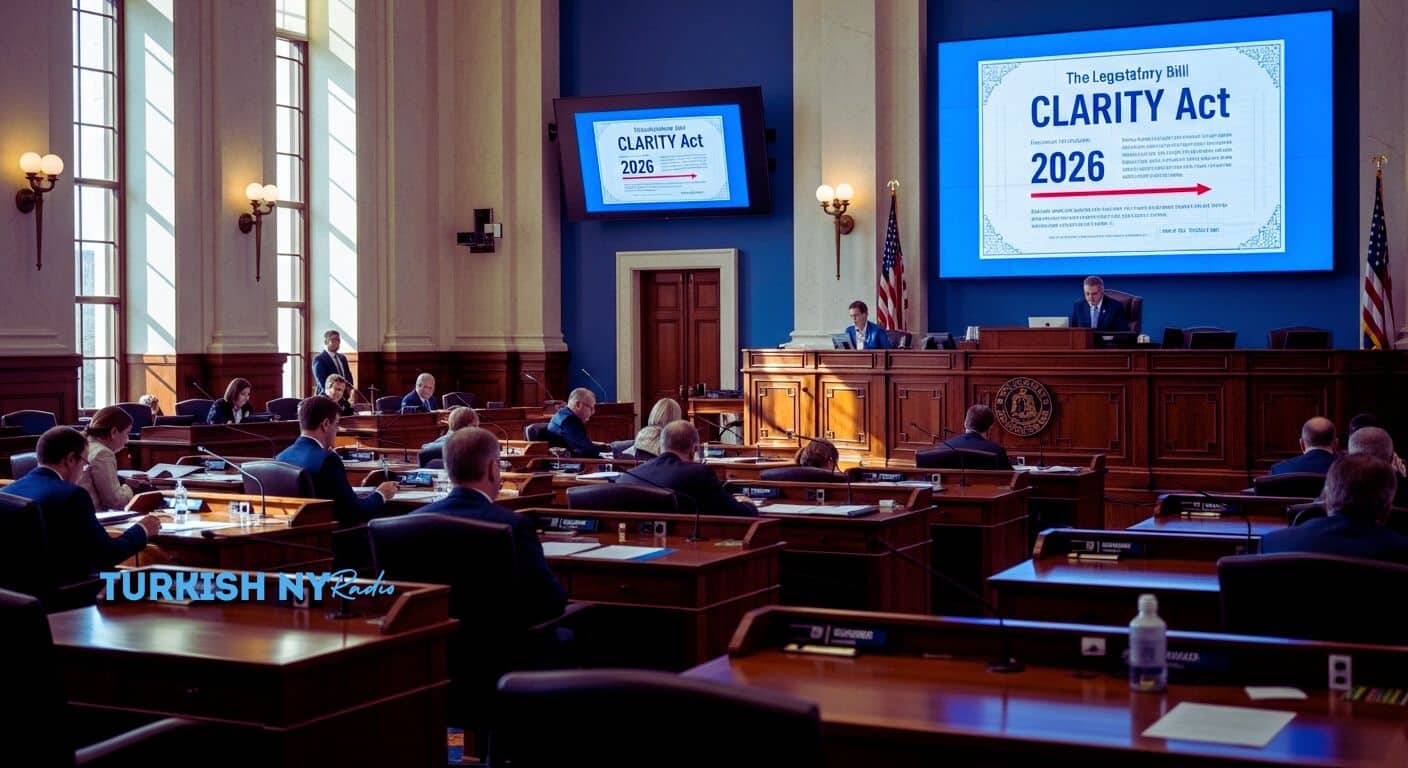
This article was first published on TurkishNY Radio.
The CLARITY Act, proposed U.S. legislation designed to establish clearer regulatory rules for digital asset markets, may struggle to pass in 2026 unless lawmakers accelerate the legislative process in the coming weeks.


Alex Thorn, head of research at Galaxy Digital, warned that the CLARITY Act must move through a Senate committee by the end of April to remain viable this year. The statement came in a public post on social media where Thorn outlined the limited timeline facing lawmakers.
“If CLARITY doesn’t pass committee by the end of April, odds of passage in 2026 become extremely low,”
Thorn wrote.
The comment reflects growing concern among policy analysts and industry observers that the window for passing the CLARITY Act is closing as Congress prioritizes other legislative initiatives.
CLARITY Act Faces Pressure From Senate Calendar
Congressional scheduling appears to be the most immediate challenge for the CLARITY Act. Senate leaders are currently focused on other policy priorities before turning their attention to digital asset regulation.
John Thune, the Senate Majority Leader, recently indicated that lawmakers are unlikely to address digital asset market structure legislation until after April.
The Senate is first expected to consider the SAVE America Act, which requires individuals to provide proof of U.S. citizenship in person when registering to vote.

If the CLARITY Act does not clear committee review before the end of April, the remaining legislative calendar may not leave enough time for debate, revisions, and a final vote.
Congressional sessions often become more restricted later in the year as lawmakers shift attention to election-related activities and other policy negotiations.
Meanwhile, blockchain networks continue to process large volumes of transactions daily. Public blockchain explorers such as Etherscan and Blockchain.com show consistent network activity, which industry participants often cite as evidence that regulatory clarity is becoming increasingly necessary.
CLARITY Act Talks Stall Over Stablecoin Yield Debate
Beyond scheduling challenges, policy disagreements are also slowing progress on the CLARITY Act.
One of the most contested provisions involves whether stablecoin issuers should be allowed to provide yield or rewards to users who hold their tokens.
Traditional banking organizations have raised concerns that yield-bearing stablecoins could draw deposits away from commercial banks.


Digital asset companies, on the other hand, argue that such incentives could improve payment systems and broaden stablecoin usage.
However, the stablecoin yield issue is only one part of the broader discussion surrounding the CLARITY Act. Lawmakers are also debating how regulatory authority should be divided between federal agencies and how decentralized finance platforms should be treated under U.S. law.
Angela Alsobrooks, a member of the Senate Banking Committee, recently acknowledged that progress may require compromise from both the banking sector and the digital asset industry.
Analysts Warn Crypto Regulation May Be Delayed
Some policy analysts believe that the CLARITY Act could face delays extending beyond the current congressional cycle.
Research from TD Cowen suggests that large-scale crypto market structure legislation may not pass Congress until 2027, with implementation potentially stretching to 2029 if political disagreements persist.

Such a delay would leave the digital asset sector operating under a fragmented regulatory framework for several more years. The final shape of crypto regulation could also be influenced by future election outcomes and changes in congressional leadership.
Despite these uncertainties, executives at Coinbase have expressed confidence that bipartisan support for crypto policy still exists. Industry representatives believe stablecoin legislation could advance first, with broader rules such as the CLARITY Act following afterward.
White House Comments Add Political Pressure
Debate around the CLARITY Act has also drawn attention from national political leaders.
Donald Trump recently called on lawmakers to finalize a digital asset market structure framework more quickly. The former president criticized banking institutions for slowing legislative progress related to crypto regulation.
For now, the future of the CLARITY Act depends largely on whether Congress can move the bill through committee before the April deadline. Without that step, analysts say the probability of the legislation advancing in 2026 could drop significantly.
Summary
The CLARITY Act is facing a tightening timeline in 2026 as Congress struggles to move the bill forward. Galaxy Digital research head Alex Thorn said the legislation must pass a Senate committee by the end of April to remain on track this year.
Ongoing disagreements over stablecoin yield, regulatory authority, and competing priorities in Congress are slowing progress, raising concerns that broader U.S. crypto market structure rules could take several more years to finalize.
Glossary of Key Terms
- CLARITY Act
The CLARITY Act is a proposed U.S. law intended to bring clearer rules to the cryptocurrency industry. It aims to define how digital assets are regulated and which federal agencies oversee them. - Digital Asset Market Structure
Digital asset market structure refers to the set of rules and policies that determine how cryptocurrencies and blockchain-based platforms operate. It includes regulations for trading, exchanges, and investor protection. - Stablecoin
A stablecoin is a cryptocurrency designed to maintain a stable price, usually by linking its value to a traditional currency like the U.S. dollar. They are widely used for payments and trading. - Stablecoin Yield
Stablecoin yield refers to rewards or interest users may receive for holding or lending stablecoins on certain platforms. These returns have become a major topic in ongoing regulatory discussions. - Senate Committee Review
Senate committee review is a step in the U.S. legislative process where lawmakers examine a proposed bill, debate its details, and decide whether it should move forward for a full vote. - Regulatory Authority
Regulatory authority means the legal power given to government agencies to oversee and enforce rules within an industry. In crypto, this often involves agencies responsible for financial markets. - Decentralized Finance (DeFi)
Decentralized finance, or DeFi, refers to financial services built on blockchain networks that operate without traditional banks. These platforms allow users to lend, borrow, and trade directly.
FAQs About CLARITY Act
1. What is the CLARITY Act and why does it matter for crypto?
The CLARITY Act is a proposed U.S. bill aimed at setting clear rules for digital assets. It defines which regulators oversee crypto markets and how companies operate.
2. Why is the CLARITY Act facing delays in Congress?
The CLARITY Act is moving slowly because lawmakers are debating stablecoin rules, regulatory authority, and other priorities in Congress, which has reduced the time available.
3. How could the CLARITY Act help the crypto industry?
If approved, the CLARITY Act could give crypto companies clearer legal guidance, improve investor protection, and help the industry grow within a structured regulatory framework.
4. When might the CLARITY Act actually take effect?
Even if lawmakers pass the CLARITY Act soon, analysts believe implementing full crypto market regulations could take years because agencies must finalize rules first.