


This Article was first published on TurkishNYR.
JPMorgan has just tokenized a traditional money-market fund on the Ethereum network. JPMorgan’s fund, which it dubs the My OnChain Net Yield Fund (ticker MONY), seeded the new portfolio with $100 million of its own capital and is available to qualified clients using the bank’s Morgan Money platform.


MONY is operationally structured like a traditional money market fund (holding short-duration US Treasury securities and repos) but with blockchain-based tokens on Ethereum.
Investors get tokens in their wallet, and dividends are compounded daily. Investors can subscribe and redeem with cash or USDC stablecoin. This JPMorgan’s newly christened Ethereum fund is only open to accredited institutional investors ($1M minimum investment) but also with high net worth eligibility.
MONY is the first time a major Wall Street bank has placed a regulated cash fund on a public blockchain.
These reforms formed the very basis of the tokenization, for as JPMorgan states, it “provides increased transparency, peer-to-peer transferability and the potential for broader collateral usage within the blockchain ecosystem.”
This means that in theory, the fund’s token can settle instantly 24/7, be sent directly to an address and even serve as collateral within other DeFi protocols, capabilities that typical money market funds don’t have.
The move was driven by JPMorgan using its Kinexys platform and is integrated within Morgan Money, the firm’s liquidity management portal for institutions.
What Is JPMorgan Ethereum Fund and How Does It Work?
JPMorgan’s OnChain Net Yield product is a tokenized money market fund running on Ethereum.
The way it’s structured is this: It’s a 506(c) private-placement fund, meaning it can be sold only to qualified (accredited) investors. The bank initially seeded MONY with $100 million and then allowed it to be opened up to outside investors who had reached a lofty threshold (High net worth clients with greater than $5M in assets for individuals, institutional clients with more than $25M).
Investors subscribe through Morgan Money and immediately receive blockchain tokens that represent their stake. The only assets the fund owns are U.S. Treasury bills, notes, and fully-collateralized repos.
Because it’s on-chain, clients earn yields as much as they would with a traditional fund, only the shares exist as tokens. Investors can redeem in those tokens at any time, including outside of market hours, either for cash or for the USDC stablecoin, marrying hassle-free crypto with regulated asset backing.
Features of the MONY fund are:
Conservative Assets: Only Treasuries and repo securities, identical to other money funds
Blockchain Settlement: The shares issue in the form of on-chain tokens on Ethereum
Transparency and Flexibility: Records ledger in real time, peer-to-peer (P2P) transactions, 24/7 access to the asset
Digital Flexibilities: Redemptions in fiat or stablecoin, and potential use of tokens as collateral in DeFi
Investor Access : Through the JPMorgan corporate portal, Morgan Money is limited to institutional or professional clients.
Table: JPMorgan’s tokenized money fund (MONY) vs. a conventional money market fund.
| Feature | MONY (On-Chain MMF on Ethereum) | Traditional Money Fund |
| Issuer | JPMorgan Asset Management | Other fund managers |
| Assets | U.S. Treasuries & Repo contracts | U.S. Treasuries and Repo contracts |
| Blockchain Platform | Public Ethereum network | None (off-chain accounting) |
| Investor Eligibility | Accredited investors only | Retail and institutional investors |
| Subscription/Redemption | Via Morgan Money portal (cash or USDC) | Fund-based purchases/redemptions |
| Settlement Speed | Instant on-chain (24/7) | Typically T+1 business day |
| Transferability | Tokens can be transferred peer-to-peer | Shares not transferable between parties |
| Transparency | Full on-chain visibility | Periodic statements |
| Collateral Usage | Usable in DeFi and lending | Limited to cash reserves |
| Yield Distribution | Daily, reinvested in tokens | Daily accrual to fund NAV |
Institutional Tokenization and the Ethereum Ecosystem
JPMorgan’s on-chain fund didn’t come out of thin air. There has been an influx of institutional tokenization into the crypto industry in 2024-2025.
Similar tokenized cash fund like BlackRock’s BUIDL fund is now running with approximately $1.8-2.0 billion assets under management. Franklin Templeton and other fund firms have also offered similar products with combined tokenized Treasury assets now in the low tens of billions.
Data provided by RWA trackers estimate that the market size for tokenized financial products is in tens of billions of dollars.
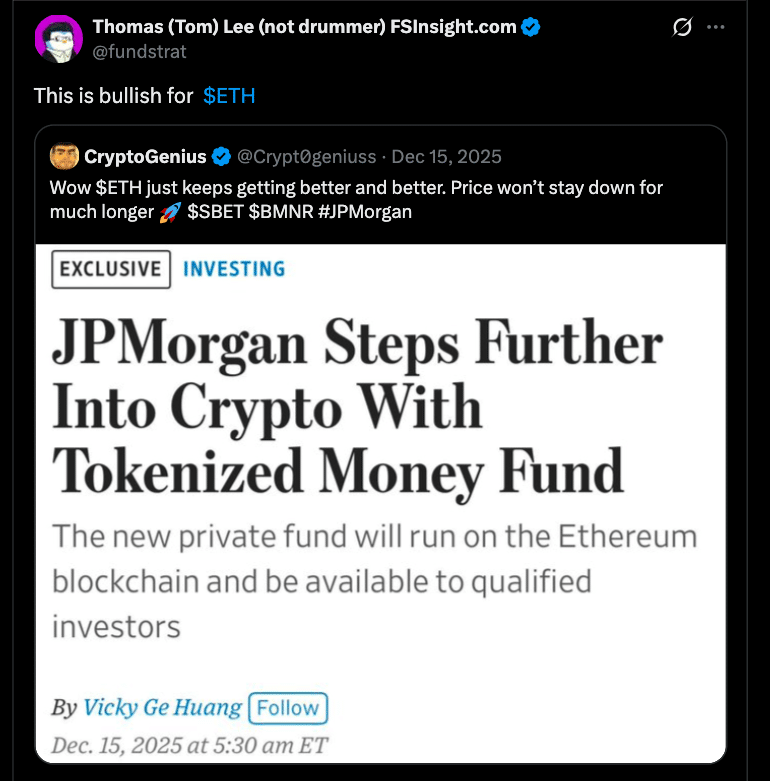
One report observes that tokenized real-world assets climbed above $30 billion in 2025 and Ethereum was responsible for most of that volume. Thomas Lee of Fundstrat had gone as far as to declare JPMorgan’s move “bullish for $ETH,” noting that heavyweight tokenized funds tend to use Ethereum as their settlement layer.
The new wave of tokenization is prompted by regulatory clarity. The U.S. GENIUS Act and other regulations have paved the way for using stablecoins and tokens for settlement in regulated markets.
With certain rules in place, Wall Street firms are wagering that blockchain can enhance capital markets infrastructure.
By Building on Ethereum, JPMorgan’s MONY joins Coinbase’s Base and other projects to integrate TradFi and Crypto rails.
According to JPMorgan’s head of liquidity, John Donohue,
“with Morgan Money, tokenization can fundamentally change the speed and efficiency of transactions”.
Why the Focus on Ethereum Is Important
The fact that JPMorgan’s fund chose Ethereum did not go unnoticed. Public Ethereum, unlike smaller or private chains is notably more secure, liquid and connected.
JPMorgan is showing confidence in the fact that Ethereum and its robustness and network effects are where MONY belongs. The fund puts pooled, regulated cash onto the same settlement layer that is used by the world’s DeFi protocols, stablecoins and a variety of tokenized treasuries.
This is a bridge between traditional finance and crypto: idle dollars parked in JPMorgan’s fund are folded into blockchain assets capable of flowing into on-chain applications.
There are also tangible benefits to the blockchain universe. With tokenization on Ethereum, settlement will occur 24/7, with the transparency of real-time movement of these assets, something not available to the clients of money-market clients today.
If nothing else, an on-chain transfer can settle in seconds rather than a whole banking day. And with full ledger visibility, auditors and clients can verify fund holdings instantaneously.
The tokens can be used as collateral in DeFi lending or swaps, leading to new efficiencies. This collection of benefits quoted by executives at JPMorgan lie behind the big step forward in how assets will be traded.
Moreover, Ethereum’s mature ecosystem will allow MONY to integrate with current tools. Although MONY is only available through JPM’s platform (not as a retail product), its tokens could be used to place deposits into institutional DeFi pools or tokenized lending protocols.
If, on the other hand, the fund had launched on a smaller chain, it could have been isolated from much of crypto’s infrastructure.
Industry data also corroborates that more than 70% of the existing tokenized RWA value is living on Ethereum or its Layer 2 networks.
Implications and Outlook
Analysts caution that while tokenized funds can drive adoption, they won’t single-handedly cause overnight price spikes without a larger upswing from the crypto market. For investors who believe in fundamentals, this is validation of Ethereum’s utility. It demonstrates that traditional cash management tools can operate comfortably on-chain, without sacrificing regulation or safety.
In the months ahead, JPMorgan itself hinted that it may introduce more products if clients want them. There are also global financial companies such as competitors like Bank of New York Mellon, Goldman and so on, that are actively looking into tokenized funds.
Every new launch increases confidence, as regulated businesses see their peers using Ethereum-based solutions, they feel more comfortable with the technology.
That said, challenges remain. The tokenized market is still only a drop in the bucket compared to traditional cash like funds ($8-9 trillion worldwide). Competition among blockchains is real: BlackRock has launched BUIDL across several chains including Ethereum and others, while some banks could favour Solana or even Ripple’s network.
At the end of the day, JPMorgan’s Ethereum fund is a material institutional endorsement of blockchain for finance.
By combining Wall Street cash products with the Ethereum technology, it is creating a secure and high-speed cryptocurrency transaction network with a transparent due process and a rule-based reference mechanism.
It could, over time, also deepen on-chain liquidity and solidify Ethereum’s status as the settlement layer for real-world assets. As Morgan Money’s platform of tokenized products expands, the once-obscure concept of regulated funds on crypto rails is sounding more and more like the future of finance.
Conclusion
JPMorgan Ethereum fund’ is a positive push in mainstream crypto adoption. JPMorgan’s Ethereum-based tokenized money market fund (MONY) is a fusion of traditional cash management and blockchain settlement. It is evidence that a $4trillion bank is prepared to rely on the Ethereum network for regulated, yield-bearing assets.
The fund is small compared to global markets, but its strategic signal is large. More tokenized finance is on the way and Ethereum is at its heart.
For investors, this development means real-world assets merging with DeFi liquidity on Ethereum’s rails, possibly driving even deeper the network’s growth over time.
It does not come with the promise of an immediate $ETH price boom, but instead points to a more durable, wider base of demand for Ethereum in the decade ahead.
Glossary
Ethereum: One of the most widely used blockchain platforms that enable smart contracts. Its native cryptocurrency is !ETH. Public Ethereum is frequently used as a rail of exchanging money involving tokenized assets.
Tokenization: To convert a real-world asset such as cash, bonds or real estate, into a digital token that is available on the blockchain . In this scenario, shares in a money fund are transformed into on-chain tokens.
Money Market Fund (MMF): A mutual fund that buys low-risk, short term debt (i.e. U.S. Treasuries, commercial paper). It supplies capital and yield, typically paying interest to investors.


Stablecoin: A cryptocurrency tied to a stable asset (such as USD). JPMorgan’s fund offers stablecoins for redemption.
DeFi (Decentralized Finance): An umbrella term for financial services that are created on top of public blockchains. Covers lending, trading and assets managed by smart contracts rather than banks.
KINEXYS: JPMorgan’s tokenization platform (which MONY is issued on), internal tech bridging traditional finance with blockchains.
Frequently Asked Questions About JPMorgan Ethereum Fund
What is JPMorgan’s on-chain fund?
It’s named “My OnChain Net Yield Fund” (ticker: MONY). It was debuted by JPMorgan Asset Management in Dec 2025 as a tokenized money market fund on the Ethereum blockchain. It invests in short-term U.S. Treasuries and repo agreements, just like any old cash fund does, but it mints shares as digital tokens.
Who can invest in JPMorgan’s Fidelity Ethereum fund?
Only qualified (accredited) investors. JPMorgan sets the bar at $5million for individuals and at $25million for institutions. The minimum investment is $1million per share. Customers sign up through JPMorgan’s Morgan Money portal and receive Ethereum-based tokens in their crypto wallets.
Why did JPMorgan choose Ethereum for the fund?
Ethereum is the most popular smart-contract platform, particularly when it comes to regulated assets. It provides the highest security, deepest liquidity and 24/7 settlement. By being built on Ethereum, MONY can leverage existing DeFi infrastructure (such as stablecoins and lending protocols) and take advantage of transparent on-chain auditing. Alternative blockchains are feasible, though JPMorgan indicated that public Ethereum is most suitable for this purpose.
How does this differ from a traditional money market fund?
MONY is functionally as safe as holding similar short-term assets. The difference is tokenization. Unlike traditional funds which settle using banks and custody, MONY’s shares live on-chain. This enables rapid settlement, transfer and on-chain clarity. It also enables investors to pay in fiat or stablecoin. A standard money fund, in contrast, does not allow for 24/7 access or the transferability of blockchain.