
This article was first published on TurkishNY Radio.
A quiet regulatory shift in Dubai has triggered a global debate about privacy, transparency, and the long-term structure of digital finance. Authorities did not outlaw privacy-focused cryptocurrencies outright. Instead, they removed them from licensed financial activity inside a major economic zone.


This narrow but powerful distinction signals a structural change in how modern financial systems plan to integrate blockchain technology, and it places the Dubai crypto ban at the center of global policy discussion.
For more than a decade, cryptocurrencies promised borderless value exchange and resistance to centralized oversight. Traditional finance depends on identity checks, transaction monitoring, and legal accountability. When these two systems intersect, regulation defines the limits of adoption.
The recent decision affecting privacy-enhancing tokens shows where institutional finance is drawing that boundary and why the Dubai crypto ban carries consequences far beyond one jurisdiction, especially for the future of regulated crypto markets.
Dubai Crypto Ban Marks a Turning Point for Institutional Adoption
Dubai has spent years building a reputation as a global center for compliant digital innovation. Exchanges, venture firms, and infrastructure providers established operations within the Dubai International Financial Centre, a special economic zone governed by an independent legal framework.
In January 2026, the Dubai Financial Services Authority prohibited anonymity-focused cryptocurrencies such as Monero and Zcash from use on licensed platforms operating within this district, formalizing the Dubai crypto ban inside supervised finance.
The restriction applies to trading, custody, marketing, and inclusion in regulated investment products offered by DFSA-authorized firms. It does not criminalize ownership. Individuals may still hold privacy coins in personal wallets or transact through decentralized networks beyond supervised intermediaries.
The change instead limits how institutional channels interact with assets that obscure transaction data, reinforcing boundaries inside regulated crypto environments.
This jurisdictional precision matters. The rule governs financial services conducted in or from the DIFC rather than the entire United Arab Emirates. Licensed firms must now independently determine whether any digital asset satisfies compliance expectations before offering it to clients. Responsibility shifts toward intermediaries, reinforcing alignment with global financial supervision standards and strengthening the structural meaning of the Dubai crypto ban.
Hidden Transactions and the Compliance Challenge
Privacy-focused cryptocurrencies rely on cryptographic systems that conceal transaction information. Monero uses ring signatures and stealth addresses to mix user activity into broader transaction groups, making it extremely difficult to trace senders or receivers.
Zcash enables shielded transfers that hide wallet addresses and transferred amounts through zero-knowledge proofs, although users may still choose transparent transactions.
These protections support legitimate confidentiality. Businesses may wish to hide supplier payments from competitors. Individuals may seek protection from surveillance or data misuse. Monero also operates without a fixed supply cap. After its initial emission phase, it introduced a small permanent reward known as tail emission to maintain miner incentives and long-term network security.
Yet regulated financial institutions must monitor transactions for illicit finance, sanctions violations, and fraud. When blockchain architecture prevents visibility, compliance systems cannot function effectively. International anti-money-laundering standards require service providers to identify counterparties, trace fund movements, and report suspicious activity.
Global regulatory guidance emphasizes that traceability is essential for secure digital asset markets. If a network removes that traceability by default, licensed intermediaries face legal barriers, reinforcing why the Dubai crypto ban directly affects the evolution of regulated crypto.

A Coordinated Global Direction Beyond Dubai
The Dubai crypto ban reflects a wider international trend rather than an isolated restriction. European policymakers are advancing anti-money-laundering rules expected to prevent privacy coins from appearing on regulated exchanges by July 2027, even though broader crypto legislation stops short of naming explicit bans. Several Asian jurisdictions and major exchanges had already delisted privacy coins years earlier in response to local compliance guidance.
In the United States, enforcement attention has expanded toward privacy-enabling infrastructure and developer responsibility. A high-profile 2025 criminal case involving transaction-mixing technology intensified debate about whether open-source privacy tools can expose creators to liability. A research shows regulators worldwide increasingly prioritize transaction visibility as a baseline for institutional participation, shaping the long-term direction of regulated crypto policy.
Even when privacy tools remain technically legal, regulatory systems are evolving around the expectation that financial intermediaries must identify users and track transaction flows. This convergence signals a durable governance shift closely aligned with the reasoning behind the Dubai crypto ban.
Market Reaction Reveals Two Emerging Crypto Economies
Prices of privacy-focused assets rose sharply around the time of the announcement. Monero climbed roughly twenty percent in a single day and briefly approached the mid-$500 range, while Zcash recorded strong gains and ranked among the better-performing digital assets of the previous year. Market researchers linked part of this movement to renewed investor interest in anonymity-preserving systems despite regulatory pressure following the Dubai crypto ban.
Short-term rallies, however, do not ensure lasting value. Instead, they highlight liquidity shifting from regulated venues toward decentralized environments where access remains unrestricted. Institutional investors typically avoid assets that cannot integrate with custody rules, disclosure requirements, or reporting frameworks. Transparent cryptocurrencies such as Bitcoin, Ether, and regulated stablecoins therefore continue to dominate allocation inside regulated crypto portfolios.
These dynamics reveal two parallel crypto economies forming simultaneously. Regulated access channels are narrowing around transparency and compliance, while decentralized channels continue enabling privacy-focused activity. Capital flows increasingly reflect this divide created in part by the Dubai crypto ban.
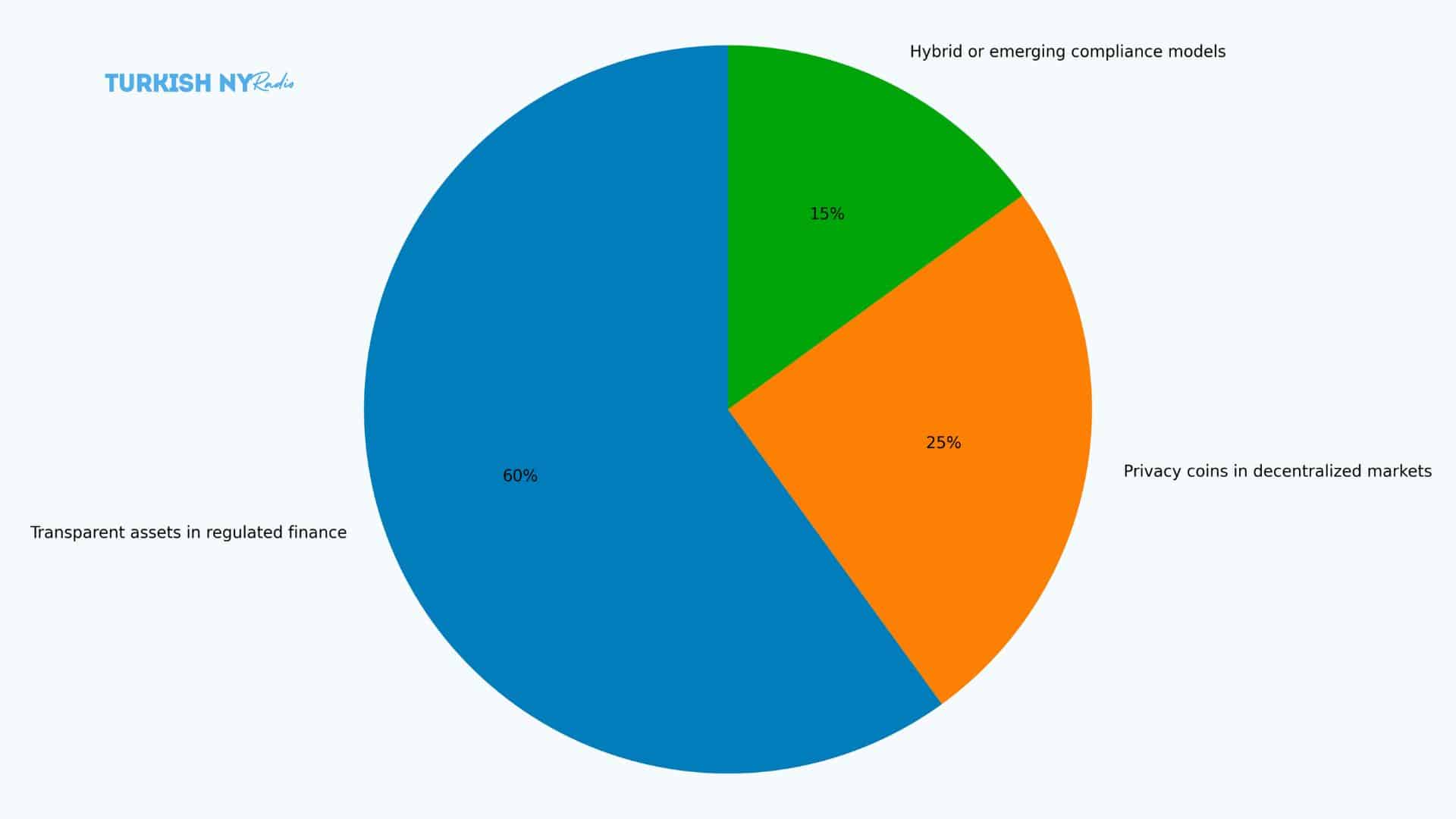
Consequences for Exchanges, Developers, and Token Architecture
Regulatory clarity often narrows available products while reducing uncertainty. Exchanges seeking licenses in global financial hubs must assume that built-in anonymity will prevent approval. Listing decisions now depend on auditability, governance transparency, and compatibility with travel-rule reporting obligations tied to regulated crypto compliance.
Developers pursuing institutional adoption are exploring hybrid privacy models. Optional confidentiality layers may allow users to shield data while still enabling lawful disclosure when required. Other approaches involve zero-knowledge compliance proofs that verify regulatory conditions without exposing full transaction histories.
Academic studies suggest such systems could eventually reconcile confidentiality with oversight, though scalability and legal certainty remain unresolved.
Privacy-first ecosystems may continue expanding through peer-to-peer infrastructure outside regulated finance. However, structural separation from institutional liquidity could limit long-term capital formation and reinforce the broader implications of the Dubai crypto ban.
Indicators Defining the Next Phase of Regulated Crypto
Several measurable signals now shape the evolution of regulated crypto markets. Institutional participation strongly correlates with transparency, auditability, and legal clarity. Assets operating within defined compliance frameworks tend to achieve deeper liquidity and steadier long-term adoption.
Developer funding patterns provide another indicator. Engineering talent increasingly concentrates on custody technology, identity verification tools, and automated compliance reporting. Regulatory certainty also reduces volatility by clarifying which business models can scale sustainably within regulated crypto infrastructure shaped partly by the Dubai crypto ban.
Liquidity fragmentation presents a contrasting signal. When regulated venues restrict certain tokens, trading volume migrates to alternative markets, often increasing price swings. Together, these indicators demonstrate how compliance architecture influences digital finance more profoundly than short-term speculation.
Privacy Versus Trust in Financial Policy
Not all policymakers equate privacy with wrongdoing. During a public regulatory discussion in late 2025, a senior U.S. financial commissioner warned that surveillance models from traditional banking may not translate directly to decentralized systems. The statement cautioned against treating privacy-preserving software itself as evidence of criminal conduct.
This debate reflects a deeper philosophical divide. Privacy can defend civil liberties, commercial confidentiality, and personal safety. Transparency supports fraud prevention, sanctions enforcement, and systemic trust. Effective governance must balance both principles rather than eliminate either one.
Dubai’s policy illustrates this compromise. Personal ownership of privacy coins remains lawful, preserving autonomy. Institutional finance, however, requires visibility to operate within regulated crypto frameworks shaped by the Dubai crypto ban.
What the Policy Signals for the Future of Digital Finance
The Dubai crypto ban does not end privacy innovation. Instead, it clarifies the boundary between decentralized experimentation and institutional adoption. Regulated crypto systems are converging around identity verification, transaction traceability, and reporting obligations as core requirements.
Privacy-centric networks may continue growing in peer-to-peer contexts where censorship resistance matters most. Yet large-scale investment vehicles, corporate treasury participation, and institutional liquidity increasingly depend on compliance alignment. Future advances in cryptography may merge confidentiality with auditability, but present-day infrastructure has not fully achieved that balance.
For analysts and developers, the lesson is structural. The future of regulated crypto will emerge where technological capability aligns with legal accountability and institutional trust—an evolution clearly accelerated by the Dubai crypto ban.
Conclusion
Regulatory turning points often reshape entire industries. The Dubai crypto ban represents one such moment for blockchain finance. The decision reinforces a global shift toward transparency as the foundation of institutional participation while leaving room for decentralized privacy innovation beyond regulated channels.
Digital assets will continue evolving along diverging paths. Compliance-aligned systems are positioned to attract capital, partnerships, and mainstream adoption. Privacy-first networks may preserve autonomy yet operate outside institutional finance. The balance between these worlds will define the coming era of the crypto economy.
Glossary
Privacy coin: A cryptocurrency designed to conceal transaction details through cryptographic privacy mechanisms.
Ring signature: A cryptographic method that mixes one user’s transaction among many to hide the sender.
Shielded transaction: A transfer that hides wallet addresses and amounts using zero-knowledge proofs.
Tail emission: A permanent small block reward used to sustain mining incentives in certain networks.
Regulated crypto: Digital assets operating within licensed, compliance-driven financial environments.
FAQs About Dubai Crypto Ban
Is owning privacy coins illegal in Dubai?
No. Individuals may still hold them privately, but DFSA-regulated firms in the DIFC cannot offer related services.
Why are privacy coins restricted in regulated finance?
Because hidden transaction data prevents monitoring required for anti-money-laundering and sanctions compliance.
How did markets react to the announcement?
Privacy-focused tokens briefly surged, while institutional capital continued favoring transparent digital assets.
Could privacy and compliance coexist in the future?
Emerging zero-knowledge compliance technologies suggest a potential balance, though real-world deployment remains limited.