
This article was first published on TurkishNY Radio.
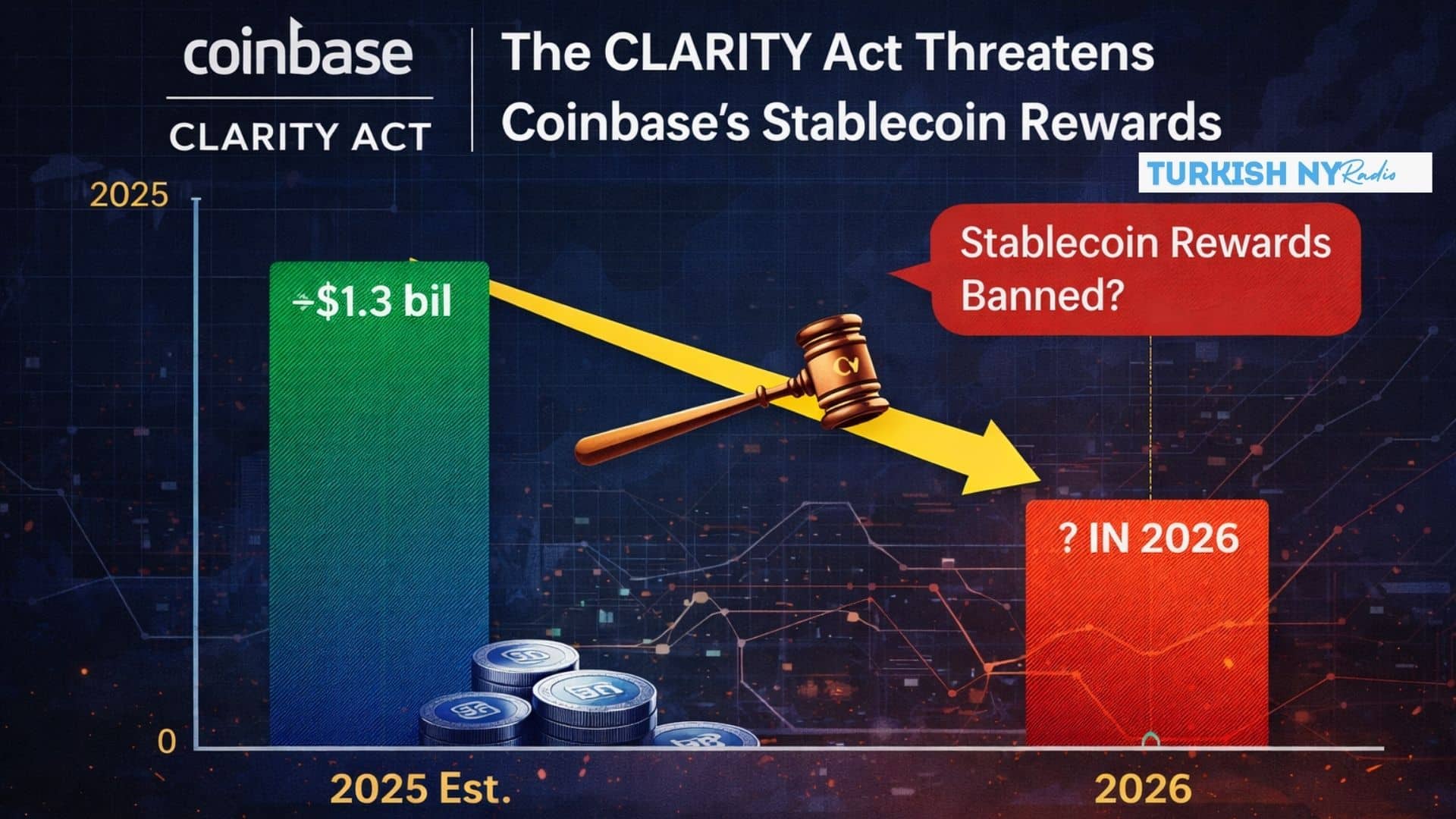
The Coinbase CLARITY Act is reaching a critical phase in Washington, with Coinbase indicating that it might change its endorsement for the measure if stablecoin incentives are constrained. News highlighting how precise legal phrasing may affect the financial sustainability of US-based digital currency exchanges. Instead of rejecting regulation entirely, Coinbase calls for clearer differences between stablecoin generation and platform-specific incentives.


Coinbase draws a line on stablecoin rewards
Coinbase’s position centers on one issue: whether stablecoin rewards offered by exchanges should be treated the same as interest paid by stablecoin issuers. According to statements cited in the original report, Coinbase argues that its rewards programs are funded through reserve income and commercial arrangements, not through changes to the stablecoin itself.
Also read: CLARITY Act Heads to Senate Markup in January: U.S. Crypto Regulation Nears Final Stage
This distinction is critical to the Coinbase CLARITY Act, which aims to define regulatory responsibilities across the crypto market without banning widely used consumer features. Coinbase has warned that if lawmakers blur this line, the bill could unintentionally harm compliant U.S. platforms.
“Rewards offered by platforms are not the same as interest issued by a stablecoin,” a Coinbase policy representative said, emphasizing the need for precise language.

Why rewards matter to Coinbase’s model
Stablecoin rewards are not a marginal feature for Coinbase. They play a role in user retention, liquidity management, and revenue diversification. Public disclosures show that stablecoin-related income has grown as trading volumes fluctuate, making the issue material to Coinbase’s long-term planning.
Because of this, the Coinbase CLARITY Act is viewed internally as more than a regulatory framework. It is a test of whether U.S. policy can accommodate modern digital finance models without defaulting to bank-centric rules.
Banking concerns influence lawmakers
Traditional banking groups have raised concerns that stablecoin rewards could encourage users to move funds out of banks. Some policy proposals reportedly suggest limiting rewards to regulated banking institutions, a move Coinbase believes would distort competition.
Coinbase has cautioned that rewriting the Coinbase CLARITY Act to favor one sector could reduce consumer choice and slow innovation. The company has not threatened immediate withdrawal from discussions but has made its position clear to lawmakers.


A narrow path to compromise
Many sources who are aware of the procedures, legislators are considering clarification terminology rather than absolute prohibitions. Possible solutions include explicit definitions separating issuer activity from exchange-level incentives. Whether those adjustments make it into the final Coinbase CLARITY Act text remains uncertain.
What is clear is that Coinbase’s stance reflects broader industry concerns about how nuanced regulatory details can carry significant economic consequences.
Conclusion
As debate continues, the Coinbase CLARITY Act illustrates how crypto regulation now hinges on precision rather than ideology. Coinbase’s response underscores that industry support depends on clear, workable rules that recognize how platforms actually operate. The final outcome may shape not only this bill, but future cooperation between lawmakers and U.S. crypto firms.
Also read: Coinbase CEO Bitcoin Prediction: Could BTC Hit $1 Million by 2030?
Summary
The Coinbase CLARITY Act has gained traction after Coinbase expressed worry about potential limitations on stablecoin payouts. The business contends that incentives differ from paid by the issuer interest and should be approved. With lawmakers weighing monetary worries alongside crypto innovation, the argument focuses on how granular legislative wording might impact company models, public access, and the future trajectory of US crypto policy.
Glossary of Key Terms
Coinbase CLARITY Act: Suggested US legislation intended to outline the bitcoin market framework.
Stablecoin rewards: Are Advantages offered by services to users who possess stablecoins.
Stablecoin issuer: An association that issues and backs a stablecoin.
USDC: A currency-pegged stablecoin widely utilized on US sites.
Market structure regulation: Guidelines that control how markets for commodities are constituted.
FAQs for Coinbase CLARITY Act
1. What’s known as Coinbase’s CLARITY Act?
It is a regulation aimed at clarifying regulatory control of US digital currency markets.
2. Why is Coinbase interested in stablecoin payouts?
According to Coinbase, rewards are platform motivations rather than issuer interest, and eliminating them might hurt competition.
3. Are stablecoin incentives now illegal?
No. The argument is about potential limits under new legislation.
4. Who is lobbying for reward limits?
Some banking associations warn that awards might drive deposits away from established banks.
5. What comes next?
Legislators are currently evaluating the text, and revisions could happen before the measure moves forward.