
This article was first published on TurkishNY Radio.
Worldwide energy costs keep going up, and in colder regions, this is most keenly felt by farms. As greenhouse operators look for cleaner, more affordable energy sources and explore how to leverage Bitcoin mining’s emerging business model, unexpected ideas come out of their discussions.


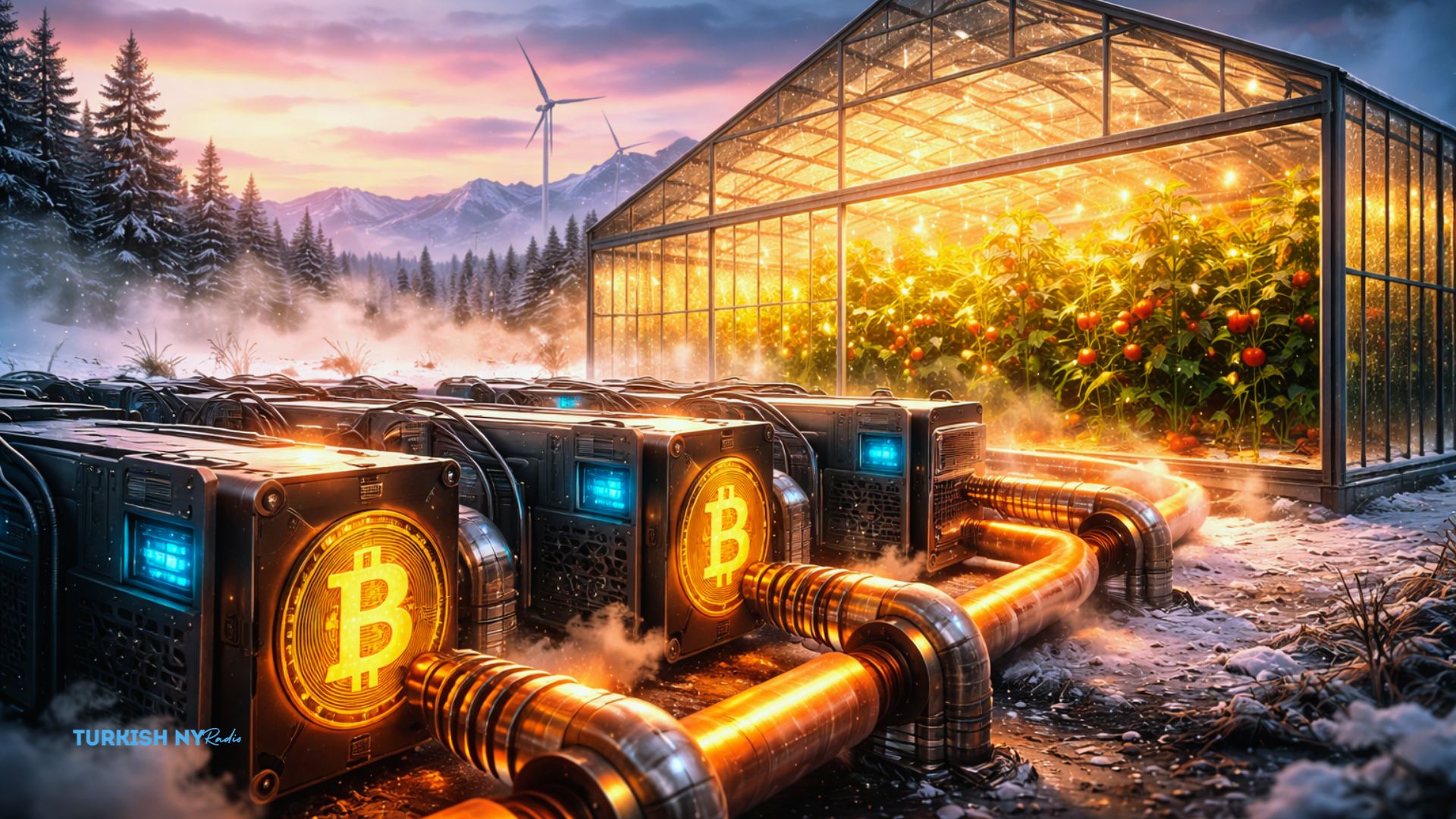
Bitcoin mining heat, once seen as useless waste, is being tested as a reliable energy source for agriculture. An experiment was shown off in Canada last week. This experiment shows how digital networks and food production may come together in novel ways, pushing analysts to reassess the connection between crypto-currencies and real-world utility.
A Growing Interest in Turning Digital Heat Into Real Value
The search for new heating solutions has never been more eager. In the past, the heating of greenhouses in wintry climes was a matter of concern to growers. Normal heating by means of natural gas or electricity is very expensive burden on growers. It was under this pressure that researchers first began to explore newer ways of creating climates where plants might grow. Many folk now see bitcoin mining as a real possibility for creating this sorts of controlled atmosphere.
Bitcoin mining is the process by which computers secure the network and verify transactions. This process uses specialized machines designed to solve mathematical problems, which generate substantial heat. For years, miners paid to remove this heat through fans or cooling systems.
Now, experts recognize that this heat can be repurposed instead of wasted. Several industry reports highlight this shift. A study published by the Cambridge Centre for Alternative Finance notes that miners already convert nearly all the electricity they use into heat, which makes them excellent candidates for heat recovery systems.
The International Energy Agency also explains that waste heat from digital infrastructure can serve as an efficient thermal source when captured correctly.
Why Canada Became a Testbed for This Unusual Pairing
Canada offers ideal conditions for this experiment. Its long, cold winters bring a constant marching line of greenhouse heating customers, and the clean hydropower in many areas means electricity is both reliable and low-carbon. Both these factors spell a natural working environment to prove whether or not mining-power thermals are worth pursuing.
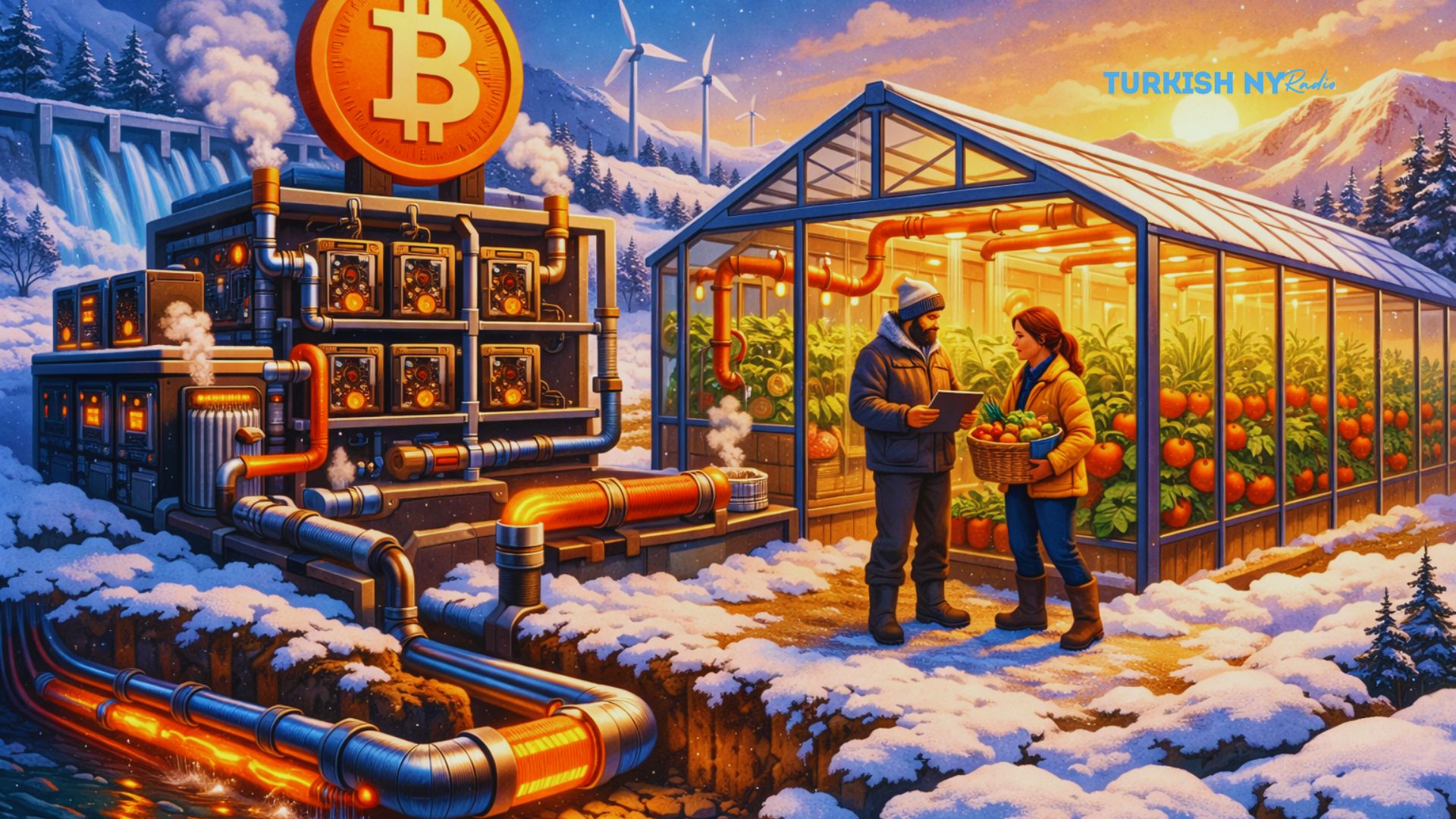
One of the most talked-about examples comes from Manitoba, where Canaan and Bitforest Investment are running a 24-month pilot. The project uses about 360 liquid-cooled mining units, roughly 3 megawatts, connected to a closed-loop system that preheats the water flowing through greenhouses’ pipes. This helps growers cut fuel use, while miners save on cooling costs.
Researchers describe the idea as simple but effective: the greenhouse gets affordable heat, and miners turn waste energy into something useful. The shared benefits are encouraging more interest in larger-scale applications across cold-climate regions.
How Heat From Mining Machines Can Support Food Production
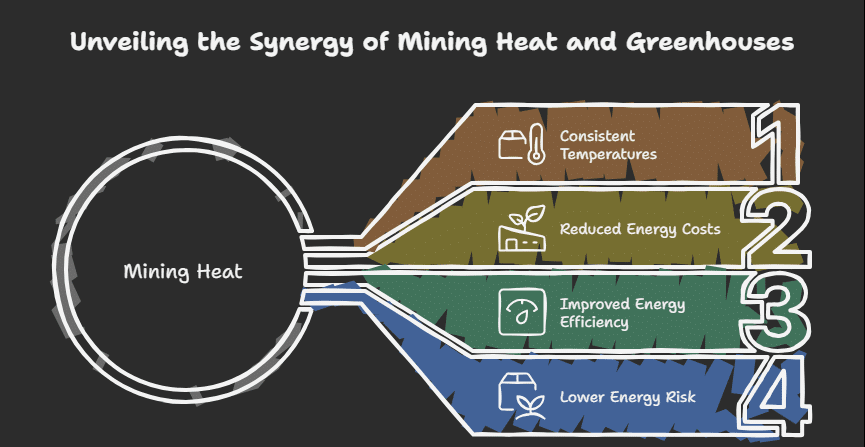
Greenhouses require a constant temperature to grow crops well. Energy analysts commonly refer to the fact that heating can cost over half of total greenhouse operating expenses in cold climates. This tends to go up further in winter, when demand for heating peaks and maintenance costs rise due to increased demand.
Mining systems can provide a reliable heat source. Mining machines are operational 24/7. Liquid-cooled mining systems play a central role in the setup, and they take heat away from hardware inside a sorter with water which is then cooled to keep it at around 20 degrees Celsius or lower (usually using some sort of dielectric solution as coolant).
The engineers then send this warmed liquid through heat-exchangers, allowing it to expand into greenhouse heating lines across the complex. As long as miners are still working, the process will continue. Well-designed, such techniques reduce reliance on non-renewable energy sources in glasshouses and make them more environmentally friendly.
Academic papers from the University of Waterloo argue that liquid cooling improves energy efficiency by capturing heat at higher temperatures than air cooling. This makes the heat more useful for industrial applications. Many greenhouse operators view this as a way to lower energy risk, especially during periods of extreme cold.
The Economic Case Behind the Experiment
The cost of heating often determines whether greenhouse farms stay profitable during harsh winters. When growers pay high fuel bills, profit margins shrink. This financial pressure has driven interest in low-cost energy sources.
The heat generated by Bitcoin mining creates a unique opportunity, as miners already pay for electricity. The heat itself costs nothing extra. Once the heat recovery system is installed, the greenhouse gains a thermal source that is independent of fuel markets. For miners, this arrangement reduces cooling costs.
Traditional cooling systems require powerful fans or chillers. Heat reuse enables miners to place their machines in controlled environments, treating heat as a resource rather than a burden.
Analysts from the energy research group Rystad Energy state that heat integration can improve total site efficiency by more than twenty percent. This gain appeals to miners who face rising energy costs and increased competition across the network.
A New Model for Collaboration Between Agriculture and Technology
This emerging partnership between growers and miners has sparked interest across financial and agricultural communities. Many analysts now see digital infrastructure as a potential heating solution for small towns and farms in cold regions. The concept of a circular energy system continues to gain momentum.
In this model, electricity drives mining machines, the mined heat warms crops, and increased efficiency benefits local food production and technological development. Some experimental designs also test hybrid models combining mining heat with renewable resources, such as solar panels. These designs remove temperature fluctuations and so enhance plant resistance, at the same time cutting down the carbon footprint of food production.
In online communities, enthusiasm for these ideas is on the rise. Developers emphasize how mining projects can be transformed into multi-use energy centers rather than just isolated warehouses.
Why This Story Matters in the Larger Context of Clean Technology
Interest in sustainable solutions is spreading across the financial world. Many investors now look for projects that return a profit and also benefit the environment. Recycling mining heat not only addresses miners’ long-standing criticism of energy use, but also gives analysts a way to gauge whether mining systems can serve broader economic and environmental objectives as well.
Reports of energy agencies point out that heat recovery is a long-term strategy in itself. These reports show how countries like Finland already use data center waste heat to feed district heating networks. This example demonstrates how digital heat can support entire communities.
The Canadian greenhouse experiment applies similar principles on a smaller scale and offers a practical model for rural areas. Crypto communities on social platforms also discuss how digital networks can help solve real-world issues. Many users study the role of blockchain in transforming agriculture, energy systems, and urban development.


Such talks regularly mention the rapid development of networks such as Solana, with analysts checking out the platform’s potential use for high-throughput apps. These examples show that it’s still possible to deploy greater numbers of blockchain technologies in applications outside traditional financial work.
Risks, Limitations, and Regulatory Considerations
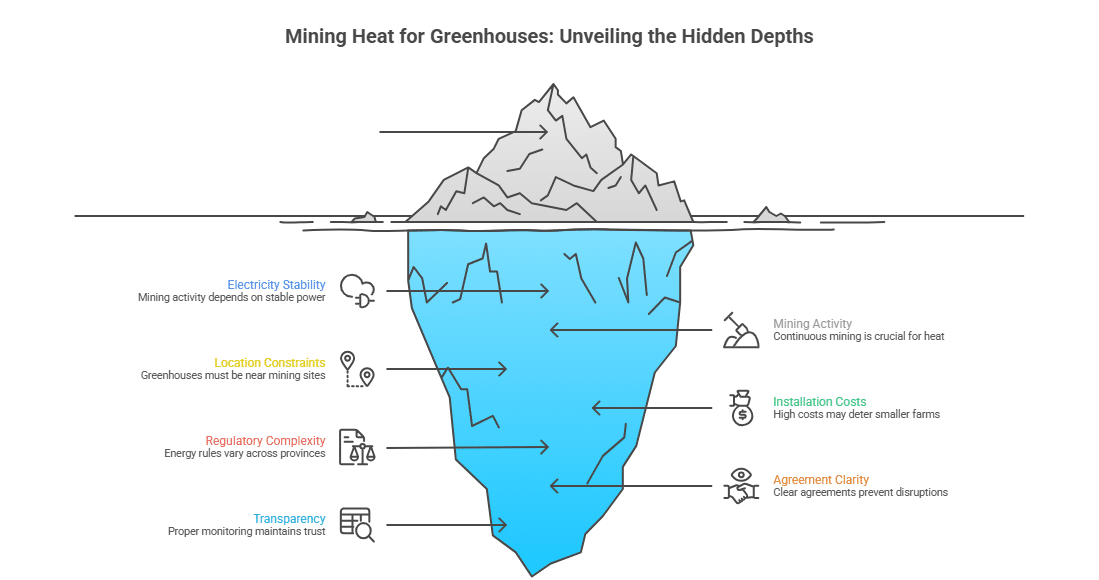
This model offers promise, but it also comes with challenges. Greenhouses need steady heat, and that depends on stable electricity and continuous mining activity. If miners shut down during market swings or equipment issues, backup heating must step in, which adds costs and operational pressure. Location also matters.
Heat cannot travel far without significant losses, so greenhouses must sit close to mining sites. Installation costs for liquid cooling and heat exchangers may be too high for smaller farms.
Regulation adds another layer of complexity. Energy rules differ across provinces, and some regions may restrict mining or power consumption. Clear agreements between miners and growers are essential to avoid disruptions. Experts also emphasize that organizations need to adopt transparent practices together with effective monitoring systems to maintain trustworthiness.
The concepts presented here comply with international regulatory standards which include MiCA regulations in Europe and FATF digital asset guidelines.
The Future of Mining Heat in Sustainable Agriculture
As greenhouse operators search for reliable heating options, interest in mining heat will continue to grow. The Canadian pilot shows how this approach can support both local food production and technological progress, prompting energy experts to rethink how mining fits into community infrastructure.
While these digital networks align with agriculture, opportunities (if anything) for collaboration will likely grow. For example, researchers expect to see more trial programs in the near future that deploy larger-scale heat recovery systems and are fitted with automatic cooling that spells cajagua. They could even be integrated into renewable energy sources.
If successful, this new approach to mining heat might become an important means of adding value to the agricultural economy in cold climates; in addition, public opinion may be further altered when farmers see just how practical mining can be for them.
Conclusion
Even though it may appear an unconventional idea to use Bitcoin mining heat for warming greenhouses, it has changed rapidly in cold climates into one of the most promising energy proposals ever. At the same time, Early experiments in communications, if put into practice, prove that digital systems can indeed produce real-world returns.
These tests show that when waste heat is turned into a collective resource, costs for growers drop while efficiency improves for miners. It opens the possibility of whole new discussions around what digital networks can do for communities, not just in finance, either.
The rising energy demand, together with growing sustainability needs, will establish these solutions as essential elements that will determine the future of agriculture, community infrastructure, and environmentally friendly technologies.
Glossary
Bitcoin mining: The process of validating transactions and securing the Bitcoin network through specialized computers.
Mining heat: Thermal energy produced during the mining process.
Hydropower: Electricity generated by moving water, often used in clean energy grids.
Heat exchanger: A device that transfers heat between two separate fluids.
Greenhouse heating: Controlled heating used to maintain plant growth in enclosed structures.
Liquid cooling: A method of cooling machines using fluids to absorb and transfer heat.
Carbon footprint: The total amount of greenhouse gases produced by an activity.
Energy efficiency: The ability to use less energy to perform the same function.
District heating: A system that distributes heat from a central source to multiple buildings.
Thermal recovery: The method of capturing and reusing waste heat.
FAQs About Bitcoin Mining
How does mining heat help greenhouses?
It provides a steady source of warmth, reducing the need for fossil fuel heating.
Is this heating model safe?
Yes. Engineers use closed-loop systems that keep mining machines separate from greenhouse environments.
Can this model work in warm climates?
It works best in colder regions where year-round heating is needed.
Is mining heat enough to replace traditional heating?
Most greenhouses still use backup systems, but mining heat can significantly reduce overall energy use.