![Sun [New]](https://s2.coinmarketcap.com/static/img/coins/64x64/10529.png)




This article was first published on TurkishNY Radio.
The global mining sector is no longer what it once was, and the change is deeper than most market participants realize. Bitcoin miners, long viewed as simple operators that convert electricity into digital assets, are now evolving into hybrid infrastructure companies. This transformation is driven by collapsing mining margins, rising operational costs, and a rapid shift toward artificial intelligence computing.


Industry-wide mining data suggests that the economics of traditional mining have weakened to a point where survival requires strategic reinvention. At the same time, recent infrastructure filings indicate that large-scale investments into AI data centers are accelerating across the sector. This dual movement has triggered a major shift in how markets value mining companies.
The result is a quiet but powerful redefinition of Bitcoin miners, where stock prices increasingly reflect infrastructure potential rather than pure Bitcoin exposure.
Profit Compression Is Forcing Bitcoin Miners to Rethink Everything
The financial squeeze on Bitcoin miners has fast accelerated over the past year. Estimated production costs are nearing $80,000 per Bitcoin, but revenue indicators keep trending lower. Hash price has declined from about $36–$38 to approximately $29, with forward projections also near at approximately $30.42.
At the same time, transaction fees now only make up 0.40% of rewards total, taking away a useful source of extra income. In some cases Bitcoin miners are earning as little as $500 per unit, emphasizing just how narrow margins have become, recent mining profitability analysis shows.
Recent network performance metrics also show three downward difficulty adjustments in a row, a noteworthy indicator that the weaker participants are being progressively pushed out of the system. While this might ultimately boost profitability for the survivors, it just reaffirms that the industry is under severe pressure.
In such an environment, Bitcoin miners cannot simply hold on to their assets anymore. They’re selling Bitcoin to keep liquidity and fund operations.
Selling Under Pressure: Why Bitcoin Miners Are Driving Market Cycles
Currently bitcoin miners possess over 121,000 BTC, meaning they are both a powerful mover as well as an actor on the market. However, recent treasury activity revealed a definitive pivot to selling rather than accumulation.
According to treasury analysis industry-wide, Bitcoin miners have evolved into commodity producers instead of long-term players. This, when margins contract, they will liquidate assets and try to keep the effort going, even when conditions are not favorable in the market.
This creates a pro-cyclical dynamic. Selling accelerates in the face of weak prices, adding to the weight on the market. Consequently, Bitcoin miners now serve as a destabilizing force instead of a stabilizing one during bear markets.
The AI Pivot: From Mining Operators to Infrastructure Builders
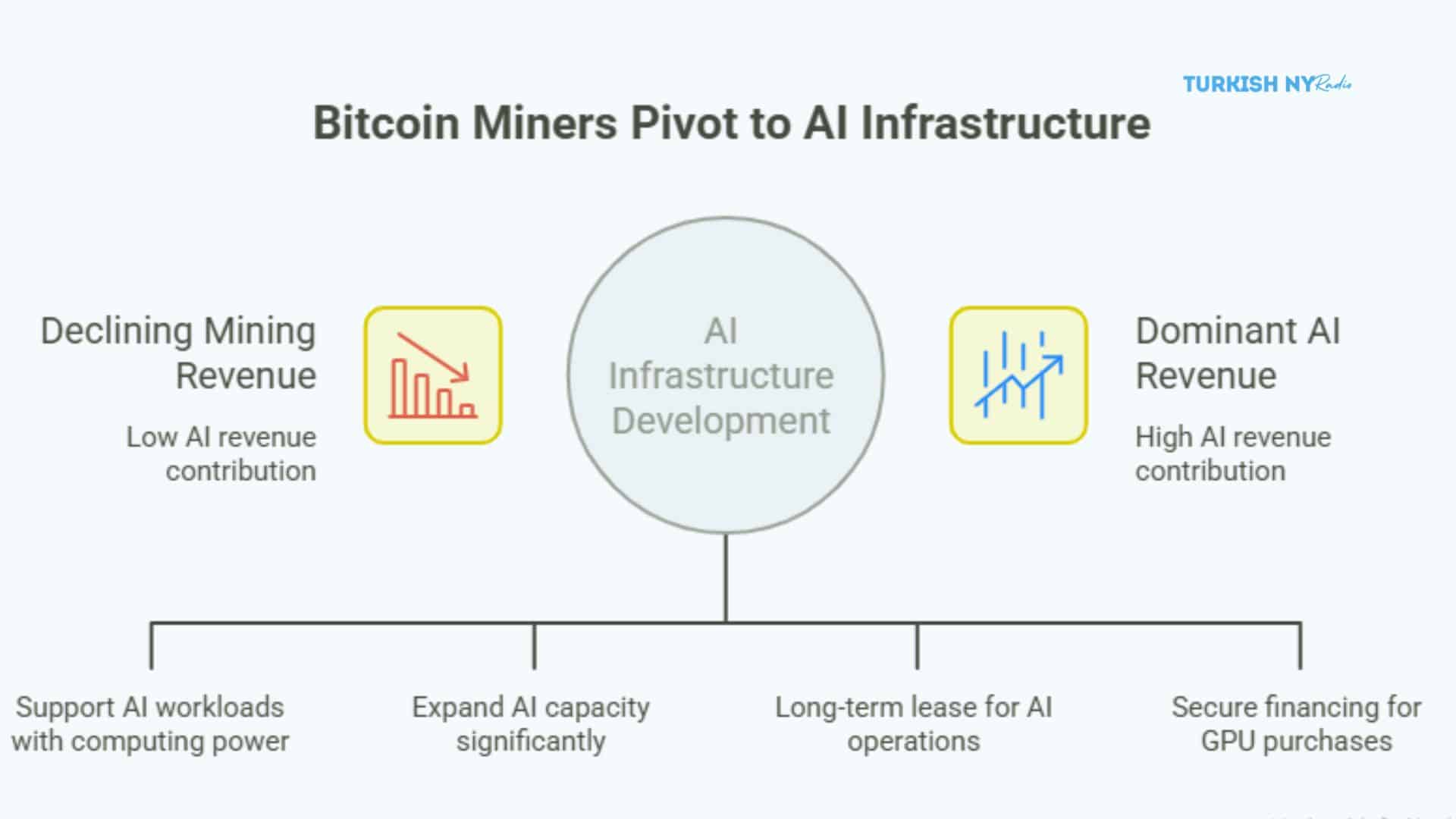
The most important transformation shaping Bitcoin miners is the rapid AI pivot. Mining companies are repurposing their infrastructure to support artificial intelligence workloads, which require massive computing power and energy resources.
Recent infrastructure development data indicates that AI-related revenue could account for up to 70% of total income for some operators by the end of 2026. This marks a significant shift from the current level of roughly 30%.


Large-scale projects confirm the seriousness of this transition. One operator has already deployed approximately 350 megawatts of AI capacity and plans to expand to nearly 590 megawatts. Another has secured a long-term data center lease valued at around $7 billion. Additional filings show $3.6 billion in GPU financing tied to a major cloud partnership, alongside multi-billion-dollar customer contracts and financing agreements exceeding $6 billion.
The AI pivot is not simply a diversification strategy. It is becoming the foundation of how Bitcoin miners generate future revenue.
The Bifurcation Explained: Why Some Bitcoin Miners Trade at Premiums
There seems to be a clear divide within the sector between hybrid operators and pure mining operations. But the real insight is not in the split, but rather in how markets price these differences.
Hybrid Bitcoin miners are trading at higher multiples, according to industry valuation analysis because these hybrid companies’ revenue streams are more predictable. AI infrastructure creates long-term contracts, recurring cash flows, and stick around locations from enterprise clients. Those traits are similar to traditional infrastructure or cloud computing businesses.
In comparison, Bitcoin price, inherently volatile, is at the very core of a pure mining operation. Their revenue varies from day to day based on market conditions, so earnings are less predictable.
This cash flow stability difference is a driver of valuation premiums. Markets reward predictable income with higher multiples, and discounted volatile income streams. Consequently, hybrid Bitcoin miners are being appreciated less as mining companies and more as infrastructure platforms with exposure to high-growth technology sectors.
The Hidden Shift: Why Mining Stocks No Longer Track Bitcoin Alone
This shift of focus is not just about differences in valuation. It turns mining stocks upside-down. Two companies in a similar sector can behave quite differently, based on their exposure to AI infrastructure.
The latest analysis of the equity markets suggests that mining stocks contain multiple layers of risk and opportunity. Investors are tired of just Bitcoin exposure. What they are acquiring instead is a blend of Bitcoin price sensitivity, AI revenue optionality, debt obligations and execution.
Such a transition can be misleading for retail investors, who still view mining shares as direct proxies of Bitcoin. The truth, however, is that these firms now embody intractable business models spanning far beyond the production of digital assets.
Understanding this change is critical. Without it, investors are at risk of inaccurately pricing assets and failing to react correctly to market movements.
Equity Repricing: How the AI Pivot Is Changing Market Perception
The AI pivot is a catalyst for equity repricing through the mining space. As a result, and as the valuation frame for these companies from eight years of cheap money, where money with no return on risk was pooled together into commodities, ie preferred shares with royalties that somehow made 300 per cent, in an ecosystem charged by networks, starts to blink out at scale, markets are starting to re-originalize valuations as infrastructure.
Crypto Mining Recent market action indicates that hybrid Bitcoin miners are more and more seen by investors as close to data center operators and cloud infrastructure companies rather than traditional mining firms. This reclassifies to then effectuate richer multipliers as investors bake in longer growth potential and more stable cash-flows.
Pure mining firms, meanwhile, continue to trade in a correlation trend with Bitcoin price movements as all their revenue streams are so heavily dependent on that volatile sub-market.
This divergence represents a fundamental break. The same sector now includes firms that act like technology infrastructure companies, and others still linked to commodities cycles. As markets are all but pricing hybrid miners against forward-looking infrastructure earnings instead of current Bitcoin output.
The Dual Headwind: A New Risk Model for Bitcoin Miners
As Bitcoin miners expand into AI infrastructure, they face a new and complex risk structure. This can be understood as a dual headwind.
On one side, Bitcoin price remains a critical factor. A decline reduces mining revenue and increases pressure on operations. On the other side, the success of AI investments depends on execution. Delays, cost overruns, or weak demand can impact returns.
Recent infrastructure risk analysis suggests that companies with large debt loads are particularly vulnerable. They must manage both declining mining income and the challenges of building and operating large-scale data centers.
This dual exposure creates a more demanding environment. Even if Bitcoin prices recover, poor execution in AI projects can limit upside. Conversely, strong AI performance may not fully offset losses from weak Bitcoin markets.

Network Stress and Efficiency: The Battle for Survival
The technical state of the network further highlights the challenges facing Bitcoin miners. The total hash rate has reached approximately 961 exahashes per second, reflecting strong overall capacity. However, efficiency differences reveal underlying stress.
Mining hardware operating at 25–38 joules per terahash struggles to remain profitable, as energy costs exceed revenue. In contrast, newer systems operating near 17.9 joules per terahash offer significantly better performance.
Recent operational data also shows that around 252 exahashes per second temporarily went offline due to external factors, demonstrating how quickly capacity can shrink under pressure.
These conditions favor well-capitalized operators with advanced hardware and efficient energy management.
Scenario Analysis: Two Paths That Will Shape the Industry
The future of Bitcoin miners depends on how market conditions evolve, and two clear scenarios help explain what lies ahead.
In the first scenario, Bitcoin prices recover toward higher levels, potentially approaching the $100,000 range. In this environment, mining margins improve, reducing the need for asset sales. Hybrid Bitcoin miners benefit the most, as they combine stronger mining profitability with growing AI revenue. This leads to further valuation expansion, with markets rewarding both recovery and infrastructure growth.
In the second scenario, Bitcoin prices remain under pressure, keeping hash prices in the low range. Under these conditions, Bitcoin miners continue selling reserves to sustain operations. Weak operators exit the market, leading to increased shutdowns and consolidation. Debt-heavy firms face additional challenges, particularly if AI projects fail to deliver expected returns.
These scenarios highlight the importance of both market conditions and execution capability in determining future outcomes.
Conclusion
The mining industry is undergoing a transformation that extends far beyond short-term price movements. Bitcoin miners are no longer defined solely by their ability to produce digital assets. They are evolving into hybrid entities that combine elements of infrastructure, finance, and technology.
The AI pivot has become a central force driving this change, reshaping revenue models and triggering a broader market re-rating. At the same time, the shift introduces new risks, as companies must navigate both Bitcoin volatility and infrastructure execution challenges.
For investors, the key takeaway is clear. Bitcoin miners can no longer be evaluated through a single lens. They represent complex, multi-dimensional businesses that require deeper analysis and a more nuanced understanding.
The future of the sector will depend on how effectively companies balance innovation with discipline. Those that succeed may redefine the role of mining in the digital economy, while others may struggle to adapt in an increasingly competitive landscape.
Glossary
Bitcoin miners: Entities that validate transactions and secure the Bitcoin network using computational power.
AI pivot: Strategic shift toward artificial intelligence infrastructure.
Hash rate: Total computational power of the network.
Hash price: Revenue per unit of mining power.
J/TH: Measurement of mining hardware efficiency.
Convertible debt: Debt that can convert into equity.
FAQs About Bitcoin Miners
Why are Bitcoin miners changing their business models?
Because traditional mining profits are shrinking due to rising costs and lower rewards.
What drives higher valuations for hybrid miners?
More stable and predictable AI revenue compared to volatile Bitcoin income.
Are mining stocks still tied to Bitcoin price?
Partially, but they now reflect additional factors like AI growth and debt.
What is the biggest risk for mining companies?
Managing both Bitcoin price volatility and AI infrastructure execution.