

This article was first published on TurkishNY Radio.
As the world moves toward hyperconnected communication systems, the rise of blockchain in 6G Networks is reshaping how trust, value, and data flow across digital environments.


At the same time, 6G edge computing is becoming a core enabler of advanced financial, industrial, and Web3 applications by placing computing power closer to users.
For financial students, crypto enthusiasts, blockchain developers, and analysts, this shift is not just about faster wireless speeds. It signals a redefinition of how future global economies and digital ecosystems may operate.
Why Blockchain in 6G Networks Matters More Than Ever
6G is described as more open, software-driven, and interconnected than any previous wireless generation. A detailed survey on 6G and blockchain notes that future networks will rely on shared infrastructure built by multiple stakeholders.
According to the study, this openness increases the need for stronger security, transparent governance, and reliable trust management. Blockchain can provide these features through tamper-resistant records and decentralized verification.
Researchers highlight how blockchain enables traceability, identity assurance, and automated rule enforcement. These capabilities are vital for multi-tenant 6G slices, real-time financial applications, and decentralized communication services.
Smart contracts can manage spectrum access, payments, and service level guarantees without intervention from a single authority.
The Edge Is the New Battleground for Trust and Computing
Traditional cloud computing remains far from devices and users. 6G edge computing brings processing closer to the source. When blockchain merges with this low-latency edge layer, it creates a trustworthy decentralization model. Edge nodes can verify transactions, store ledgers, and coordinate services with maximum speed.
A recent study introduced a blockchain-enabled task offloading model in which each edge server serves as a blockchain node. Consensus selects the most reliable nodes for computing tasks. The approach improves offloading efficiency and increases security. The researchers reported lower latency and better resource allocation as a result of decentralized decision-making.
The combination of local computing and blockchain verification provides a foundation for reliable financial services, real-time crypto applications, and decentralized artificial intelligence.
Practical Use Cases Where Blockchain and 6G Edge Align Perfectly
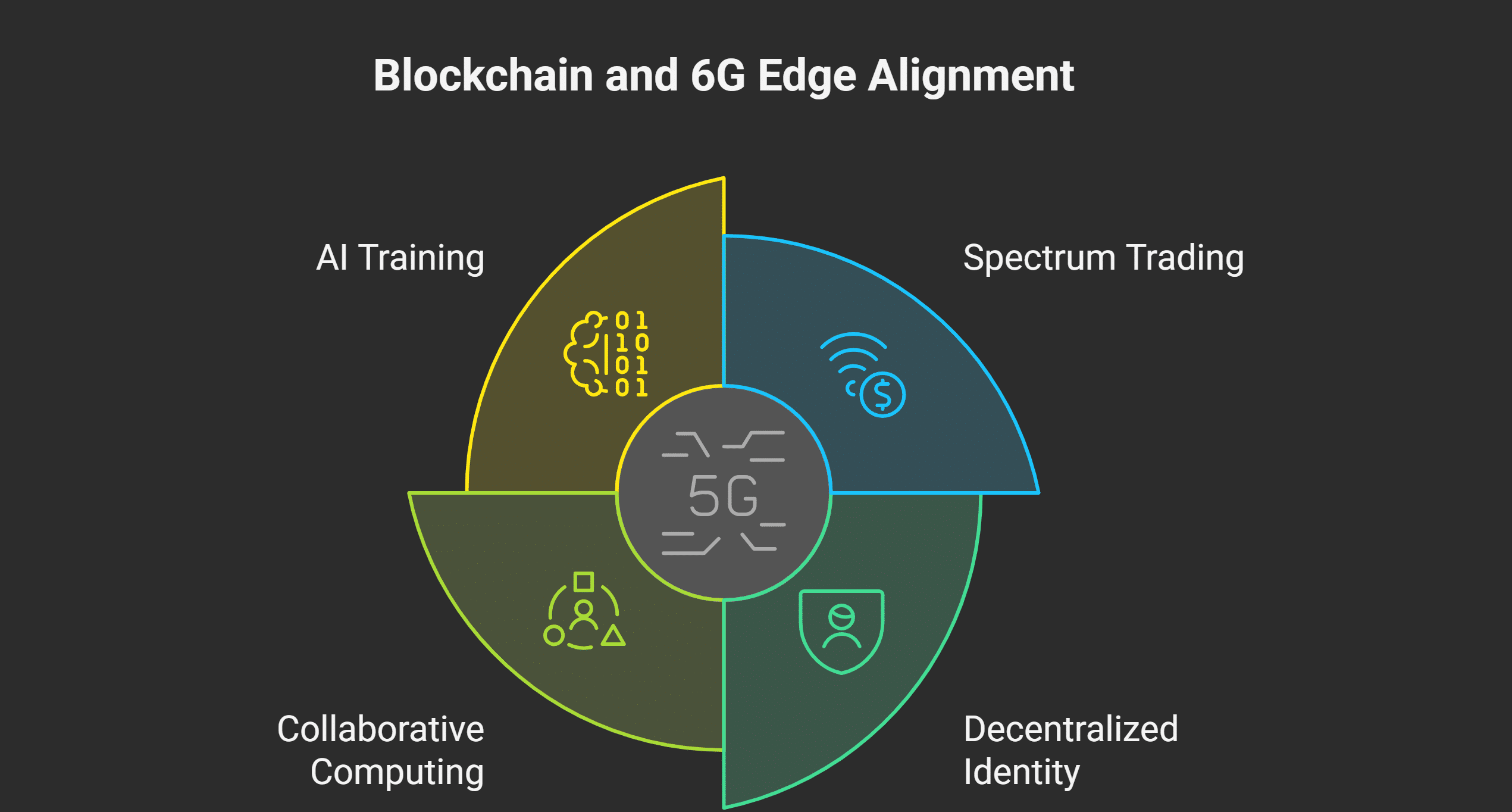
Spectrum trading provides one clear example. A study explores a blockchain framework that transparently records spectrum rights and usage. It also uses reputation scores to reward responsible behavior and punish malicious activity. This type of ledger-based system can make spectrum allocation fair and automated.
Decentralized identity is another robust case. Instead of relying on centralized authentication, blockchain can issue verifiable credentials to devices and users while preserving privacy.
Collaborative computing shows even greater potential. Devices can share their unused compute power, and smart contracts can fairly reward them. The edge creates local marketplaces where machines exchange computing services through token incentives.
Blockchain can also anchor AI training processes. This improves trust in the data and algorithms used at the edge by providing verifiable histories of model updates and inferences.
The Technical Backbone Behind the Blend of Blockchain and 6G Edge Computing
Consensus That Fits the Needs of 6G
Conventional proof-of-work is too slow and energy-intensive for edge networks. Permissioned consensus methods such as PBFT and Tendermint provide faster validation and lower overhead. They are well-suited for environments where the participants are known or semi-known.
Emerging methods go even further. A protocol named AirCon uses a superposition of wireless signals to help devices agree on blockchain states with minimal communication overhead. This design suits wireless environments with limited bandwidth.
Scaling for Millions of Nodes
As millions of devices join 6G networks, blockchain must scale accordingly. Researchers propose sharding the ledger into smaller clusters that synchronize with a higher-level chain. This structure keeps the system responsive and reliable.
To reduce storage overhead, hybrid models store core data on-chain while keeping large files off-chain at the edge. Hashes connect the two layers and maintain integrity.
Privacy That Meets Global Standards
Transparency is a strong point of blockchain, but privacy must be preserved. Regulations such as GDPR restrict the storage of personal information. Developers now use techniques such as zero-knowledge proofs and selective disclosure to prove compliance without exposing identities or sensitive details.
Token-based resource markets or financial services built on 6G networks will also need to align with telecom and securities regulations, making privacy a central requirement.
Why Crypto Communities Are Watching This Movement Closely
The fusion of blockchain in 6G Networks with 6G edge computing creates an ideal environment for decentralized physical infrastructure networks, often called DePIN. In these systems, edge devices can earn tokens for offering compute, data, or network services.
With smart contracts enforcing rewards, a camera, sensor, or smartphone could become a micro contributor to a global service network. Tokenized marketplaces could allow devices to rent compute cycles, purchase bandwidth, or earn credits for sharing data.
Discussions in major crypto communities often highlight how high-throughput chains such as Solana could support real-time micro transactions. Activity spikes when analysts note Solana’s ability to handle thousands of transactions per second, according to its official explorer. Some speculate that this speed could enable rapid settlement for edge-based micro-rewards.
Although real-world deployment is still in its early stages, the concept excites developers and analysts who see DePIN as a bridge between telecom infrastructure and digital assets.
The Risks That Every Researcher and Analyst Should Understand
While the opportunities are significant, blockchain-enabled 6G networks face real risks.
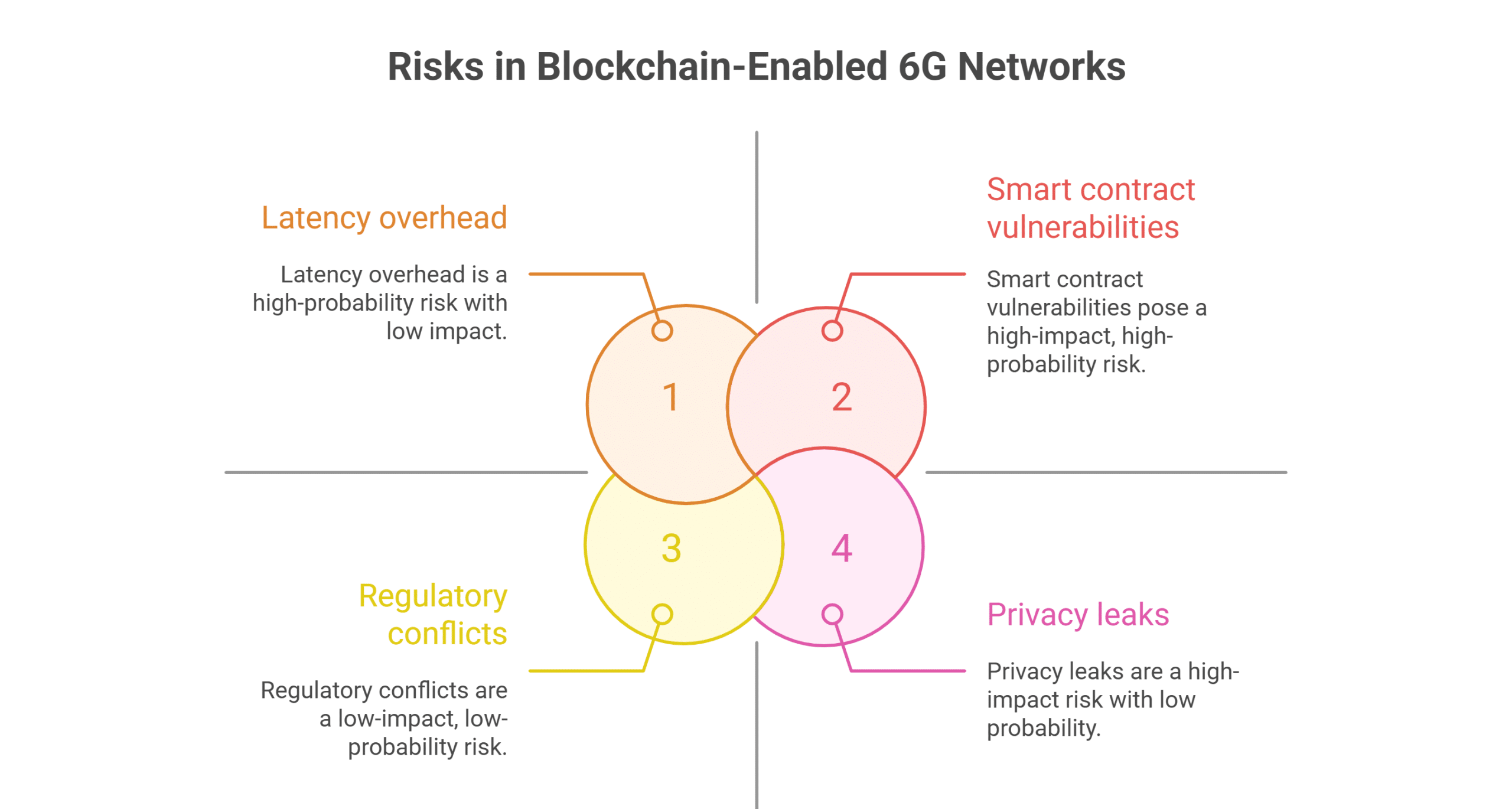
- Latency overhead remains a concern. Even lightweight consensus adds extra steps that might conflict with the strict timing demands of 6G.
- Energy consumption at edge nodes also conflicts with global sustainability goals. Efficient consensus and hardware-level optimization will be essential.
- Smart contract vulnerabilities pose another risk. If contracts manage resource allocation or payments, an exploit could have network-wide consequences.
- Regulatory conflicts may arise as telecom rules meet crypto economics. Tokenized spectrum or compute resources could trigger securities laws or licensing requirements.
- Privacy leaks pose an additional challenge because blockchains permanently store data. Developers must design systems that preserve confidentiality without compromising auditability.
Where Experts Believe Future Innovation Will Happen
Researchers expect a tight integration of blockchain, AI, and edge networks. Models could train at the edge and use blockchain for integrity checks. Studies show early progress in privacy-preserving AI combined with blockchain-anchored audit logs.
Another innovation path involves computing power networks. In one protocol, nodes share compute resources via evolutionary algorithms while protecting privacy via zero-knowledge proofs. This creates a decentralized cloud powered by diverse participants.
A consensus tailored for advanced wireless systems is also being studied. Optimized PBFT variants for terahertz communication show promising early results.
A Financial and Economic Perspective on the Coming Shift
For financial analysts, the merging of blockchain with 6G and edge computing suggests a new form of digital asset backed by real infrastructure. Tokens might represent compute credits, bandwidth rights, or access to edge services. These tokens could circulate in DeFi platforms and secondary markets.
Telecom companies and cloud providers may adopt these models to monetize unused resources or promote collaboration. Students exploring finance and blockchain engineering can see new markets forming at the intersection of telecom economics and decentralized finance.
Regulators will need frameworks that balance innovation with safety, especially when physical infrastructure becomes tokenized. This makes cross-disciplinary knowledge increasingly valuable.
Final Reflection: A New Era of Shared Infrastructure
The blend of blockchain in 6G Networks and 6G edge computing signals a fundamental change in how digital infrastructure could work. Instead of depending on centralized entities, users and devices might help operate and secure networks. Value, trust, and processing power could move to the edge, where services run faster and closer to real life.
This vision requires new research, careful engineering, and responsible regulation. Yet it carries potential to unlock a future where communities and networks grow together, supported by transparent incentives and secure technology.
Glossary of Terms
- 6G: Sixth-generation wireless network promising ultra-fast data rates and low latency.
- Blockchain: A distributed ledger that records transactions securely and transparently.
- Edge Computing: Computing resources placed close to users instead of centralized servers.
- Smart Contract Code that executes automatically when conditions are met.
- Consensus Mechanism: A protocol that helps blockchain nodes agree on shared data.
- DePIN: Decentralized Physical Infrastructure Network, where users earn tokens for providing real-world services.
- Sharding: Dividing a blockchain into smaller parts to improve performance.
- Zero Knowledge Proof: A technique to prove information without revealing it.
- Tokenization: Turning tangible assets or services into crypto tokens.
- Micropayment: Minimal digital payments used for minor services or consumption.
FAQs About Blockchain In 6G Networks
1. Is blockchain required for 6G networks?
Blockchain is not required, but it adds trust, transparency, and automation that help manage complex multi-stakeholder 6G environments.
2. Can edge devices support blockchain nodes?
Edge servers and base stations can run lightweight blockchain nodes. Smaller devices usually interact as clients rather than full validators.
3. Are there tokens linked to 6G infrastructure today?
Not widely at this stage, though DePIN projects explore models in which devices earn tokens for providing services.
4. What risks come with blockchain in 6G edge environments?
Risks include latency overhead, energy usage, regulatory uncertainty, smart contract attacks, and privacy concerns.
References