![Sun [New]](https://s2.coinmarketcap.com/static/img/coins/64x64/10529.png)


![BitTorrent [New]](https://s2.coinmarketcap.com/static/img/coins/64x64/16086.png)

This article was first published on TurkishNYR.
APR (Annual Percentage Rate) is a standard measure of the yearly cost to borrow or earn on an investment; expressed as a percentage. APR consists of the interest rate plus some fees and costs; providing consumers with a single number to evaluate loan offers or credit cards.


A mortgage for instance; might have a nominal interest rate of 4.5 percent but carry fees for origination and closing that push the APR to 4.75 percent. The U.S. Truth in Lending Act requires lenders to present APR to borrowers; in order to be transparent.
In today’s lending market; APR tells you what credit really costs per year.
How APR Is Calculated?
Calculating APR vary from one loan to another and also depends on associated fees, but the basic premise is annualizing how much the credit costs. APR is defined by the total finance charge (interest plus fees) and the timing of payments.
Simply put, APR = periodic interest rate x number of periods per year.
For instance, a loan with monthly interest rate of 1% has simple APR of 1% times 12 = 12%.
APR is a yearly rate without accounting for compounding throughout the year.
More accurately, APR is the interest rate plus fees, calculated so that the present value of all payments equals the loan amount. The Consumer Financial Protection Bureau says that APR is a “measure of the cost of credit, expressed as a yearly rate,” linking loan payments and the credit received.
APR vs APY: It’s important to note that APR does not include compounding within the year. So for example, if an account pays 1% a month interest; the APR is just 12%. The annual percentage yield (APY); on the other hand, factors in compounding. The APY in that case would be APY = ((1 + 0.01)^{12} – 1 which is approximately equal to 12.68%).
The difference is summarized in the table below.
| Periodic Rate | Periods/Year | APR (Approx.) | APY (Effective) |
|---|---|---|---|
| 1% monthly | 12 | 12.00% | 12.68% |
| 2% quarterly | 4 | 8.00% | 8.24% |
| 0.5% daily | 365 | 182.50% | 201.33% |
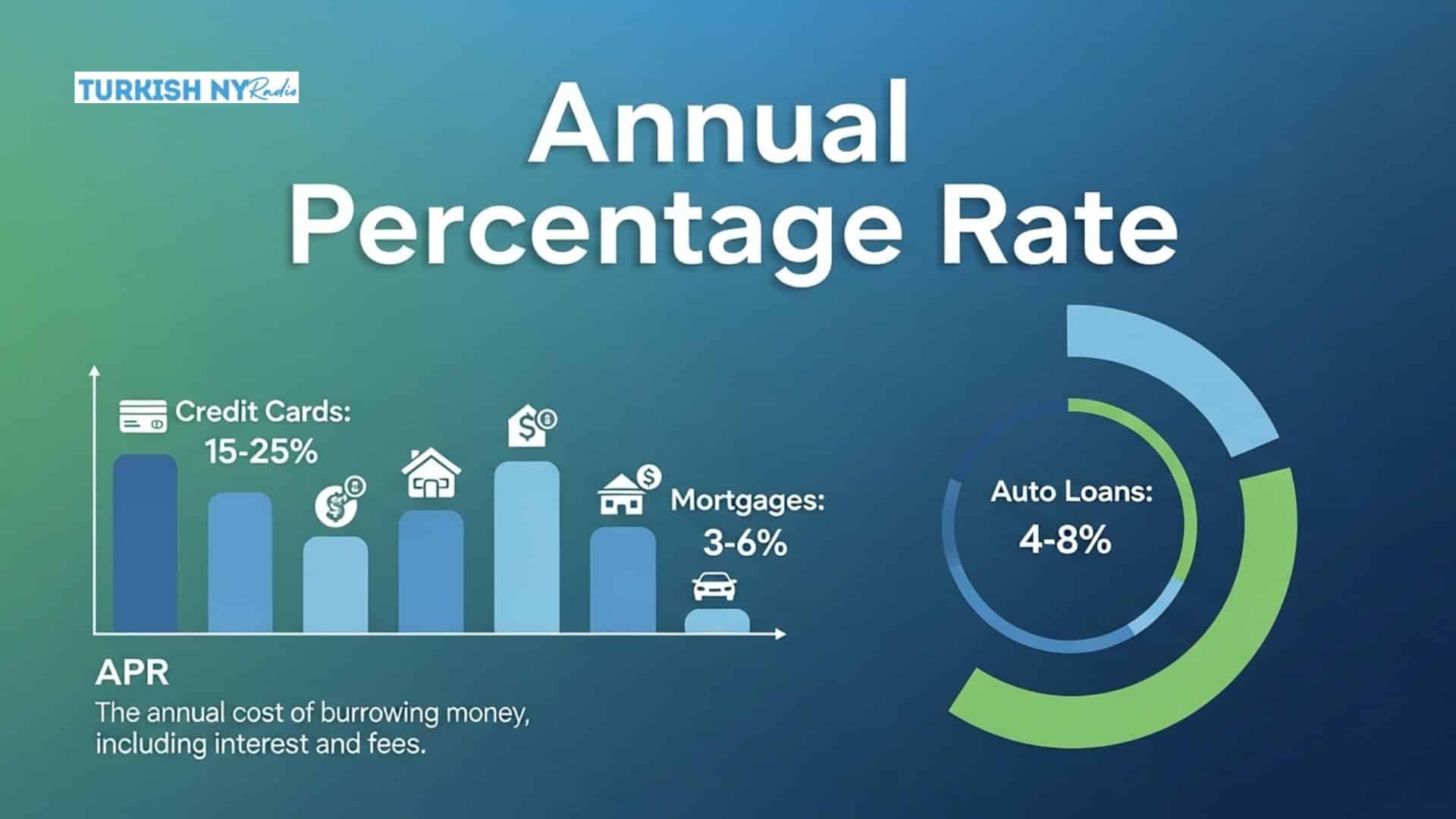
APR vs APY and Other Rates
The Annual Percentage Rate is often confused with other types of interest rates. The Annual Percentage Yield (APY) measures earnings on deposits, and does factor in compound interest. On the other hand, APR is for borrowing costs. For example, a savings account will advertise APY to show how much you earn with compounding while a credit card advertises APR to show your borrowing cost.
Another term is the nominal interest rate which is the stated interest rate before fees or compounding. For loans, the “interest rate” that is typically advertised is the nominal rate. APR takes things further by including some fees (like origination fees and closing costs) to provide a more accurate picture of annual cost.
So for example, it is common with a mortgage to have a nominal rate of 4.0% but an APR of 4.25% once fees are accounted for. Thus, APR is greater than nominal rate; while, APR is less than effective annual rate or APY, since it includes compounding.
Credit card APRs may also be variable (meaning they can change alongside the prime rate) or fixed for promotional periods. Regulations mandate issuers to disclose APR clearly.
Why APR Matters to Consumers
APR is needed to be able to make proper comparisons on loans or credit cards. Lenders are required to disclose APR before closing on a loan. This transparency allows borrowers to assess which loan actually costs less.
For instance, a 30-year mortgage at 3.8% with $1,500 fees has a higher APR than a 3.8% rate without any fees. Consumers using APR avoid getting misled by low rates with big hidden fees.
APR also accounts for various loan characteristics. With credit cards, there are several APRs: a purchase APR, a cash advance APR, balance transfer APR and penalty APR if your payment is late. Each illustrates the cost of carrying various types of balances. Always confirm APR for a specific transaction.
With mortgages; APR may also account for mortgage insurance and prepayment penalties in the calculation, resulting in a higher figure than just the note rate.
Car loans and personal loans also use APR to give some sense of finance charges beyond the sticker rate. Consumer agencies caution that APR can still understate total cost; if compounding or other periodic fees apply.
Most importantly, APR does not include every potential charge. Late payment fees or overdraft fees do not fall into the APR.
Therefore, consumers should always read loan disclosures
APR Examples and Formulas
APR formulas are simple for common scenarios. Here is a typical approach:
Single-disbursement loan (e.g. personal loan): APR = (((Total interest + Fees)/Principal) × (365/Days in loan term)) × 100.

Credit card or amortizing loan: Most lenders apply complex amortization formulas to APR. The simplified actuarial APR formula is a shorter way:
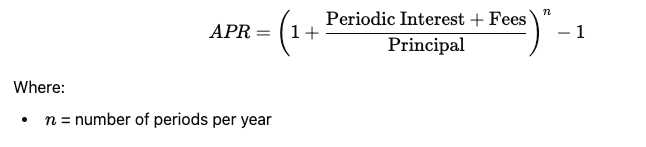
(For instance; a $5,000 loan that will cost a total of $500 in interest and fees over 2 years period has an ordinary periodic rate of around 5.5%/year; therefore APR = 5.5%)
Credit card APR: Many credit card issuers calculate APR using daily periodic rates. An example of that would be:
For example; if your daily rate is 0.06%, the APR = 21.9%. However, the actual price is affected by compounding daily. If the card utilizes daily compound interest, the effective rate can also be greater than the simple APR.
Worked Example
For example; let’s say you borrow $10,000 for 3 years at 6% annual interest with $300 in origination fees and monthly payments. Interest over three years = roughly $1,009. Total fees = $300. Using the formula:
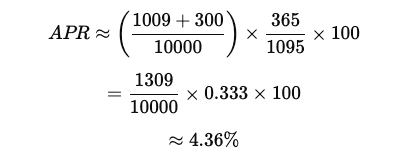
So APR is approximately 4.36%. The nominal rate was 6%, but since fees were paid upfront, it reduced the APR.
Expert Perspective and Trends
Financial experts urge clarity around APR. According to a 2023 report from the Federal Reserve, the average APR on credit cards that incurs interest increased from 12.9% in 2013 to 22.8% in 2023; exposing how expensive borrowing became. This shows the real-word effect of the APR: it educates consumers about trends in credit costs.
Regulators such as the CFPB emphasize that APR be clearly disclosed on ads and statements so that borrowers can make informed choices.
Industry analysts say too, that APR is a simple annualized rate and doesn’t include compounding, which means that when it comes to savings, you have to look at APY. APR is what you pay without compounding and APY is what you earn with compounding.
With consumer rates peaking in 2026, knowing APR is more important than ever. Borrowers should compare APRs on loan offers. Savers should compare APYs, but be aware that APY doesn’t include fees because you actually earn money.
Essentially, APR provides a standardized overview of credit cost and consumers may need to do more analysis for full cost comparison.
Conclusion
APR is the required annualized rate that shows the total cost of borrowing, including interest and certain fees. This is spread out over the length of the loan into an annual percentage rate. APR helps consumers evaluate loans side by side on a fair basis; it does not include compounding unlike APY.
APR applies to costs of borrowing, APY to yields on saving. Simply put, APR is the annual interest “invoice”. Always read the APR disclosures, and keep in mind that a lower APR equals cheaper credit.
For savings and investments; make sure to look at APY instead; since APR won’t let you know what you actually earn with compounding.
Glossary
APR (Annual Percentage Rate): Yearly cost of borrowing including interest and a couple of fees.
APY (Annual Percentage Yield): The actual annual rate of return on a deposit account; with compounding taken into account. For a given nominal rate, APY ≥ APR.
Nominal Interest Rate: The interest rate on a loan or financial account; before taking into account any fees or compounding.
Finance Charge: Total fees and interest paid over the life of a loan. APR is calculated using finance charges.
Actuarial Method: The APR is calculated by adding unpaid interest to the principal (compounded). This method is mandatory for most loans by the CFPB
Frequently Asked Questions About Annual Percentage Rate
What Is the Difference Between an APR and an Interest Rate?
APR is the interest rate plus any number of other fees (origination, closing costs) rolled up into one annualized rate. An interest rate is simply the nominal rate without fees. If there are fees involved; APR will typically be higher.


How is APR vs APY compared?
APR (annual percentage rate) is for loans/credit cards; APY (annual percentage yield) is for savings accounts. APR does not factor in compounding; APY does. For instance; a 1 percent monthly rate means 12 percent APR but also about 12.68 percent APY upon compounding. APR is best for comparing loans; APY is best for deposits.
Why is a lower APR better?
An APR that is lower also means that the overall cost of the loan is less per year. It combines rate and fees. A lower APR can help save money over time especially if you pay off a loan or credit card balance.
Is APR or APY used by credit cards?
Credit cards express its cost of borrowing over a year through an APR. There is no APY on credit card debt because you don’t earn interest on what you owe.
Does a credit card have multiple APRs?
Yes. Often, cards will have one APR for purchases, another for cash advances, another for balance transfers and penalty APRs for late payments. Most new charges fall under the advertised APR for purchases.
References
Consumer Financial Protection Bureau
Disclaimer:
This information is not financial advice. APRs differ by lender and product. Always read official disclosures and consider your financial situation with a qualified professional.