
This article was first published on TurkishNY Radio.
A decentralized exchange is an online market where users can buy and sell cryptocurrencies directly with each other, without a central party holding their funds. Rather than trusting a corporate intermediary, its users rely on blockchain-based smart contracts to automatically execute trades.


This architecture restores actual ownership: people have complete control over their private keys and never transfer assets to a custodian. According to a respected Britannica overview, this difference gives DEXs a transparency and security profile that centralized platforms cannot match.
Historically, early decentralized exchanges struggled because they used order-book systems that failed on blockchains: trades were slow, liquidity was thin, and prices often deviated sharply from market norms. That changed when the concept of an automated market maker (AMM) took hold, and the landscape of crypto trading never looked back.
How DEXs Work Under the Hood, The Magic of AMMs and Liquidity Pools
Smart contracts lie at the core of every modern decentralized exchange. These are pre-written programs deployed on blockchains that can manage assets without human oversight. When a user wants to swap one token for another on a decentralized exchange, they don’t wait for a human to find a counterparty. Instead, they trade against a liquidity pool, a shared pot of tokens supplied by other users, called liquidity providers (LPs).
At its core, the automated market maker (or AMM) employs a simple, but aesthetically brilliant rule to price tokens: the constant product formula ( x × y = k ), where x and y are quantities of two tokens (like ETH – USDC) within a pool and k is held constant after each trade. When tokens are exchanged, the pool adjusts its holdings so that x × y remains constant (which automatically determines the new trading price).
Here is a simple example: assume there is a pool of 10 ETH and 20,000 USDC. That sets k to 200,000 (because 10 \ times 20,000 = 200,000). If someone purchases 1 ETH, then the pool will end up with about 9 ETH and ~22,222 USDC to keep k constant.
So the price of that ETH is about 2,222 USDC (or more if we want to get into the decimal places) due to this increase in demand. Each trade shifts the token ratio and, in turn, the price. Larger trades relative to the pool size lead to larger price shifts (known as slippage).
Liquidity providers earn a share of the trading fees when users swap tokens. Their rewards scale with the liquidity they supply and the level of trading activity. Over time, some platforms have also offered additional incentives via governance tokens or yield-farming programs.
Why Many Prefer DEXs? The Key Advantages
The growing popularity of DEXs is indicative of the global need for financial freedom, transparency and inclusivity. A number of powerful advantages account for their popularity.
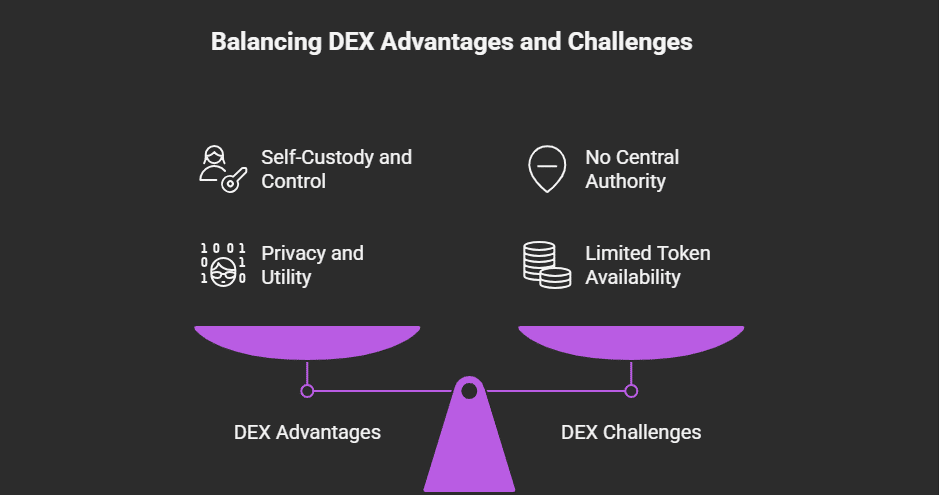
Ownership and self-custody. At a decentralized exchange, users connect their wallets. Only they possess the private keys. Unlike KYC-based exchanges, characterized by use of third-party custody, users of DEXs control their own funds. This removes a substantial single point of failure, and risk of being hacked on the exchange or mismanagement.
Permissionless access and broad token availability. You can connect a supported wallet and immediately start trading or supplying liquidity; there is no registration required, no ID requests, and no waiting to be approved.
That’s where DEXs are especially useful: in areas with no financial infrastructure or that are too volatile for banks. For the most part, DEXs are where new tokens go first because centralized exchanges generally won’t list them.
Privacy and censorship resistance. There is no overarching body governing a decentralized exchange, so trades take place in the shadows. The transactions are all visible on a public ledger called the blockchain, but personal identities are concealed. DEXs are also censorship-resistant, meaning they are more difficult to shut down or game than platforms run by a central party.
Utility beyond trading – earning potential through liquidity provision. Users who contribute to liquidity pools earn rewards from trading fees and, in many cases, additional protocol incentives. This offers an alternative way to generate returns beyond just holding tokens and opens up decentralized yield opportunities.
Why DEXs Still Face Challenges, The Trade-Offs
Decentralized exchange, however, also has a number of drawbacks. This is a risk that users should be aware of before taking part.
Complexity and poor user experience. Wallets, private keys, gas fees and blockchain UX are a hassle for even non-experienced users of a decentralised exchange. Errors such as sending tokens to a contract address can be permanent.


Liquidity limitations and slippage. Not all tokens receive equal interest. Less popular or newly launched tokens may suffer from low liquidity. In such cases, even modest trades can cause large price swings. That makes DEX trading risky for large orders or thinly traded assets.
Smart-contract risks. A DEX is only as safe as the code behind it. Bugs or exploits can compromise liquidity pools and the assets they hold. Without a centralized custodian, victims of such failures may have little recourse.
Transaction (gas) fees. Every trade and liquidity action on a blockchain requires fees. On busy networks, those fees can surge. Even small trades can become prohibitively expensive for retail users.
Impermanent loss for liquidity providers. If the relative market price of pooled tokens diverges significantly, LPs can lose more value than they would have by simply holding the assets. That risk increases with volatility, putting pressure on LPs.
Front-running and MEV risks. Because blockchain transactions are public before confirmation, bots can detect large planned trades and reorder transactions for profit. This can cause slippage and unfair execution for regular users. A recent academic study highlights that this remains a systemic challenge for DEXs.
Recent Improvements: Lower Fees, Better Liquidity, and Smarter AMMs
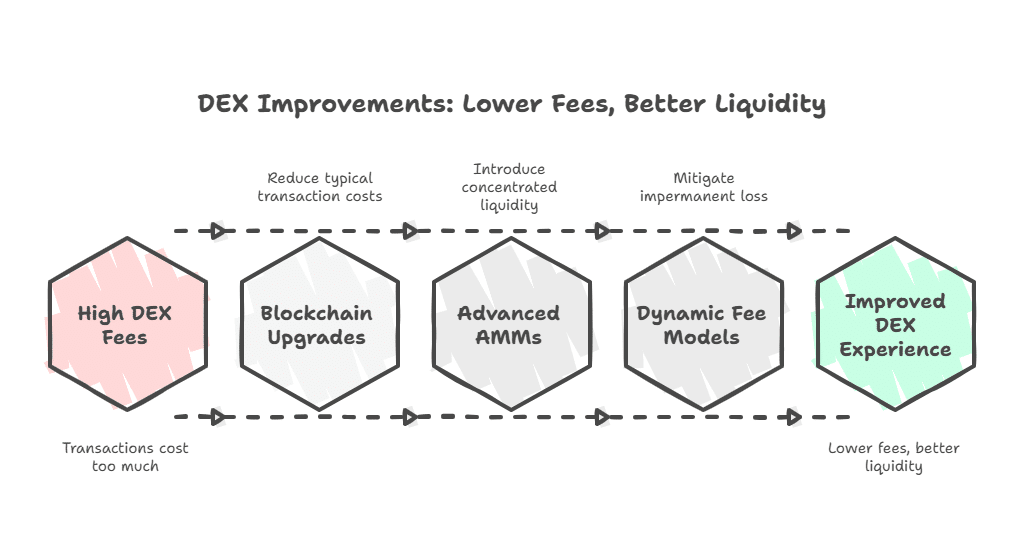
The technical barriers to using DEXs have been falling. For instance, following upgrades to major blockchains, typical transaction costs have shrunk dramatically. On one network, average swap fees fell from around $86 to just $0.39 after a major protocol upgrade.
Moreover, advanced automated market makers (AMMs) have introduced innovations such as concentrated liquidity, allowing liquidity providers to place liquidity within narrower price ranges. This boosts capital efficiency and reduces slippage.
In practice, researchers are still exploring how dynamic fee models could mitigate impermanent loss while also maintaining trading volume and LP incentives. These designs might inform the next wave of decentralized exchange protocols and fairly balance risks and rewards.
What This Means for Crypto Enthusiasts, Developers, and Analysts
For financial students and analysts, DEXs are a powerful example of decentralized finance in action: trading, liquidity provision, and market dynamics all implemented via code, transparent, public, and trustless. For blockchain developers, DEXs provide modular building blocks.
A thoughtful contract exchange can easily plug into lending platforms, yield farms, and cross-chain bridges. That interoperability is driving the rapid expansion of the broader DeFi ecosystem.
Crypto enthusiasts and everyday traders benefit from the accessibility of DEXs. Anyone worldwide with a wallet and an internet connection can participate, with no regulatory approval or bank account required. That opens the door to financial inclusion and innovation.
At the same time, analysts are assessing risks. The fees, liquidity and smart contract safety, token volatility and others are the main obstacles. With an environment that changes so rapidly, the stakes are high for both opportunity and risk.
Final Thoughts:
Decentralized exchanges represent a vision of financial self-possession. They disintermediate and unbundle, placing you back in control whilst enabling an open, borderless market. As blockchain-native networks mature and smart-contract design evolves, some of the early roadblocks — high fees, liquidity issues, poor UX — have begun to dissolve.
But the decentralized financial ecosystem is young, and participants should proceed with caution. Understanding smart contract operation, wallet security, and liquidity risk is essential.
For people who analyze, develop for, or trade on crypto, DEXs offer far more than just a category of exchange. They represent a move toward permissionless finance. And as long as the code stays open and transparent, that shift will only get stronger.
Glossary of Terms
Automated Market Maker (AMM): A smart-contract algorithm (see above) often used in place of order books to price and execute trades, usually according to a formula such as x × y = k.
Liquidity Pool: A pool of at least two tokens (users provide them), controlled by a smart contract, that DEXs leverage to facilitate trades.
Liquidity Provider (LP): A user or parties who provide tokens to be included in a liquidity pool, for which they earn a share of trading fees and/or other rewards.
Slippage: The gap between the price you anticipate a trade will occur at and the actual fill price; often present in periods of high volume or illiquid trading conditions.
Impermanent Loss: A transitory loss that liquidity providers get due to a changing relative price of pooled tokens versus holding them.
Smart Contract: A computer protocol intended to automatically execute, control, or document legally relevant events and actions according to the terms of a contract or an agreement.
MEV (Miner/Maximal Extractable Value): Revenue that bots or miners can extract by changing, removing, adding , or censoring transactions from a blockchain, usually abused in DEX trading.
Self-custody: This is a model in which users control their own private keys and thus directly own their crypto assets, rather than trusting them to a 3rd party.
Governance Token: A cryptocurrency token, which grants voting rights or influence over protocol parameters on a decentralized protocol to its holders.
DeFi trading: Trading, supplying liquidity, or engaging in other financial services on a decentralized finance (DeFi) platform without intermediaries.
FAQs About Decentralized Exchange
1: How is a DEX different from a centralized exchange?
A centralized exchange takes care of the storage of your funds and facilitate matching order books. A DEX is built on smart contracts and liquidity pools, allowing users to trade directly from their wallets with no central custodian.
2: Can anyone use a DEX, even without identity verification?
Yes. Most DEXs are permissionless. Users only need a compatible wallet and tokens, without any KYC or registration process.
3. Why do some DEX trades cost more than others?
It charges fees based on network congestion, pool liquidity, and trade size. Low liquidity causes slippage. On congested blockchains, gas fees can soar, especially for small trades.
4: What are the risks for liquidity providers?
LPs are vulnerable to impermanent loss (due to bullshit token movement), smart-contract bugs, and price slippage. LP rewards are a function of trading volume and pool activity, which can vary unpredictably.