![Sun [New]](https://s2.coinmarketcap.com/static/img/coins/64x64/10529.png)



This article was first published on TurkishNYR.
In December 2025, yield has returned to the spotlight. A wide gap persists between the national average on basic savings and the more competitive rates available elsewhere, which keeps many people hunting for better returns. That search often ends in crypto, where staking pages and “earn” products advertise APY as if it were a fixed fact, not a moving target.


That is where confusion begins, because a yield figure is useful only when it is read alongside the mechanics that create it. In crypto, the same headline can describe rewards paid by a network, interest paid by borrowers, or short-term incentives that vanish once new deposits arrive.
That context is why education matters. A yield display should be read with the same skepticism used for projections, charts, and sponsored claims online.
What APY is supposed to communicate
APY stands for Annual Percentage Yield. In plain terms, it estimates what a balance would earn over a year when compounding is included, meaning earned interest can earn interest as well. That compounding feature is why it usually looks slightly higher than a simple annual rate.
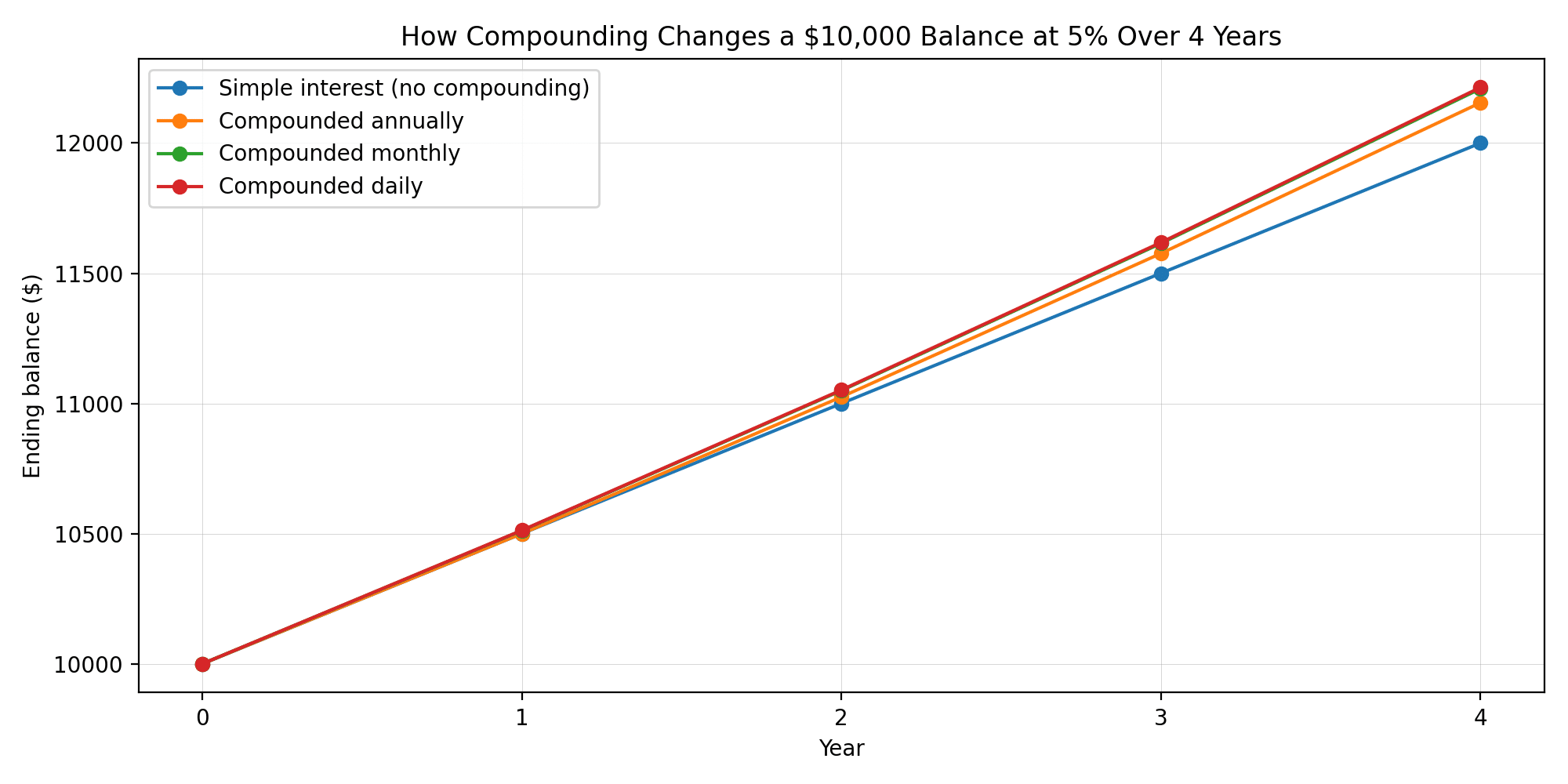
For readers who like seeing the math, APY is commonly expressed as (1 + r/n)^n − 1, where r is the nominal rate and n is the number of compounding periods. More frequent compounding usually increases the final result, even when the base rate is unchanged.
A real-world example that keeps the idea grounded
Consider $10,000 earning 5% for 4 years. With simple interest, the interest totals $2,000. With annual compounding, the ending balance becomes $12,155.06. The difference is modest early on, but it grows over time because each period builds on a larger base. This is the practical reason the APY label exists in the first place.
Why crypto uses APY so aggressively
In traditional accounts, annualized yield is often supported by familiar guardrails, including standardized disclosures and clear definitions of what counts as “earned.” In crypto, yields are frequently variable and can change day to day. A quoted rate may be accurate in the moment and still disappoint over a full year because market conditions shift, competitors pile into the same pool, or incentives are reduced once a campaign ends.
The return engine also shapes the risk. In staking, rewards can depend on network issuance, validator behavior, downtime penalties, and how many tokens are staked across the network. In lending, returns depend on borrowers paying interest and on the health of collateral during volatility. In liquidity provision, trading fees can be real, but the position can lose value when prices move sharply, even if fees look strong on paper.
There is also an operational layer that traditional savers do not face. Smart contracts can contain bugs, bridges can be exploited, and custodial platforms can halt withdrawals during stress. Yield is a package that includes liquidity, volatility, counterparty exposure, and technical risk.


APY versus APR, and the mistake that costs people money
APR is usually used for borrowing cost, while a depositor-focused yield measure includes compounding. Crypto apps sometimes show both on the same screen, which makes mix-ups common. A reader comparing products should confirm whether the displayed number represents earnings or cost, and whether any fees, spreads, or incentive tokens are being folded into the headline.
If an app advertises a high depositor return but pays it in a volatile reward token, the realized result can be lower than the headline after price moves. Clear comparisons require the same units, the same time frame, and an honest look at what can change.

A quick sanity check before chasing a big number
A cautious investor can stress-test a yield claim with a handful of checks. First, identify what produces the return: borrowers paying interest, network rewards, trading fees, or temporary incentives. Second, confirm what is paid: the same asset deposited or a separate reward token that can fall in price. Third, verify the terms: whether compounding is automatic, whether there are lockups, and whether the rate can change without notice.
If these points are not easy to answer from the product disclosures, the risk is already higher than the headline suggests, and opacity usually shows up later as cost.
If the return is funded mainly by temporary incentives rather than durable demand, it may fade fast. If the product relies on leverage demand, the yield can drop when traders become cautious. A rate shown today is a snapshot, not a contract.
A sensible approach is to start small and track what lands after fees in practice. Many products quote returns before costs, and some add limits or withdrawal pauses during volatility. Position sizing, diversification, and a clear exit plan matter more than squeezing the last decimal.
Conclusion
Crypto yield can be legitimate, but it is not a free lunch. The value of APY is that it offers a standardized yardstick for comparing returns, as long as the assumptions behind it are clear. When the return source is durable, fees are transparent, and risk is understood, that yardstick can guide smarter decisions. When those pieces are missing, the same acronym becomes marketing paint on top of uncertainty, and the investor ends up paying tuition.
FAQs
What does APY mean in one sentence?
It is an annualized yield that includes compounding, so earnings can earn earnings over time.
Is a higher number always better?
Not automatically. A higher quoted return can reflect higher risk, especially when rewards depend on incentives, leverage demand, or volatile payout assets.
Why can yields fall quickly?
Rates often change with supply and demand, and promotional incentives can expire or be reduced once liquidity targets are reached.
Is APY the same as APR?
No. APR typically describes the cost of borrowing, while depositor returns are quoted as annualized yields that include compounding.
What is the simplest way to compare products?
Compare the return source, fee structure, payout asset, custody model, and whether the rate is fixed or variable.
Glossary of key terms
APY: Annual percentage yield, a one-year return measure that includes the effect of compounding.
APR: Annual percentage rate, a standard way to describe the yearly cost of borrowing.
Compounding: Earnings being added back to a balance so future earnings are calculated on a larger amount.
Nominal rate: The stated base rate before compounding effects are considered.
Reward token: A token paid as an incentive that can add return but also adds price risk.