This article was first published on TurkishNYR.
Web3 decentralization theory holds that blockchain apps should run everywhere, without reliance on single points of failure.


However, the events of real life have proved otherwise. Notably, on October 20th, 2025, an outage in Amazon’s US-EAST-1 took down major DeFi frontends and services (Coinbase, Rollups, wallets), despite the blockchains themselves never going offline.
In other words, Web3 decentralization is still a work-in-progress, given that so many dApp components continue to live on centralized clouds.
Cloud Outages Shake Crypto Infrastructure
Big cloud outages in 2025 reveal Web3’s hidden centralization. In October, an AWS DNS error rippled across the crypto industry.
Coinbase and Robinhood were down, Ethereum L2s like Base stalled as AWS-backed sequencers went offline.
None of these hiccups were due to consensus failures with the blockchain; blocks were still being produced, and smart contract transactions were being processed.
Instead, everything around the blockchains, including frontends, APIs, and key servers, crashed.
This shows that a blockchain-only view of decentralization misses the fact that dApps require off-chain infrastructure.
A similar scenario played on November 18th, 2025 when a bug from Cloudflare led to everyone going offline around the world. This episode temporarily knocked out the popular crypto websites and APIs (Coinbase, Kraken, Dune, BitMEX, etc.) despite their servers and nodes being fine.
As Galaxy Research analyst Christopher Rosa pointed out, the core blockchain networks were “still functioning and processing transactions,” but the frontends that users needed were down.
As Binance’s chief executive puts it, Blockchain kept working. In DeFi specifically, it caused the most damage to the frontends.
In other words, Web3 networks remained up while Web3 apps went offline whenever a single cloud service did.
Below is table listing some notable 2025 outages and their affects on crypto:
| Date | Cloud Provider (Service) | What Happened | Impact on Web3/DeFi |
| Oct 20, 2025 | AWS (US-East-1 DNS) | Regional DNS failure | Coinbase and Robinhood disruptions; Ethereum L2s (Base) stalled. |
| Nov 18, 2025 | Cloudflare (Global CDN) | Bot Management bug caused worldwide outage | Popular crypto frontends (Coinbase, Ledger, etc.) went offline. |
| Dec 5, 2025 | Cloudflare (WAF rule) | WAF configuration error; 28% traffic dropped | Coinbase, Kraken and many DeFi UIs experienced brief downtime. |
Why are Web3 Apps Still Breaking?
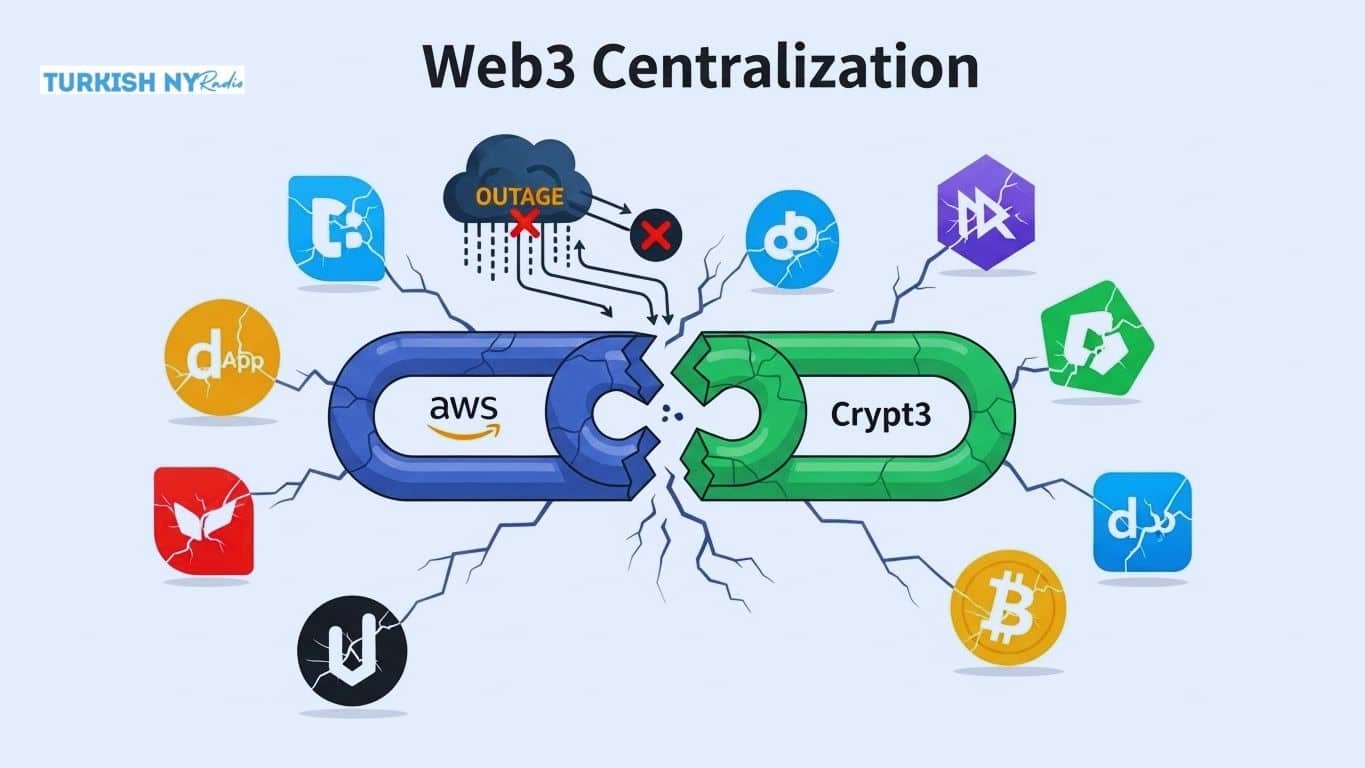
The reason Web3 dApps are still breaking when clouds go down is that they depend on surprisingly centralized infrastructure. For example, a decentralized app could use:
Frontend hosting: Common choices for static web UIs include AWS S3 or Netlify (or just a central server).
Content Delivery Networks (CDNs): Most dApps are hosted using Cloudflare, AWS CloudFront or Fastly to serve assets which centralizes web traffic at one point.
DNS: Domains are commonly registered through something like AWS Route 53 or Cloudflare DNS so a DNS outage can take whole sites down.
RPC nodes and APIs: Wallets and applications rely on services like Infura, Alchemy or QuickNode to get information from the blockchain, all three of which are very much AWS or Google Cloud-centric. If those do not work, the dApp is unable to read the blockchain.
Indexers and Oracles: Services like The Graph or Covalent provide data feeds; when they are offline, dashboards and analytics grind to a halt.
Asset storage: Even decentralized assets (images, NFTs) often depend on gateways. For instance, the downtime in Infura’s IPFS gateway made lots of IPFS-hosted files disappear.
Key-management/Custody: Services like Fireblocks or MetaMask’s RPCs add yet more centralized layers
Every layer above adds a SPOF (single point of failure). For example, two independent RPC providers both guarantee high uptime, but if both of them reside in a single AWS region, their failures are correlated at 0.9.
In the real world, a dApp built this way isn’t truly decentralized. Decentralization of blockchain is only one side of the story. Real resiliency is about re-imagining the whole stack, not just the distributed ledger layer.
Until dApp developers shift all these components to decentralized alternatives, an “AWS sneeze” or “Cloudflare hiccup” can still bring the app offline.
Off-Chain Dependencies and a Single Point of Failure
A closer look uncovers numerous “Achilles’ heels,” beyond the blockchain itself. These include:
RPC and Node Providers: A significant portion of DeFi apps use Infura or Alchemy to access transactions. If m Infura (on AWS) did indeed time out 32% of requests during the disruption, then users just can’t send or see transactions. Even ostensibly redundant endpoints crash together if they’re on a single cloud.
Layer-2 Sequencers: Most L2 rollups adopt 1 sequencer. If that sequencer is unable to gossip because it lost its Ethereum RPC (e.g. due to AWS issues), then it can’t post new batches.
CDN/DNS Layers: A bunch of the crypto sites went down because of Cloudflare outage demonstrating that routing all traffic through a single CDN or DNS provider is risky business.
Decentralized Storage: IPFS was supposed to be distributed, and yet most apps point to a single gateway. When Infura’s IPFS gateway broke, NFTs and the metadata on IPFS were temporarily unviewable.
Custody Systems: Even massive key-management platforms (Fireblocks, Metamask’s backend) experienced delays in 2025 that caused withdrawals and transactions to freeze.
User facing services shut down in each instance, even as the fundamental blockchain consensus (miners/validators) was not affected.
As 21Shares Research observed, during the downtime, networks including Ethereum, Base, and Arbitrum suffered disruption because their RCP providers were unreachable.
Blocks were being made, but no one could interact with them. The blockchains themselves were running but not their Web2 scaffolding.
Ankr researchers bluntly put it: Again, that blockchains in general were fine, but the access to them was not. This erodes trust of users. A wallet showing stale balances or a stuck swap can feel just as bad as an on-chain bug.
Yet, as experts in the industry argue, Web3 teams often value convenience over decentralization since the actual infrastructure is ‘behind the scenes’ to an end user. But these convenient defaults also become dependencies: convenient but until they fail.
Using an email analogy, it’s easy to use Gmail as a mail hub, until there’s an outage and users realize that this was risky. Now, a single cloud outage can also eviscerate a dApp whose tagline boasts of being unstoppable.
Bridging the Gap
The good news is that fixes are well in progress. Developers and infrastructure teams are beginning to leverage multi-provider strategies and decentralized tech stacks to bridge the gap between Web3 decentralization and reality.
Noteworthy approaches include:
Provider-Quorum RPCs : Instead of one endpoint, wallets and apps now query multiple node providers. This reduces potential dependence on a specific Infura/Alchemy node.
Light Clients and On-Chain Verification: Clients like Helios enable wallets to verify data on-the-blockchain, eliminating reliance of trusted APIs. Ethereum is also making progress on data-availability schemes (e.g. PeerDAS) that could allow end users to fetch and attest blockchain state without requiring centralized gateways.
Multi-CDN and Multi-DNS: Applications are hosted on multiple CDNs as well as their UIs. If one CDN or DNS provider suffers problems, traffic can be redirected to another. This practice is increasingly becoming the best in Web3 operations.
Decentralized Storage: Teams are serving static assets via IPFS, Arweave or other similar networks. For instance, some platforms pin their site files using Filebase (an S3-compatible IPFS service) or Bundlr on Arweave.
So if any AWS storage goes down, the same content can be reached through a decentralized network. These systems enable outages to be an inconvenience rather than a catastrophe, as 21Shares puts it.
Shared/Decentralized Sequencers: Rollup projects (e.g. Espresso, Radius, Astria) are working on multi-operator sequencers. OP Stack’s permission-less fault proofs also entail that the block producer can be rotated when one fails.
No solution instantly has Web3 as decentralized as one might believe. But the gap narrows with every metric.
As one Filecoin engineer said recently, outages just show how much traffic goes through a few centralized networks and by distributing that transmission load, future outages should be far less devastating.
Ultimately, a truly decentralized app won’t imply every user running his or her own server; it will mean that no single server can take the system down.
In the meantime, the industry is scrambling to make sure that when the cloud sneezes, corporations get only a blockchain-size sniffle.
Conclusion
Web3 decentralization ideals still seem to fall short in some given instances. Lots of DeFi dApps run on centralized cloud infrastructure. Recent AWS and Cloudflare outages only confirmed the reality that a single cloud failure can take down half of a so-called “decentralized” stack.
But with multi-cloud deployment, decentralized storage (IPFS/Arweave), provider-quorum RPCs and other protocols, the ecosystem is erasing these single points of failure gradually.
The takeaway is that decentralization needs to be architected all the way through the stack, not only at the blockchain layer.
Glossary
Web3: The next generation iteration of the web that runs on blockchain and peer-to-peer networks, with the goal of doing away with centralized servers.
Decentralization: Spread control and data across many independent nodes, so one party or server can’t own or crash it.
dApp (Decentralized App): An app that operates on a blockchain (or another decentralized network) instead of a single server.
DeFi (Decentralized Finance): Financial services (trading, lending, and the like) built on blockchains, not using traditional intermediaries.
Blockchain: A shared, immutable digital ledger that is the basis for many cryptocurrencies and dApps.
Cloud Computing: Using shared servers hosted on the internet to store and process data (e.g.; AWS, Google Cloud).
CDN (Content Delivery Network): A grid of servers around the world (such as those provided by Cloudflare or Fastly); that serve up website content quickly; it can become a single point of failure if overused.
RPC (Remote Procedure Call): A network endpoint that provides the ability for an app or wallet to communicate with blockchain nodes (e.g. getBalance).
Frequently Asked Questions About Web3 Decentralization vs Cloud Downtime
If the blockchain was live, why did my DeFi app go offline?
The blockchain network itself (validators/miners) remained online, but the app’s front end, APIs or data services typically live on centralized clouds. If those clouds fail, the app can’t work even if consensus is great.


What remains centralized in a dApp?
Typically, the web UI (hosted on AWS, Netlify, etc.), CDN and DNS (using Cloudflare or Amazon services), blockchain RPC endpoints (Infura/Alchemy on AWS/GCP) and other services (The Graph, Fireblocks). Any one of these can act as a single point of failure.
Does a cloud failure equal a breach of the blockchain?
No, in every instance so far, the blockchain (be it Ethereum, Solana and so on) has been perfectly healthy. What broke were the off-chain layers. The consensus remained but the user interfaces died.
What is being done to avoid future outages?
Teams are modifying infrastructure with multi-clouding, multicaching, hosting assets in IPFS / Arweave, running their own servers and crafting “provider-quorum” RPC queries. There’s also new tech (like the light clients and programs with multiple decentralized sequencers). Regulators are imposing multi-cloud requirements (e.g. EU’s DORA) to additionally minimize dependence on any single provider.
How does this connect to “Web3 decentralization”?
Real Web3 decentralization means that no single failure can shut the whole system down. The recent downtime demonstrated that a lot of dApps still rely on centralized infrastructure, which this vision undermines. By making these centralized components decentralized and fail-safe, the industry is finally bringing it in line with the actual promise of decentralization.