
This article was first published on TurkishNY Radio.
Washington is yet again focusing its attention on cryptocurrency, and this time the stakes are particularly high for a business that has spent years in legal limbo. The CLARITY Act act is set for a Jan markup, a procedural move that might determine whether the United States finally provides clear rules, or continues to force corporations to figure out where they stand.


For developers, customers, and bureaucrats alike, the present time is about relief, responsibility, and trust rather than hype.
A long-awaited attempt at regulatory clarity
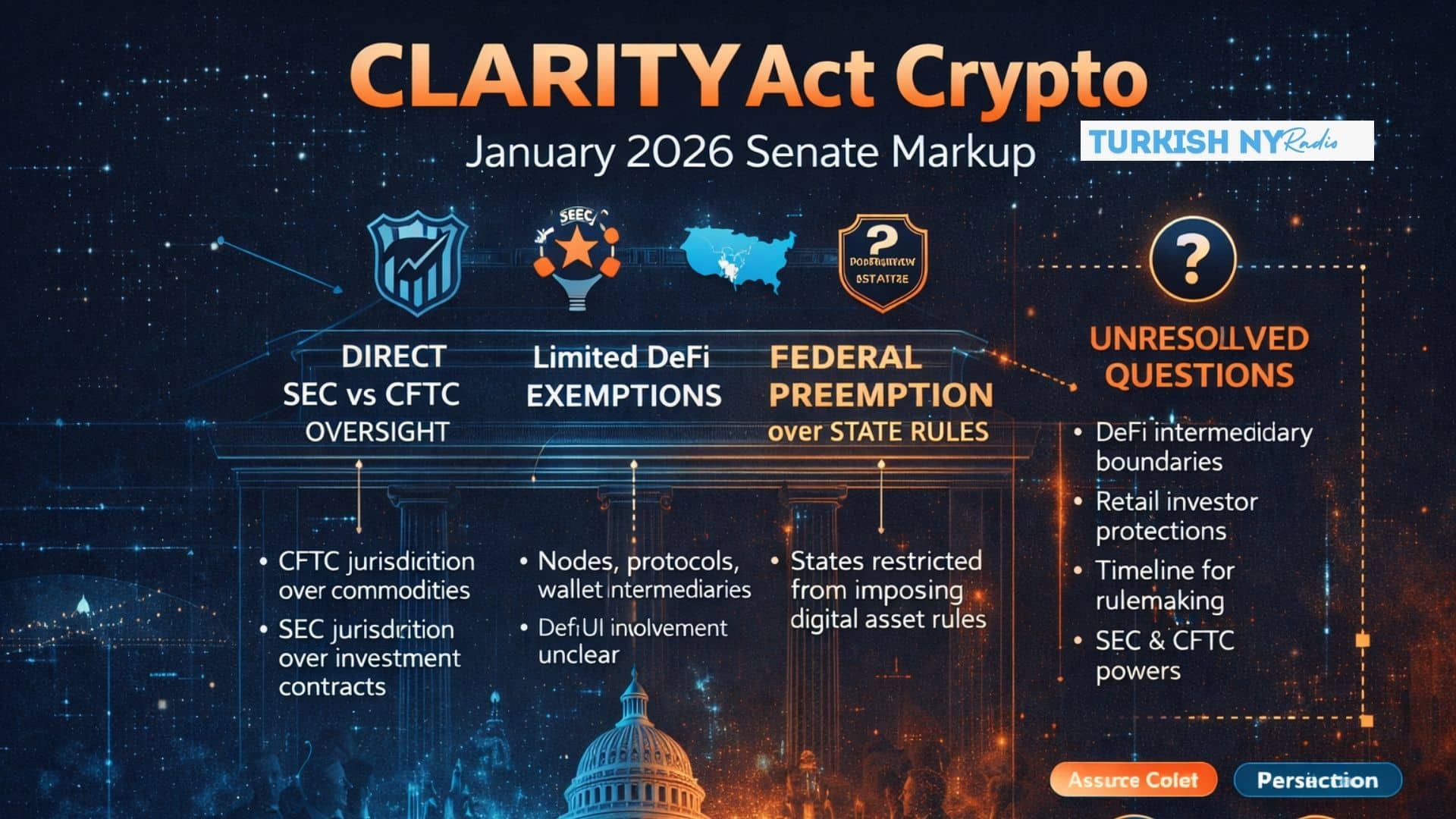
At its heart, the CLARITY Act proposal is trying to solve a problem that has frustrated everyone: who regulates what. The bill seeks to draw a cleaner line between the Securities and Exchange Commission and the Commodity Futures Trading Commission, especially for digital assets that don’t behave like traditional stocks.
Also read: Japan’s 20% Crypto Tax Could Attract Billions From Asian Investors
One congressional staffer described the bill as “an effort to replace courtroom battles with a rulebook people can actually read.” That sentiment explains why industry leaders see the CLARITY Act as a turning point rather than just another policy experiment.

DeFi protections and the fears around them
Decentralized finance is where emotions run highest. The CLARITY Act includes language that aims to protect core blockchain infrastructure, such as node operators and open-source developers, from being automatically treated as financial intermediaries.
Supporters argue this is about fairness. “You shouldn’t be regulated just for publishing code,” one lawmaker said during recent discussions. Still, critics worry the language may be too soft on front-end platforms that guide users and influence trades, a concern that continues to shadow the CLARITY Act debate.
States versus federal control
Another sensitive issue is power as under the CLARITY Act framework, federal rules would override many state-level crypto regulations. For companies juggling 50 different compliance standards, that sounds like progress.
But some state officials argue they’re being sidelined. Consumer advocates fear local protections could weaken before federal agencies are fully ready to step in, adding pressure on lawmakers shaping the final CLARITY Act text.
Why January’s markup matters
A markup is not a final vote, but it’s where a bill either gains momentum or quietly stalls. Amendments proposed in January could tighten DeFi language, clarify enforcement powers, or reshape how fast rules roll out after passage. Even supporters admit the CLARITY Act won’t deliver instant clarity, since regulators would still need months to write detailed rules.
Conclusion
The impending markup provides a possible check. Lawmakers must evaluate if the CLARITY Act really balances innovation and protection, or if unfilled loopholes risk causing further misunderstanding. Whatever happens next will determine how comfortably crypto functions in the United States and if the country remains relevant in a rapidly changing global economy.
Also read: The 2025 moments that re-taught crypto how to grow up
Summary
The CLARITY Act bill is nearing a critical January markup that may transform US digital asset legislation. Its goal is to clarify agency duties, alleviate DeFi infrastructure problems, and consolidate monitoring at the level of the federal government. While advocates perceive a long-overdue move toward clarity, detractors point out that protecting investors and state power are still unresolved. The markup process will determine whether the bill moves forward or requires significant modifications.
Glossary of Key Terms
Digital asset: Is a coin or token that is built on blockchain technology.
DeFi: Means blockchain-based monetary services that do not require central middlemen.
SEC: Is the United States’ watchdog in charge of monitoring the securities exchanges?
CFTC: Is a US authority that oversees materials and exchanges.


Markup: A legislative session during which a measure can be discussed and revised.
FAQs for CLARITY Act Crypto
1. What exactly does the CLARITY Act Crypto bill want to achieve?
It seeks to clearly clarify how digital files are governed in the United States.
2. Why does the January markup matter?
It decides on significant adjustments and whether the measure moves ahead.
3. Can the bill cover DeFi developers?
It suggests minimal safeguards for infrastructure developers, rather than bad actors.
4. Will nations lose complete control over cryptocurrency?
Some state power would be decreased in exchange for federal supervision.
5. At what point would the rules take effect?
Only after passage and an extensive regulatory rulemaking procedure.