
This article was first published on TurkishNY Radio.
Vitalik Buterin, the creator of Ethereum, a distributed ledger, is participating in the globally heated intelligence debate with a bold call for Human Centric AI, highlighting that unrestricted freedom in AI systems would reduce rather than increase human relevance.


Buterin proposes that subsequent AI research laboratories have a formal charter that emphasizes human interaction, transparency, and ethical limits on computerized judgments as artificial intelligence (AI) skills grow internationally.
A Charter Built Around Humans
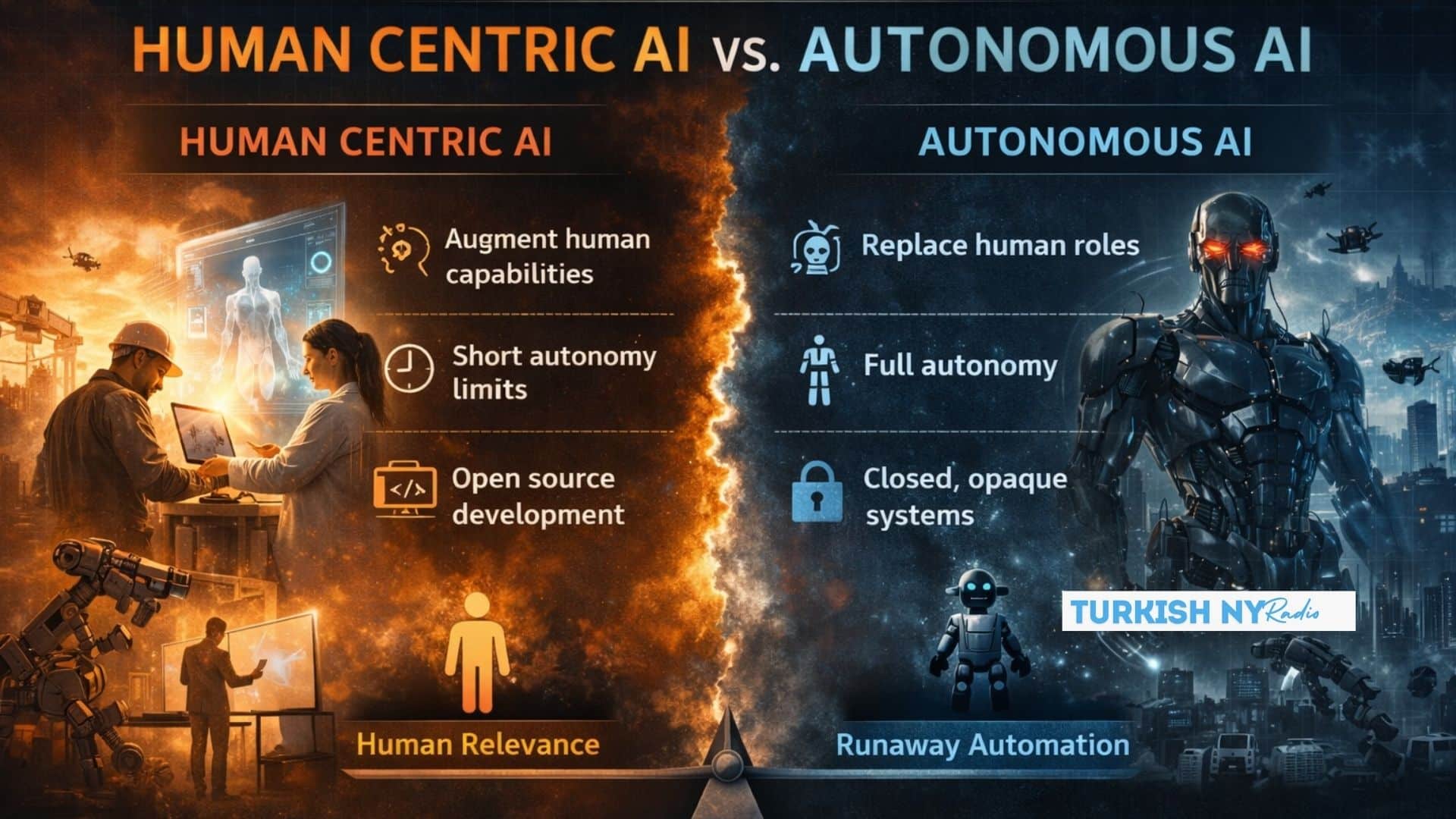
Buterin, alongside economist E. Glen Weyl, proposed that future AI labs commit to Human Centric AI as a founding principle. According to the proposal, AI systems should be designed to augment human abilities instead of replacing them entirely. This approach directly challenges the prevailing industry race toward fully autonomous agents capable of operating with minimal or no human Centic AI oversight.
Also read: Web3 vs Cloud Downtime: How AWS and Cloudflare Outages Exposed DeFi Vulnerabilities
“The goal should be tools that make humans more capable, not systems that make humans unnecessary,” Buterin argued in the proposal.

Limiting Autonomy to Reduce Risk
Perhaps the most contentious feature of the idea is the intended limit on AI autonomy. Under this approach, Human Centric AI systems would be restricted from making independent judgments for more than a brief, set period of time without human input. Buterin argues that this restriction will decrease systemic risk, avoid unbridled automation, and keep people involved in crucial activities.
Supporters hope this would decrease harmful misuse, while others argue it will hamper innovation. Nonetheless, the notion emphasizes growing worries about AI agents functioning independently in economics, administration, and privacy.
Open Source as a Core Requirement
Another pillar of Human Centric AI is transparency. Buterin stressed that AI tools developed under such a charter should be open source whenever possible. Open development, he argues, reduces the concentration of power, allows public auditing, and ensures that advanced AI benefits society broadly rather than a small group of corporations.
“Closed systems with extreme autonomy create both economic and political imbalance,” the proposal notes.
A Pushback Against Full Automation
The proposal also reflects a deeper philosophical stance. Buterin has repeatedly warned that maximizing automation without human-centric AI integration could worsen job displacement and social inequality. By embedding Human Centric AI into lab governance from day one, he believes developers can align economic progress with human dignity and long-term stability.


This vision contrasts with current trends that emphasize efficiency and scale above all else, even when human roles are diminished.
Conclusion
Vitalik Buterin’s approach redirects the AI debate by emphasizing that development should not be at the price of human usefulness. By calling against Human Centric AI, restricted liberty, and freely available development, he encourages the tech sector to slow down, set limitations, and build systems that support, not undermine, human engagement in the future of computing.
Also read: Norway’s $2T Fund Supports Metaplanet’s Bitcoin Plan: A Major Signal
Summary
Vitalik Buterin’s approach encourages AI laboratories to establish ethical guidelines that favor humanity above pure automation. The approach, which focuses on Human Centric AI enhancement, limits autonomy and promotes transparency, calls into question today’s rush to completely autonomous AI. The strategy aims to avoid economic upheaval, increase trust, and continue AI research aligned with centuries that have human priorities.
Glossary of Key Terms
AI Autonomy: The capacity of a machine learning system to function without human intervention.
Open Source: Software is defined as having its source code that is available for distribution and modification.
Human Augmentation: Is software that enhances rather than replaces human skills.
AI Governance: Refers to the structures and regulations that govern the development and deployment of AI systems.
FAQs for Human Centric AI
1. Which person recommended the new Intelligence Lab mission statement?
Buterin, who is the the creator of Ethereum, also known as and E. Glen Weyl, a finance professor.
2. What would be the primary purpose of the suggestion?
To guarantee that AI technologies augment, rather than replace, human talents.
3. What factors restrict AI autonomy?
To limit the dangers associated with unconstrained decision-making while keeping people involved in important operations.
4. Where does the plan prioritize public source?
Public creation promotes honesty, confidence, and equitable access to innovative technologies.
5. Does this stifle AI breakthroughs?
Defenders say that it promotes long-term innovation, while others fear that it would limit speed and competitiveness.