![Sun [New]](https://s2.coinmarketcap.com/static/img/coins/64x64/10529.png)



This article was first published on TurkishNY Radio.
The latest US labor data revision has sent shockwaves through financial markets after officials confirmed that more than one million previously reported jobs were removed from payroll totals.


The adjustment marks the largest annual downward correction in more than twenty years. It has raised fresh concerns about the strength of the American economy in 2025.
Investors reacted quickly to the development. Economists began revising growth forecasts. Policymakers are now reassessing the trajectory of the labor market.
US Labor Data Shows Over 1 Million Jobs Cut
Over one million jobs were wiped from previous employment estimates. Economists had anticipated a downward revision on the order of 750,000 to 900,000 jobs, although now that we have it in hand it looks even bigger after accounting for monthly revisions.
Hiring in December slowed to a near stall with only about 50,000 jobs added. For the next month’s report, the unemployment rate is expected to be at around 4.4 percent.
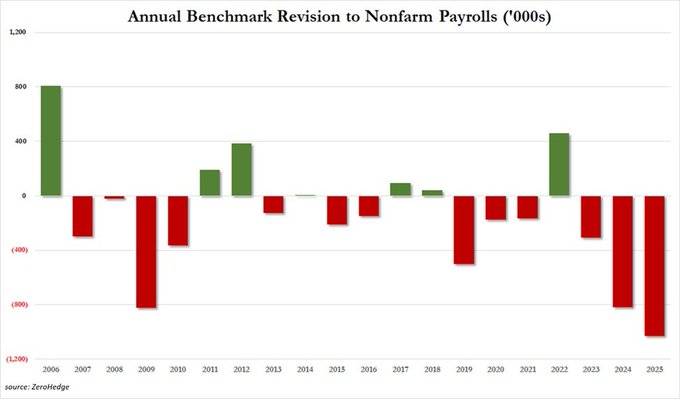
Benchmark Revision to Payrolls Shows Deeper Job Cuts
The Bureau of Labor Statistics does a benchmark revision each year to fine-tune the payroll numbers with new tax filings and employer data. Revisions are a normal part of the statistical process. But the magnitude of the latest US labor data adjustment is all the more noteworthy.
Previous preliminary estimates had indicated steep reductions. The estimates implied close to 911,000 jobs could be eliminated. The latest revisions now show a more thorough weakening in employment growth through 2025.


Historic Scale of the Adjustment
The downgrade is rare in its scale. Analysts had expected some pullback but not to this extent. The updated US labor data indicates that the hiring juggernaut was overstated for big parts of the year.
Robust job creation has bolstered consumer confidence and spending. The correction now disputes that presumption. Economists will have to revise earlier forecasts for economic growth.
Market Reaction Intensifies
Financial markets moved swiftly following the revised US labor data. Treasury yields fluctuated as traders recalculated expectations for interest rates. Slower job growth often signals cooling economic activity.
Stock markets also showed uncertainty. Companies that rely heavily on consumer demand may face pressure if employment conditions are weaker than previously thought. Some investors, however, see softer labor conditions as increasing the likelihood of rate cuts.
Federal Reserve in Focus
Labor market performance plays a central role in Federal Reserve policy decisions. Officials monitor employment growth closely when setting interest rates. Weaker data could shift the policy outlook.
If the revised US labor data confirms sustained softness, policymakers may consider adjusting their stance. However, inflation figures will remain a critical factor in any decision.
Signs of Slower Hiring
The updated data reinforces signs of slowing job creation in late 2025. December gains were modest, capping a year of muted hiring. Economists are also examining revisions beyond the March benchmark period.
Further adjustments through December may reshape the final picture of the year’s labor performance. The revised US labor data points to a more fragile employment environment than initially believed.
January Employment Report Ahead
The benchmark revision is being released alongside the January employment report. Economists expect modest job growth and an unemployment rate near 4.4 percent.
The report was delayed by a brief federal government shutdown, which added uncertainty. Markets will study the new figures closely to determine whether hiring shows signs of stabilization.
Broader Economic Impact
Job creation fuels consumer spending and business investment. Weaker US labor data may lead to a downward revision in expectations for the economy in the months ahead.
Some analysts say weaker hiring could help alleviate wage pressures and the risk of inflation. Still others caution that anemic readings could hang over the broader economic momentum.
Cryptocurrency markets also responded cautiously. Digital currencies are sensitive to shifts in interest rate outlooks and market sentiment.
Why Revisions Matter
Annual benchmark revisions are designed to improve accuracy. They incorporate more comprehensive payroll records. While this strengthens long-term reliability, large corrections can disrupt short-term narratives.
The latest US labor data serves as a reminder that economic assessments can change once more complete information becomes available. Policymakers and investors must adapt to updated realities.
Conclusion
More than one million jobs are being wiped from prior payroll estimates in a defining economic event of 2025. The new US labor data indicates that job growth was much weaker than previously reported.
Markets are still skitterish to incoming news. Policymakers are monitoring trends carefully. It remains to be seen whether the slowdown continues or levels off.”
Appendix: Glossary of Key Terms
Benchmark Revision: Annual revision of payroll data to reflect more complete employer records.
Nonfarm Payrolls: Total number of paid workers in the economy, not including farm employees.
Bureau of Labor Statistics (BLS): A government agency that provides information about employment and inflation.
Unemployment Rate: Proportion of the labor force looking for work, but unemployed.
Monetary Policy: Policies of the Fed to control interest rates and money supply.
Yield on Treasury notes: The interest rate on a 10-year U.S. government bond.
Economic Slump: Times of deceleration or shrinkage in the economy.
Payroll Adjustment: Revision of previously reported employment figure up or down after review.
Frequently Asked Questions About US labor data
1- What is the US labor data revision?
It is an annual benchmark update that adjusts payroll numbers using more complete employer records.
2- How many jobs were removed?
More than one million jobs were cut from previously reported totals.
3- Why is this revision significant?
It is the largest annual downward adjustment in more than twenty years.
4- How could this affect interest rates?
Weaker job growth may influence Federal Reserve decisions, depending on inflation trends.
References