It’s not often that a proposal lands in Washington with the potential to reshape centuries of financial orthodoxy, but that’s exactly what the $115 billion Bitcoin reserve plan is doing.
Spearheaded by Senator Cynthia Lummis and supported by President Donald Trump, this ambitious strategy calls for the U.S. government to acquire one million bitcoins over five years, establishing a The U.S. plans a $115B Bitcoin reserve to tackle debt, hedge inflation, and reshape monetary policy, supporters see hope, critics warn of risks. as a long‐term store of value.
With public debt surging past $36 trillion and inflation threatening household incomes, the plan aims to rein in economic instability, and the stakes couldn’t be higher. Here’s everything you need to know about what this means, who supports and opposes it, and where it might lead the country.
What Exactly Is the Bitcoin Reserve?
-
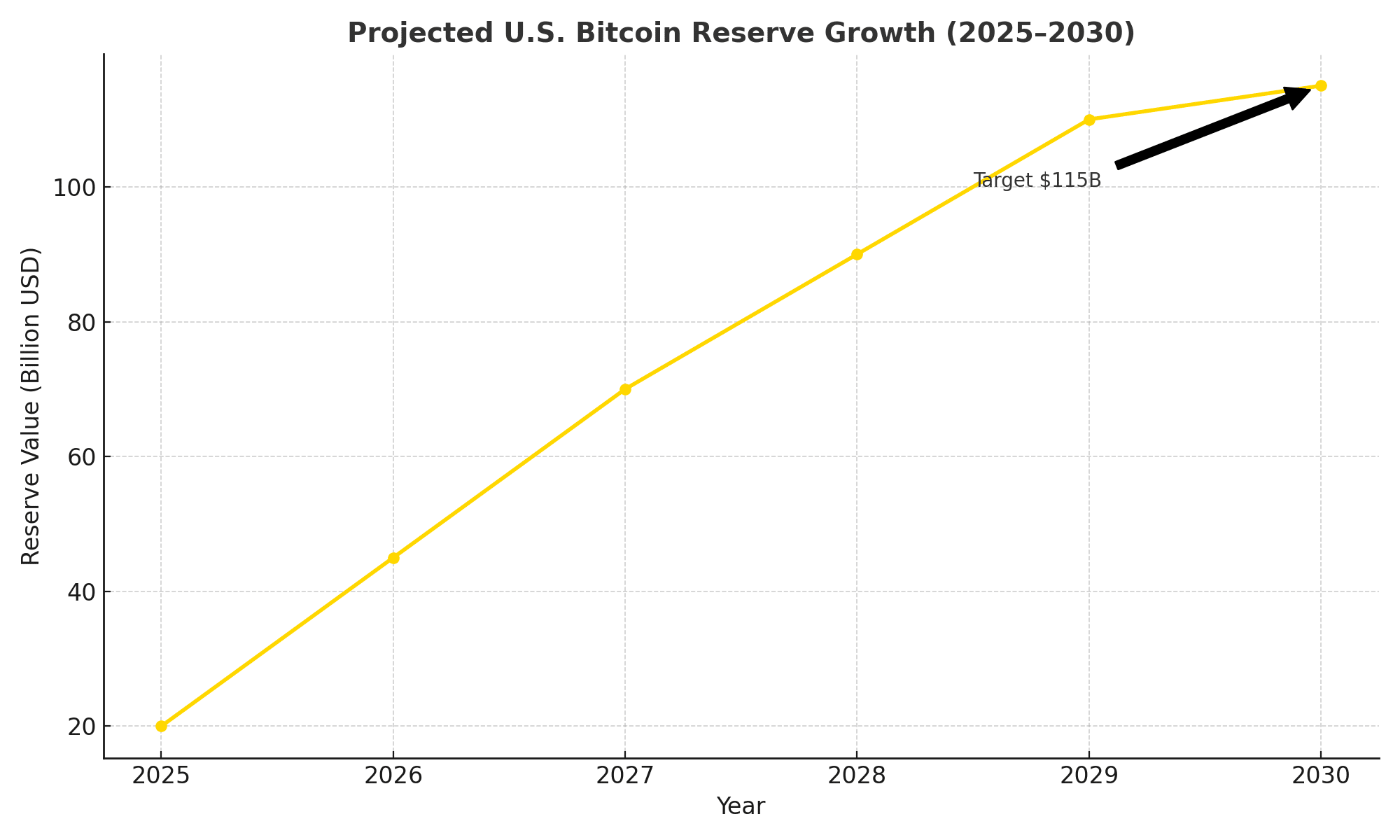
The proposal, codified in the BITCOIN Act, calls for acquiring one million Bitcoin over five years. This would cost approximately $115 billion, assuming current market prices.
-
The reserve would not be liquidated quickly. The intent is to hold it long-term as a safeguard against inflation, currency devaluation, and as a hedge compared to traditional assets.
-
Funding is meant to be budget‐neutral, meaning it wouldn’t add to deficit spending; possible sources include seized crypto assets, tariff revenue, and adjustments to existing federal holdings.
Voices in Favor: Faith, Finance, and Fiscal Rescue
Senator Cynthia Lummis has emerged as the most vocal advocate. “The BITCOIN Act is the only solution to our nation’s $36T debt,” she declared, placing Bitcoin at the core of the rescue plan. She argues that fixed supply in Bitcoin provides monetary discipline the U.S. has lacked.
President Trump has thrown his support behind the idea, backing the legislation and applauding its potential to protect the dollar and restore economic confidence.
On the financial side, experts see possible value. Neil Bergquist, CEO of Coinme, says a strategic Bitcoin reserve could act as a hedge against inflation and currency devaluation. “This strategy could enhance national financial stability,” he said.
Critics, Caution, and Contrasting Opinions
-
One of the sharpest critiques comes from those who believe the risk is too high: Bitcoin is volatile, and placing taxpayer‐backed resources in such an asset could result in sharp losses.
-
Some lawmakers worry whether this reserve is more speculative than strategic. As one state representative put it when rejecting state‐level Bitcoin reserve legislation: “This just smacks of speculation.”
-
Legal and regulatory challenges also loom large. Can the U.S. government, particularly Treasury or other agencies, legally hold vast amounts of bitcoin? Would this move require new laws or revisions to existing statutes?
Potential Impacts: Economic Ripples & Global Implications
-
If enacted, the reserve could alter how investors think about national reserves, diversifying them beyond traditional assets like gold or foreign currencies. Bitcoin’s role could shift from fringe to foundational.
-
There’s also the potential for signal effects: U.S. commitment to Bitcoin could encourage institutional adoption, spur innovation in digital asset custody, and force clearer regulation.
-
On the flip side, volatility in the crypto markets could pull down real value. There is also concern about political risk, future administrations might reverse course.
-

Bitcoin reserve


What’s Next? The Path to Decision
A critical upcoming roundtable meeting among industry leaders, lawmakers, and financial experts is scheduled, coordinated in part by Binance’s Digital Chambers and others.


They plan to work through how to make the Bitcoin reserve budget‐neutral, address critics’ objections, and firm up mechanisms for custody, oversight, and legal protection.
The $115 billion Bitcoin reserve plan is more than a political talking point. It’s a serious proposal that seeks to reshape how America thinks about money, debt, and financial security.
Supporters view it as a pathway out of rising debt, inflation erosion, and weakening trust in traditional monetary policy. Opponents warn of volatility, regulatory complexity, and risk to public funds.
As the debate intensifies, the questions at hand are: can the proposal deliver on its promises? And will the U.S. have the political will and institutional framework to make it work?
Conclusion
The $115 billion Bitcoin reserve plan is more than a political talking point. It’s a serious proposal that seeks to reshape how America thinks about money, debt, and financial security. Supporters view it as a pathway out of rising debt, inflation erosion, and weakening trust in traditional monetary policy.
Opponents warn of volatility, regulatory complexity, and risk to public funds. As the debate intensifies, the questions at hand are: Can the proposal deliver on its promises? And will the U.S. have the political will and institutional framework to make it work?
For more news, visit our platform.
FAQs about one million nitcoins
Q1: What is the price basis of the $115 billion figure?
A: It comes from multiplying the targeted purchase, one million Bitcoin, by current market prices. If Bitcoin’s price shifts, that figure could rise or fall significantly.
Q2: How would this plan be “budget‐neutral”?
A: The plan aims to use non‐taxpayer sources like seized crypto, tariff revenues, or reallocated funds so that no extra burden falls on taxpayers.
Q3: Could the U.S. reverse the decision later?
A: Yes. Without strong legal protections, future administrations could divest or change policy. That’s why many supporters emphasize the necessity of legislation, not just executive orders.
Q4: How risky is holding such a large amount of Bitcoin?
A: It’s quite risky. Bitcoin is known for volatility. A steep drop could wipe out value. But proponents argue that over a long horizon and with proper safeguards, risks may be manageable.
Glossary of Key Terms
| Term | Definition |
|---|---|
| Bitcoin (BTC) | A decentralized digital currency with a fixed maximum supply. |
| Strategic Bitcoin Reserve | A proposed government‐held stockpile of Bitcoin intended as a long‐term asset. |
| BITCOIN Act | The bill introduced by Senator Cynthia Lummis to codify the purchase of one million Bitcoins over five years. |
| Budget‐neutral | A financial strategy that does not increase the government deficit or require new tax revenue. |
| Inflation hedge | An asset that retains value or appreciates when inflation erodes the value of fiat currency. |
| Custody | The physical or digital preservation and safeguarding of an asset. |