This article was first published on TurkishNY Radio.
The Lazarus Upbit Hack has quickly become one of the most alarming crypto security incidents of the year. More than $30 million worth of Solana-based assets disappeared from Upbit’s hot wallet in a matter of minutes, setting off shockwaves through South Korea’s digital asset community.


Early signs point toward the North Korea-linked Lazarus Group, and the Lazarus Upbit Hack is now prompting renewed scrutiny of centralized exchange security, on-chain laundering patterns, and the country’s broader crypto regulatory stance.
Upbit’s Hot Wallet Breached in Minutes
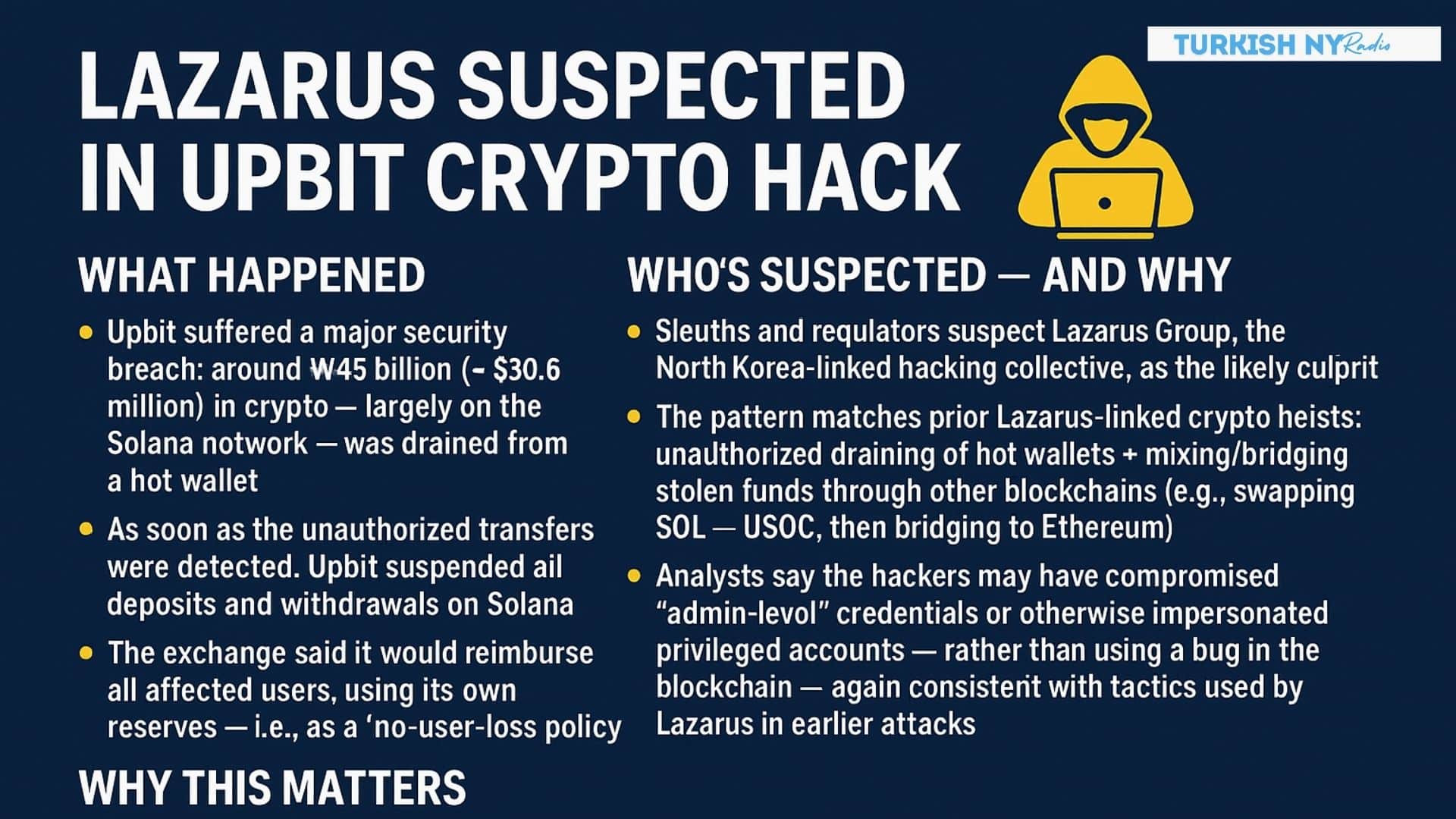
Upbit immediately suspended deposits and withdrawals after confirming that the intrusion came from their Solana network wallet. The stolen money was swiftly transferred via a network of wallets, converted into stablecoins and bridged over many chains, a pattern of money laundering that has grown unsettlingly common.
In total, the Lazarus Upbit Hack resulted in an estimated ₩44.5 billion loss, though some sources place the number slightly higher. Upbit assured customers that their balances remain safe.


Also read: Dunamu Nasdaq IPO Could Become Asia’s Most Watched Crypto Listing
“Our priority is protecting users, and we will reimburse all affected customers fully,” an Upbit spokesperson said. “We are working closely with authorities to identify those responsible.”
The parallels between the two events are hard to ignore, and this is Upbit’s worst breach since 2019.
Signs Point Toward the Lazarus Group
South Korean investigators quickly zeroed in on the Lazarus Group due to the recognizable transaction flow and technical behavior. Analysts note that the attackers appeared to use compromised administrative keys rather than exploiting any flaw in the Solana blockchain itself.
The Lazarus Upbit Hack follows the group’s long history of targeting exchanges, DeFi protocols, and cross-chain bridges. Their motives are believed to be tied to funding North Korea’s weapons programs.
A cybersecurity researcher familiar with the investigation explained:
“The laundering pattern seen in the Lazarus Upbit Hack mirrors previous Lazarus operations almost step-for-step. Their signature tactics are all over this incident.”
Authorities say they expect to provide a formal attribution once additional transactional tracing is complete.
Industry Response and Security Implications
The Lazarus Upbit Hack has revived concerns about the vulnerability of hot wallets and the risks that come with managing large volumes of digital assets online. Analysts warn that the combination of high liquidity and rapid cross-chain movement makes Solana-based assets especially attractive to sophisticated attackers.
The incident is likely to accelerate South Korea’s push for tighter security regulations and mandatory wallet audits for exchanges.
For many in the industry, the Lazarus Upbit Hack serves as another reminder that even top exchanges remain at risk if their operational security practices fall behind the evolving threat landscape.
Conclusion
The Lazarus Upbit Hack is notable not just for the quantity of money taken but also for its geopolitical relevance and the accuracy with which it was carried out. The world is still concerned about how soon the stolen money may be found and how soon the Lazarus Proceeds Crimes Team will be formally identified as the perpetrator, as Upbit strengthens its systems and collaborates with South Korean law enforcement.
The Lazarus Upbit Hack reaffirms a well-known but crucial point: as state-backed threats increase and attackers become more coordinated, cryptocurrency platforms must keep bolstering security.
Also read: New Sanctions Incoming: South Korea’s FIU Targets AML Failures at Top Crypto Exchanges
Glossary
Lazarus Group: A North Korean state-linked hacking organization known for major crypto thefts.
Hot Wallet: An internet-connected crypto wallet used for active transactions.
Solana: A high-speed blockchain used for decentralized apps and digital tokens.
Cross-Chain Bridge: A mechanism that allows assets to move between different blockchains.
On-Chain Tracing: Tracking blockchain transactions to identify stolen or suspicious funds.
FAQs for Lazarus Upbit Hack
1. Describe the Lazarus Upbit Hack.
It alludes to the $30 million heist from Upbit’s Solana hot wallet, which is thought to have been committed by the Lazarus Team.
2. What quantity was taken during the assault?
Over thirty million dollars worth of Solana-area assets were lost, according to Upbit.
3. Is user funds secure?
Indeed. All consumers impacted by the incident will get reimbursement, according to Upbit.
4. Was there a weakness in Solana itself?
No. Investigators think that rather than a weakness on the Solana blockchain, hacked admin keys were exploited.
5. What makes Lazarus a suspect?
because the transaction pattern and laundering techniques are similar to those used in earlier Lazarus-related attacks.