The Largest Bitcoin Seizure in History
The world of digital assets has seen its share of scandals, but few rival the case unfolding in London. A Chinese national, Zhimin Qian, admitted guilt in the UK’s Southwark Crown Court for laundering billions through Bitcoin.


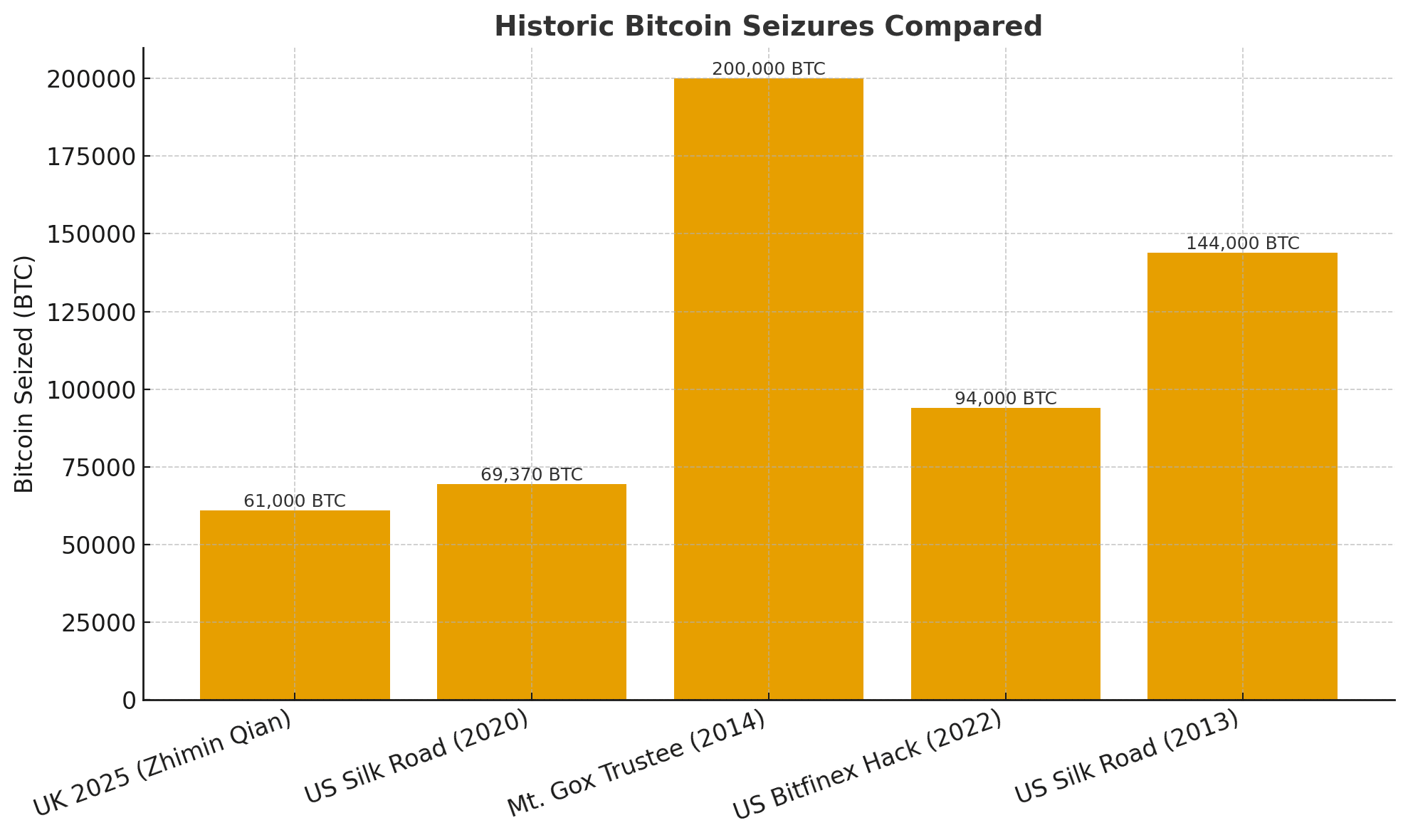
Her arrest and conviction follow the seizure of nearly 61,000 bitcoins, valued at more than $7 billion at current prices, marking the largest Bitcoin confiscation to date.
Between 2014 and 2017, Qian orchestrated a fraudulent investment scheme in China that drew in over 120,000 unsuspecting victims.
The funds, funneled through shell companies and false accounts, were later converted into Bitcoin before she fled to Britain under a false identity. The UK’s Metropolitan Police first seized the assets in 2018, but only now has the full extent of her crime come to light.
How the Scheme Unraveled
Prosecutors revealed that Qian operated a company in Tianjin, promising astronomical returns through supposed technology investments. Instead, the money disappeared into personal accounts and offshore channels.
By shifting the proceeds into Bitcoin, she attempted to place them beyond the reach of authorities.
Her accomplice, Hok Seng Ling, also pleaded guilty to related charges, while other associates have already faced convictions.
In March, Jian Wen, a former associate, was sentenced for laundering a fraction of the stolen funds, underscoring the wide network behind the scheme.
The staggering seizure has fueled debate over crypto’s role in financial crime. Yet regulators also view it as proof that blockchain transactions, while often cloaked in pseudonymity, leave trails that law enforcement can eventually follow.
Global Reactions and Industry Voices
The case has not gone unnoticed in financial circles. One analyst commented on X, “This isn’t just about fraud, it’s about trust. A $7B seizure proves crypto is no longer a wild frontier, it’s under global scrutiny.”.
Even skeptics of digital assets admit the conviction shows regulators are catching up with crypto-enabled crime. Hester Peirce, a U.S. SEC Commissioner, remarked in a separate discussion about enforcement, “Fraud is fraud, no matter the technology. The tools may be different, but accountability remains the same.”.
What Happens to Bitcoin Now?
A pressing question remains: what to do with the seized Bitcoin. British prosecutors have confirmed that civil recovery proceedings are underway. The government must decide whether to liquidate the assets into fiat currency or return them, in part, to victims of the scheme.
Legal experts warn that offloading such a vast amount of Bitcoin could ripple across global markets, potentially shaking prices.
A phased approach, similar to past U.S. auctions of seized crypto, seems the most likely path. The debate highlights how digital assets, once seen as untouchable, are now being folded into the machinery of state justice.
Lessons for the Crypto Market
This case lands at a time when institutions are debating custody rules and regulators are tightening standards across jurisdictions.
For investors, the conviction is a reminder that while blockchain offers transparency, it also provides cover for bad actors. At the same time, enforcement successes like this can boost confidence by showing that regulators are catching up with technology.
The top Google-searchable keyword—largest Bitcoin seizure—has become more than a headline. It’s a phrase symbolizing the collision of global fraud, regulatory persistence, and the maturation of the crypto industry itself.


Conclusion
The conviction of Zhimin Qian is a watershed moment for both law enforcement and crypto markets. The largest Bitcoin seizure in history is not only a cautionary tale of unchecked fraud but also a signal that digital assets are firmly within the grasp of regulators.
For crypto investors and institutions alike, it is proof that the industry, while still evolving, is no longer beyond the reach of justice.
FAQs
1. Who was convicted in the UK’s largest Bitcoin seizure case?
Chinese national Zhimin Qian admitted guilt to laundering billions through fraudulent investments converted into Bitcoin.
2. How much Bitcoin was seized?
Authorities confiscated around 61,000 bitcoins, now worth over $7 billion.
3. What will happen to the seized Bitcoin?
Civil recovery proceedings are underway, with options including liquidation through auctions or victim restitution.
4. Why is this case significant for the crypto industry?
It highlights both the risks of fraud and the ability of regulators to trace, seize, and prosecute crimes involving digital assets.
Glossary
Bitcoin Seizure: Government confiscation of Bitcoin linked to illegal activity.
Money Laundering: Concealing the origin of illicit funds by passing them through legal channels.
Civil Recovery: Legal process to reclaim assets derived from crime.
Pseudonymity: Identity masking through wallet addresses on blockchain networks.
Fraudulent Investment Scheme: A scam promising returns but diverting funds for illicit purposes.
Institutional Confidence: Trust that markets are regulated and transparent enough for large-scale investors.