After 40 long, exhausting days of gridlock, the U.S. Senate advances a bill to end the federal shutdown, a decisive move signaling hope for millions of Americans left stranded by Washington’s political deadlock.
Senators voted 60–40 on Sunday to move forward a funding measure that could reopen the federal government through January 30, 2026, restoring stability to essential services, air travel, and federal workers’ livelihoods.


President Trump expressed optimism before the vote, telling reporters at the White House, “It looks like we’re getting very close to the shutdown ending.”
The Turning Point: A Bipartisan Push
The U.S. Senate advances a bill to end the federal shutdown after weeks of finger-pointing and stalled negotiations. The measure includes three full-year appropriations bills covering the Departments of Agriculture, Veterans Affairs, and the legislative branch.
A handful of moderate Democrats, including Maggie Hassan, Jeanne Shaheen, and Angus King, struck a rare bipartisan deal with Republicans. In exchange for advancing the bill, the GOP agreed to a December vote on restoring Affordable Care Act subsidies, a core Democratic demand.
Senator Shaheen posted on X, “For over a month, I’ve made clear that my priorities are to both reopen government and extend the ACA enhanced premium tax credits. This is our best path toward accomplishing both of these goals.”
The Political Fallout Inside the Capitol
Despite progress, tensions flared among Democrats. Senate Minority Leader Chuck Schumer opposed the bill, arguing that without firm healthcare guarantees, Americans would face soaring insurance costs.
Representative Ro Khanna voiced frustration on X: “If you can’t lead the fight to stop healthcare premiums from skyrocketing for Americans, what will you fight for?”
Still, the fact remains that the U.S. Senate’s advance of a bill to end the federal shutdown marks a rare bipartisan breakthrough in an era of political division.
What’s Inside the Bill?
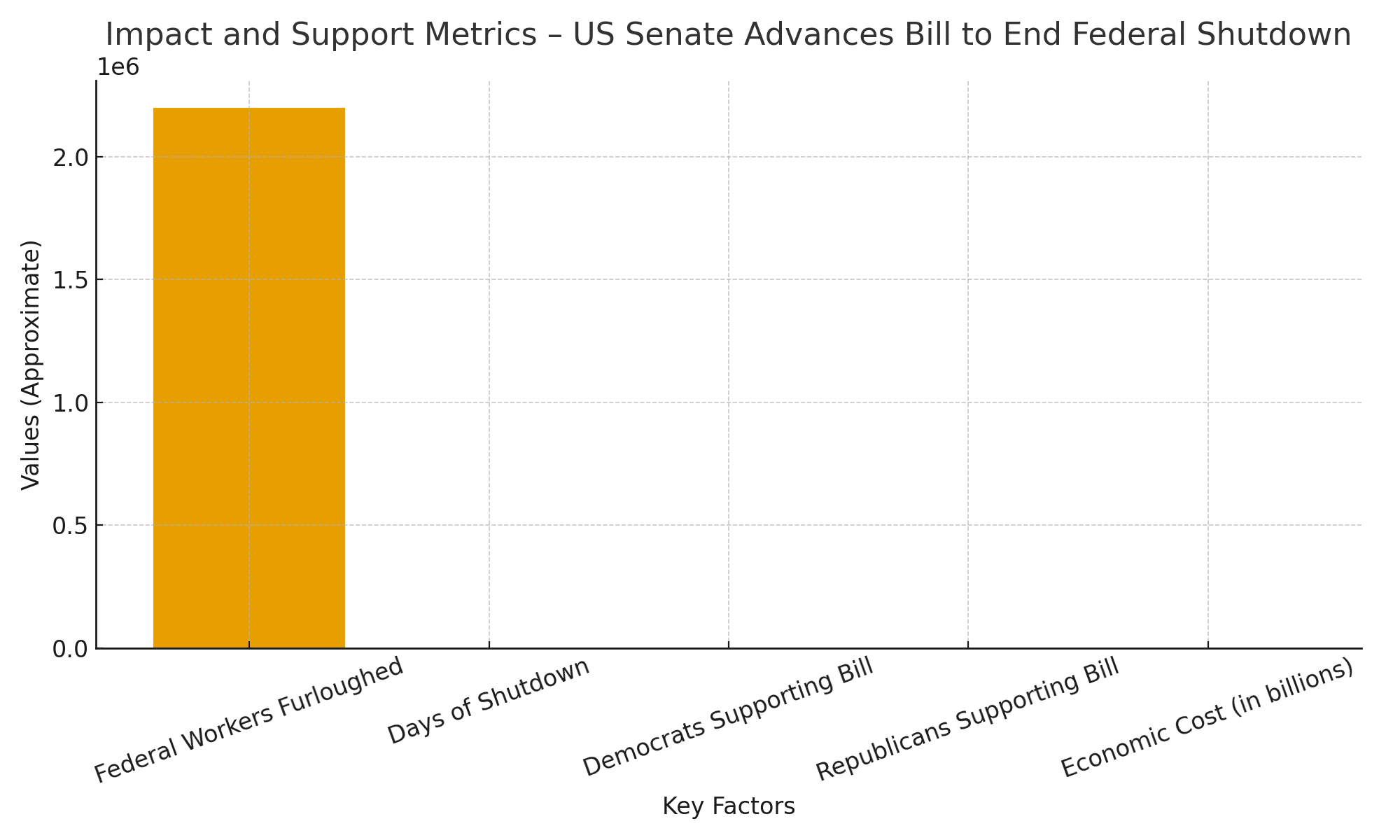
The legislation funds government operations through January 30, 2026, and ensures back pay for the 2.2 million federal employees affected. It prohibits layoffs until that date a crucial win for unions representing furloughed workers.


Air-traffic controllers, military personnel, and Border Patrol agents will receive full compensation. Food-aid programs, including SNAP, will resume after weeks of disruption.
For many, the moment feels overdue. “This vote is about getting Americans back to work,” Senate Majority Whip John Thune said after Sunday’s session. “Hopefully, we’ll get an opportunity tomorrow to set up the next votes.”
Why This Matters for Americans
The U.S. Senate advances a bill to end the federal shutdown, which not only affects government employees but also touches everyone. From delayed food assistance and airport chaos to halted loan processing, the impact has rippled nationwide.
Economists estimate that each week of shutdown costs the U.S. economy billions in lost productivity. Small businesses dependent on federal contracts have faced layoffs and closures.
With government funding restored, hope is returning but only if Congress and the White House finalize the deal quickly.
If passed, lawmakers will revisit healthcare subsidy extensions in December, a flashpoint that could reignite partisan debate. But for now, Americans can breathe a cautious sigh of relief.
As Senator Hassan put it, “This vote isn’t just about politics, it’s about people getting their lives back.”
Conclusion
FAQs about the U.S. Senate bill
1. How long did the federal shutdown last?
About 40 days, making it the longest in U.S. history.
2. When will federal workers be paid?
All affected workers will receive back pay once the bill is signed into law.
3. What’s the next step for the bill?
It heads to the House for a final vote, then to President Trump for approval.
4. Does the bill fix healthcare subsidies?
Not immediately, a separate December vote will determine that.
Glossary
-
Shutdown – A government closure when funding lapses due to failed budget agreements.
-
Appropriations Bill – Legislation that allocates funding for specific federal departments or programs.
-
ACA Subsidies – Financial assistance under the Affordable Care Act that helps citizens pay for health insurance.
-
Back Pay – Payment to employees for work missed during furloughs or shutdowns.