This article was first published on TurkishNY Radio.
The Trust Wallet hack 2025 created widespread concern in the cryptocurrency industry when a hacked Chrome browser extension resulted in millions of dollars in damages. Though no payment provider can guarantee full security, this event has reignited an unpleasant debate about how much confidence users have in browser-based technologies and how fast that trust can be checked.


What Went Wrong
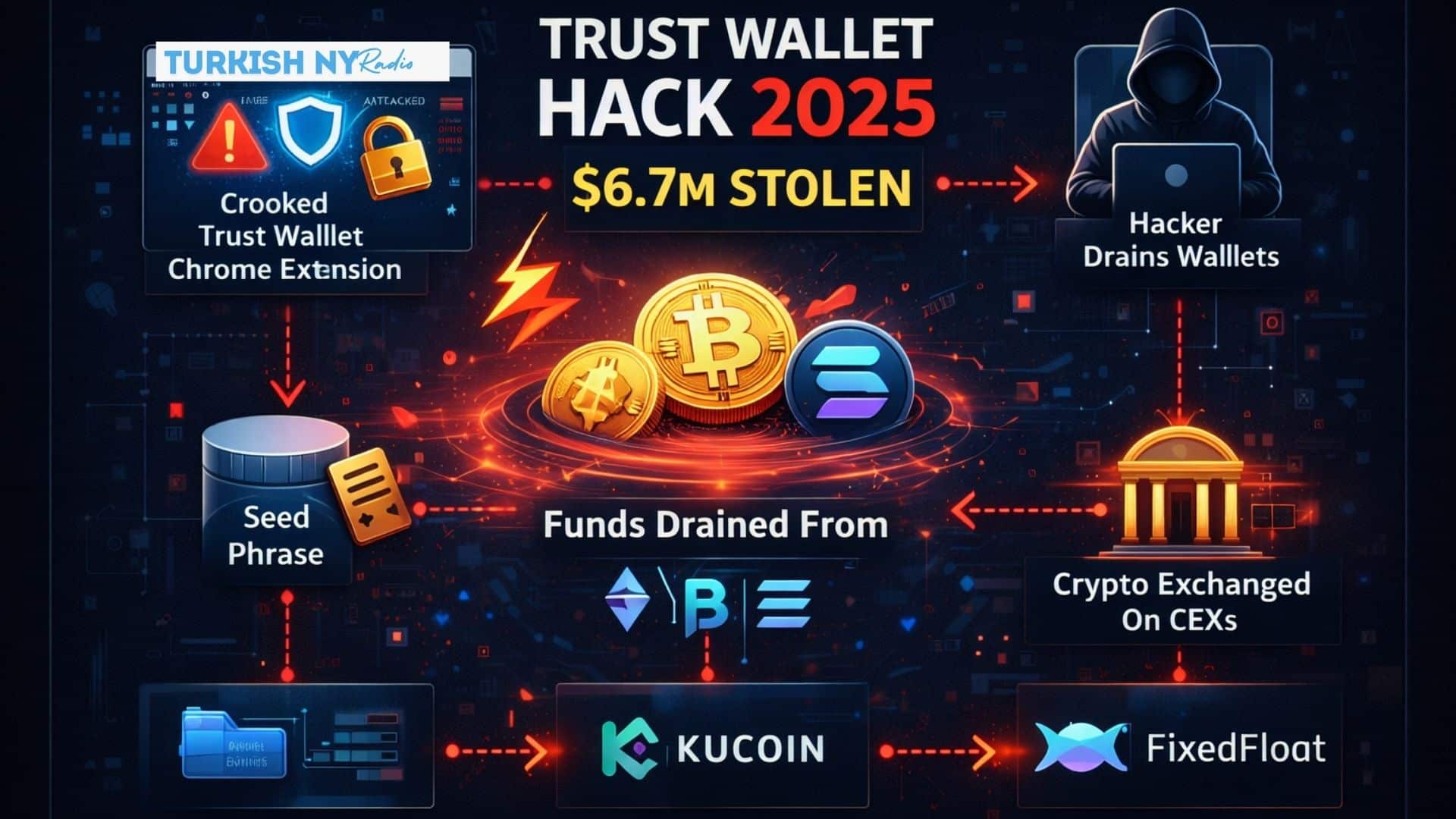
At the center of the incident was a specific version of Trust Wallet’s Chrome extension. According to early findings, users who installed the update and imported their recovery phrases unknowingly exposed their wallets. The Trust Wallet hack in 2025 was not carried out via fake websites or phishing emails. Rather, the problem looked like it originated within the program itself, making it difficult for ordinary users to discover.
Also read: Crypto Scams 2025: The Hidden Traps and How to Avoid Crypto Fraud
How Much was Lost?
Blockchain specialists who monitor suspicious transactions think that over $6 million dollars was taken from impacted accounts. The Trust Wallet hack 2025 involved the quick movement of stolen cash across different blockchains, a typical method used to minimize traceability. The pace of the transfers allowed little time for users to respond once the vulnerability was activated.
Insights From On-Chain Investigators
ZachXBT, a well-known blockchain investigator, was one of the first to openly report strange wallet behavior. In his assessment, the Trust Wallet hack 2025 showed clear signs of a malicious update rather than isolated mistakes by users.
“This wasn’t a case of people clicking bad links,” he explained. “The behavior points to compromised code interacting directly with private data.”
Trust Wallet’s Response
Trust Wallet responded immediately, warning users to eliminate the compromised plugin and switch to a safe version. The business indicated that its app for smartphones was unaffected and that it is attempting to compensate verified victims. While such answers are customary following an event, the Trust Wallet hack 2025 raises concerns about how extensions to browsers are evaluated before they are released.
Why Chrome Extensions Are Dangerous
Browser wallets continue to be tempting targets, according to security experts, since they combine ease with extensive access to cash. The Trust Wallet hack 2025 demonstrates how a single weak spot may lead to huge losses. Unlike central exchanges, digital wallet transfers cannot be reversed, prevention is significantly more vital than recovery.
What Does This Mean for the Industry
Alongside specific expenses, the Trust Wallet attack 2025 may affect how people keep cryptocurrency in the future. Wallets with hardware and offline storage options are already gaining popularity as individuals reconsider the balance between convenience of use and long-term security.
Conclusion
The Trust Wallet hack 2025 is an indicator that several widely used technologies might fail under the appropriate circumstances. If Trust Wallet’s remedial measures may mitigate the momentary damage, the event highlights an essential lesson for currency users: personal key security ought to constantly take precedence over convenience.
Also read: Kazakhstan Bitcoin ETF Emerges as a Powerful Beacon for Crypto Growth
Summary
The Trust Wallet hack 2025 exposed how a compromised browser extension can lead to large-scale losses without obvious warning signs. Millions were stolen after users imported recovery phrases into affected software. When Trust Wallet answered with improvements and compensation schemes, the incident shows the continued vulnerabilities of web wallets and the necessity for more stringent safeguarding practices.
Glossary of Key Terms
Recovery Phrase: A collection of phrases that allows complete utilization of a digital coin wallet.
Browser Wallet: A digital currency wallet that works as a web chrome attachment.
On-Chain Analysis: Examining information from the blockchain to identify activities.
Supply-Chain Attack: The malicious software was inserted via an authenticated update.


Cold Storage: Holding currency offline for increased protection.
FAQs for Trust Wallet hack 2025
1. Was this incident caused by phishing?
No, investigators believe the issue stemmed from a compromised software update.
2. Were all Trust Wallet users affected?
Only users of a specific Chrome extension version were impacted.
3. Did Trust Wallet acknowledge the issue?
Yes, the company issued warnings, updates, and announced reimbursement plans.
4. Can stolen crypto be recovered?
Once transferred, crypto is difficult to recover, which is why prevention matters.
5. How can users reduce future risk?
Using hardware wallets and avoiding browser-based seed phrase entry can help.