
This article was first published on TurkishNY Radio.
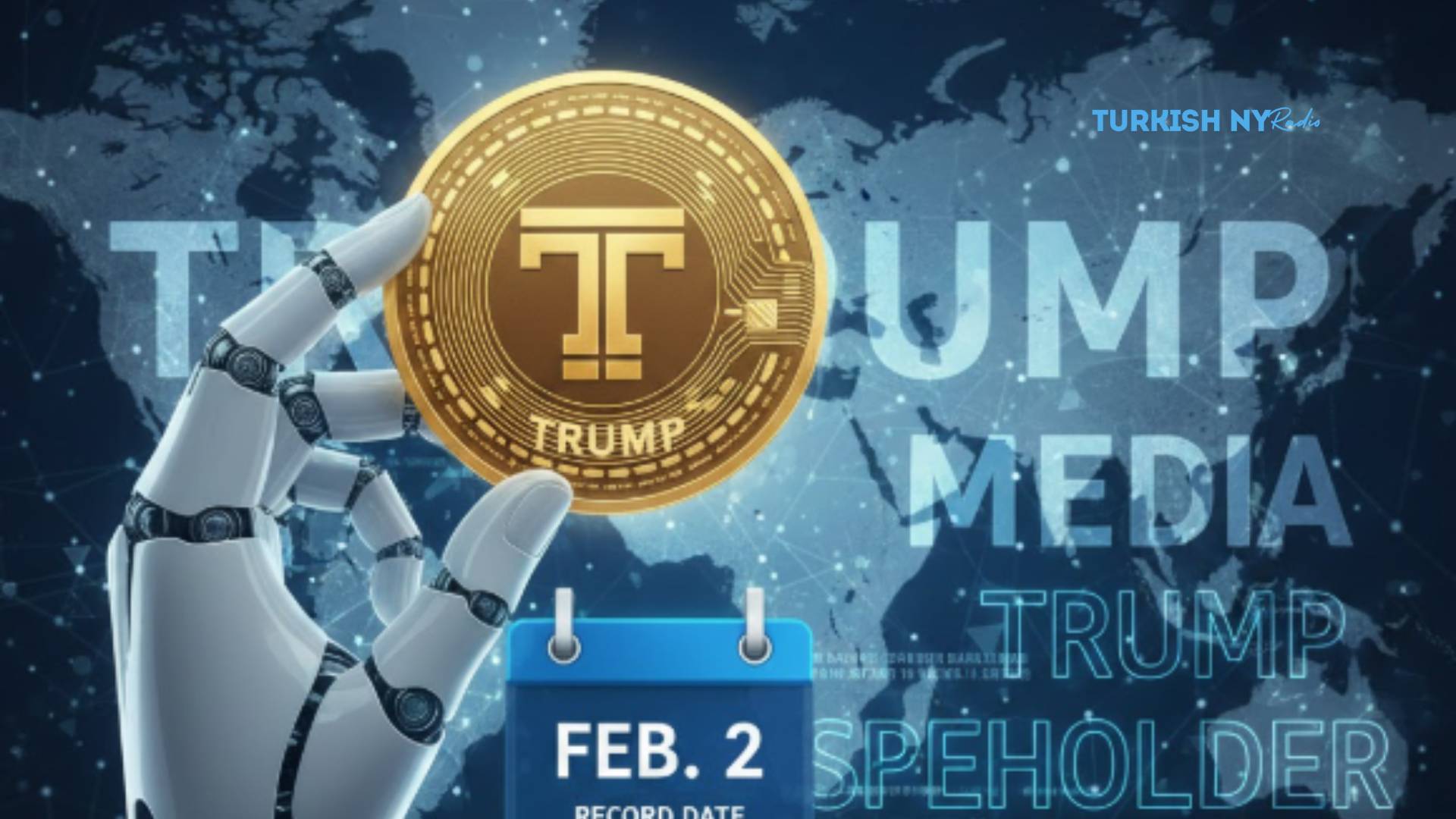
Trump Media has locked in February 2, 2026, as the record date for a shareholder-based crypto distribution, moving its token plan from “coming soon” to a timeline investors can actually track. The company said the initiative will reward eligible holders with a new digital asset tied to its ecosystem, while Crypto.com is expected to handle minting, on-chain display, and custody ahead of delivery.


For markets that live on momentum and narrative, the announcement matters because it turns an idea into a measurable event. It is also unusual in public markets: a digital token airdrop linked directly to equity ownership, rather than to user activity or an on-chain points system.


What the Feb. 2 “record date” actually means
A record date is essentially a snapshot as anyone who is the ultimate beneficial owner or a registered holder of at least 1 whole DJT share on February 2 is expected to qualify, with the company explicitly noting that borrowers of stock are not included in eligibility.
That one line is more important than it looks. It signals the company is trying to prevent edge cases where stock lending, short interest, or temporary positioning creates confusion about who gets what.
Digital token airdrop rules investors should watch closely
In the same update, Trump Media reiterated that the token is designed as a rewards-style asset, not a financial claim on the business itself. The company has emphasized the token does not represent ownership in Trump Media or any other entity, and it is expected to be non-transferable and not redeemable for cash.
That framing is not accidental. It reads like compliance-first positioning, built to avoid the token being interpreted as a profit-sharing instrument. The company also stated token holders should not expect rewards tied to “profits from the essential managerial efforts of others,” language that closely mirrors how regulators and legal teams often describe risk boundaries.
Crypto.com’s role, and why custody matters here
Crypto.com is expected to mint the tokens, display them on-chain, and hold them in custody until distribution begins, according to the company’s statement. This structure reduces the operational burden on Trump Media, but it also introduces a practical dependency: investor access will likely hinge on clean shareholder records and smooth coordination between brokers, transfer agents, and the custody pipeline.
That is why Trump Media flagged broker classification issues, including the potential friction caused by “objecting beneficial owner” settings that limit the flow of shareholder details.
In plain terms, a digital token airdrop can be simple in crypto circles, but it gets complicated fast when it has to pass through traditional market plumbing.
The rewards angle: product benefits instead of cash value
The token’s utility appears to be centered on perks, not payouts. The company has said rewards may include benefits or discounts tied to its platforms, including Truth Social, Truth+ and Truth Predict.
This is where the story becomes less about speculation and more about strategy. A digital token airdrop that behaves like a loyalty pass can still be powerful, especially if it encourages repeat engagement and keeps users inside one brand ecosystem the same way airline miles or retail memberships do.

What traders will track: the crypto “health signals” around the rollout
Even when a token is not meant for trading, crypto markets still react to attention, liquidity expectations, and perception. Analysts usually watch a few core indicators around events like this: spot volume and liquidity depth to see if interest is real, open interest and funding rates to measure leverage appetite, and volatility pricing to understand how aggressively traders are hedging.
On-chain watchers also monitor wallet activity, token contract creation patterns, and stablecoin flows for hints of shifting risk sentiment.
In that context, a digital token airdrop connected to a public stock adds a new twist, because it blends equity positioning with crypto-style event trading, even if the asset itself is designed to stay locked down.
Earlier signals point to a longer crypto roadmap
This token plan did not appear out of nowhere. In previous crypto-facing announcements tied to Cronos, executives framed the broader partnership as part of a bigger utility push. In a corporate filing, Trump Media CEO Devin Nunes said the company remained “bullish on cryptocurrency,” describing the shift toward digital markets as a long-term trend.
Crypto.com CEO Kris Marszalek has spoken in similar tones. In that same filing, he highlighted the scale and structure of earlier initiatives as a differentiator. And in an earlier public post on X, Marszalek called one development “a historic day for $CRO,” underscoring how seriously the company treats these integrations.
Those remarks help explain why this digital token airdrop is being positioned as more than a one-off headline.
Conclusion
February 2 is now the date to circle, because it turns a concept into a checkpoint that brokers, investors, and the market can verify. Trump Media is attempting something rare: tying shareholder ownership to a crypto reward system without turning it into a tradable asset or a cash equivalent.
If the rollout runs smoothly, the digital token airdrop could become a case study in how public companies experiment with crypto-native mechanics while keeping tighter guardrails than typical token launches.
Frequently Asked Questions (FAQs)
What happens on February 2, 2026?
It is the record date used to determine which shareholders qualify for the token distribution.
Is the token the same as owning stock?
No, the token is not an ownership interest in the company.
Can the token be sold for cash?
The company expects the token to be non-transferable and not exchangeable for cash.
Who is handling minting and custody?
Crypto.com is expected to mint the token and custody it before distribution.
What kind of rewards could come with it?
Benefits may include discounts or perks tied to the company’s products and platforms.
Glossary of Key Terms
Record date: The snapshot day used to decide who qualifies for a distribution.
Ultimate beneficial owner: The real owner of shares held through a broker, not a short-term borrower.
Custody: A service that securely holds assets on behalf of users until delivery or withdrawal.
Minting: The process of creating tokens on a blockchain.
Open interest: The total number of active derivatives positions, often used to gauge leveraged interest.
References