![BitTorrent [New]](https://s2.coinmarketcap.com/static/img/coins/64x64/16086.png)


This article was first published on TurkishNYR.
Crypto can feel like a fast lane to opportunity, but that speed also gives criminals room to move. New tokens, new apps, new narratives, and a constant stream of social posts create the perfect fog for bad actors to hide in plain sight.


The smart money is not the money that never takes risks. It is the money that learns patterns, stays calm under pressure, and knows what a real process looks like.
The stakes are not theoretical. Reported losses tied to crypto-focused investment fraud have been measured in the billions, and large-scale scam activity continues to evolve with better scripts, better fake interfaces, and more convincing impersonation.
Why Crypto Scams Keep Winning the First Minute
Most fraud succeeds early, not late as the first minute is when urgency is manufactured, trust is borrowed, and attention is hijacked. The scammer’s goal is simple: push a target from curiosity into action before basic verification happens. That is why so many traps start with a friendly message, a polished screenshot, or a short claim that sounds like insider access.
There is also a structural issue in crypto: transactions can be irreversible, wallets can be drained with a single bad approval, and identity checks often happen after the fact. In recent reporting and research, investigators have described increasingly professional scam operations, including forced-labor “scam compounds” and the growing use of AI-assisted persuasion and deepfakes.
Scam 1: “Pig Butchering” Investment Romance Traps
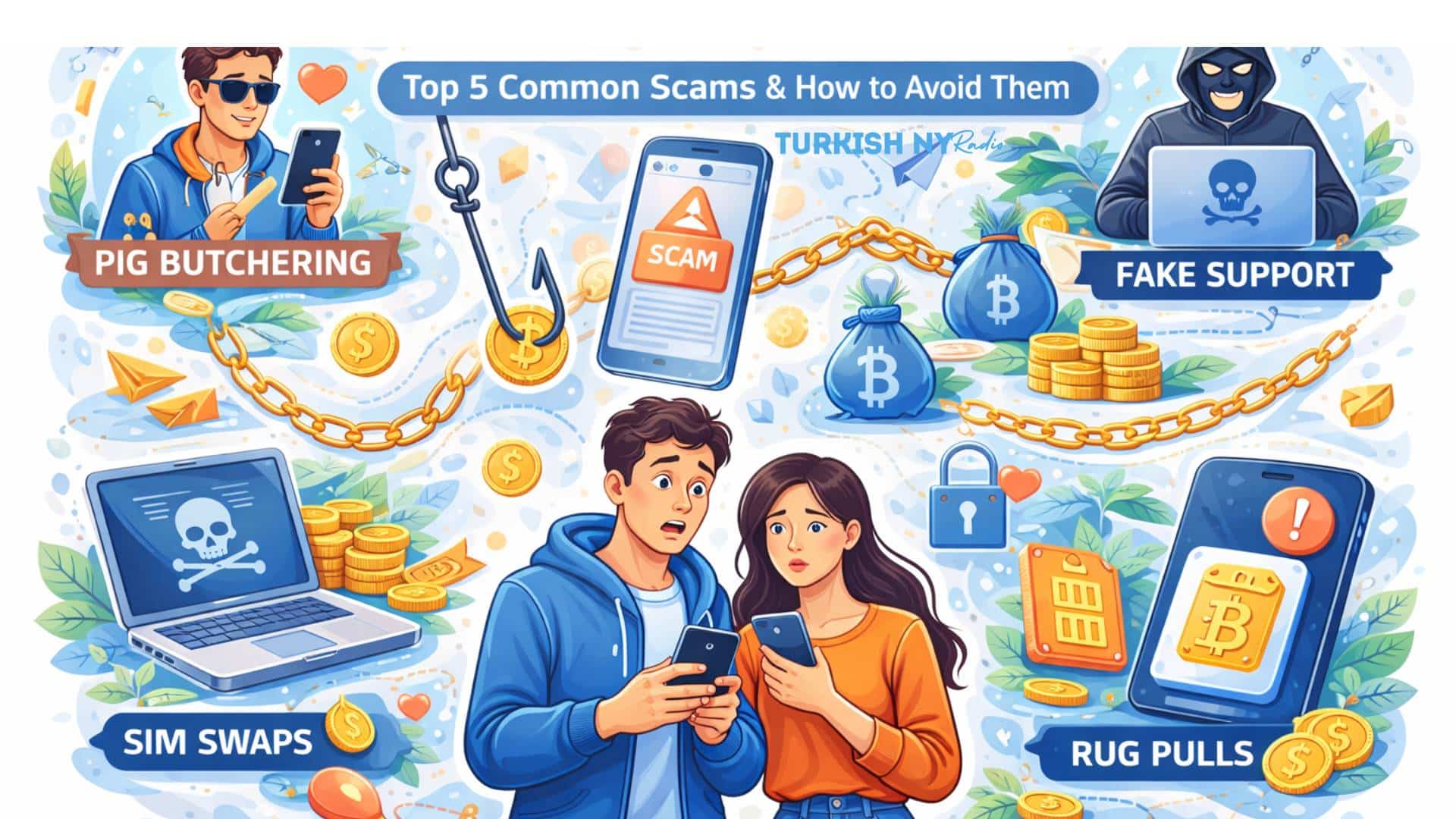
This scam blends emotion and money with unsettling skill. A criminal starts with a friendly chat on social media, a dating app, or even a wrong-number text, then builds a routine that feels personal. Over days or weeks, the victim is guided toward a “safe” crypto opportunity with a clean-looking dashboard and steady gains. The final move is the lock. Withdrawals fail, extra “taxes” appear, and the relationship vanishes.
This is not just a lone scammer with a laptop. Investigations have documented organized operations, including trafficking and coerced labor in parts of Southeast Asia, which helps explain the scale and the relentless follow-up that victims describe.
To avoid Crypto Scams like this, the safest rule is boring but effective: no financial decision should depend on a stranger’s emotional story. If an “advisor” refuses video verification that matches public identity, dodges basic licensing questions, or pushes a platform that cannot be independently verified, the risk is already extreme. If the conversation keeps pivoting back to profits, “signals,” or private groups, it is time to exit, not negotiate.
Scam 2: Wallet-Drainer Phishing and Malicious Approvals
Classic phishing has evolved in crypto. Instead of stealing a password, many attackers aim for a wallet signature or token approval. A user clicks a fake airdrop page, a cloned token-claim site, or a bogus mint link, then signs a transaction that quietly grants permission to move tokens. The wallet may still “look” intact until the attacker pulls the assets out in seconds.
Security trackers have reported wallet-drainer losses and victim counts that run into major totals, even when the year-over-year number fluctuates. The key point is not whether losses are up or down. The key point is that one careless signature can function like handing over a spare key.
To avoid Crypto Scams in this category, verification needs to happen before any signature. A legitimate team does not pressure users to sign immediately. A careful process includes checking the exact domain, confirming the announcement through official in-app channels, and reviewing what a transaction is requesting. If a site asks for unlimited approvals, unexpected permissions, or repeated signatures “to sync,” it is usually not a sync. It is a drain.
Scam 3: Impersonation, Fake Support, and “Recovery” Services
Impersonation works because crypto culture is built on communities. Scammers join a project’s replies, copy an admin profile picture, and tell users to “open a ticket” through a private link. Others pose as exchange staff and claim an account is at risk, then demand seed phrases, remote access, or a “verification transfer.”
The cruel sequel is the recovery scam. After a victim loses funds, a second fraudster appears offering help, often claiming connections to investigators or “blockchain tracing partners,” then charges fees and disappears. That two-step pattern has been widely observed in scam case studies.
To avoid Crypto Scams based on impersonation, the hard line is simple: no legitimate support agent asks for a seed phrase, and no legitimate investigator requires upfront payment to “unlock” funds. When help is needed, support should be initiated from inside the official app or a verified channel, not from a direct message. If “support” starts with urgency, secrecy, or shame, it is almost always a script.


Scam 4: Rug Pulls, Fake Presales, and Liquidity Traps
Rug pulls are older than crypto, even if the branding feels modern. A token is launched with hype, influencer-style excitement, and promises of listings, burns, staking, or “guaranteed” upside. Early buyers see price movement, social proof builds, and then liquidity disappears or insiders dump on the market. Sometimes smart contracts are written to block selling for everyone except the creator wallet. The chart can look real right up until it does not.
This is where Crypto Scams overlap with bad incentives. Projects that refuse basic transparency, such as verifiable team history, clear token distribution, auditable contracts, and credible launch mechanics, are not “early.” They are opaque.
Avoidance here is less about spotting one red flag and more about looking for a real footprint. If the entire narrative is marketing and there is no product, no independent audit record, no clear treasury policy, and no explanation for how liquidity is protected, the safest assumption is that the buyer is the exit plan. Even in legitimate launches, hype does not replace risk management, and position sizing matters.
Scam 5: SIM Swaps and Account Takeovers
Some crypto theft is not about crypto at all. It is about taking control of a phone number, resetting passwords, and grabbing one-time codes. In a SIM swap, an attacker convinces a mobile carrier to move a victim’s number to a SIM the attacker controls. That can defeat SMS-based two-factor authentication, and it can open the door to exchange accounts, email accounts, and recovery flows.
To avoid Crypto Scams that start with SIM swaps, SMS should not be treated as a strong lock for high-value accounts. Authenticator apps or hardware keys are safer. Carrier accounts should have port-out locks, account PINs, and any extra verification options enabled. If a phone suddenly loses service with no obvious reason, it should be treated as an emergency, because that is often the first visible symptom.
A Practical Safety Framework That Scales
Crypto security is not one trick. It is a set of habits that stay useful even as the tactics change. A careful operator separates “research mode” from “execution mode,” so excitement never sits in the driver’s seat. That means no rushed clicks, no signatures without understanding, and no money moved because a stranger promised a window was closing.
It also means accepting one uncomfortable truth: Crypto Scams often look most convincing when they feel personal. A friendly tone, a shared joke, a daily check-in, and a screenshot of profits are not proof. They are tools. The safest posture is polite distance until independent verification is complete.
Conclusion
Crypto is not uniquely evil, but it is uniquely unforgiving when someone makes a mistake. The best defense is not paranoia. It is process.
When verification becomes routine, criminals lose their biggest advantage, which is speed. Crypto Scams thrive on rushed trust, shallow checks, and emotional momentum. When those are removed, most traps collapse under their own weight, and what remains is a market where real opportunities are easier to evaluate with clear eyes.
Frequently Asked Questions (FAQs)
What is the most common warning sign across Crypto Scams?
The most reliable signal is manufactured urgency. When someone demands immediate action, discourages verification, or claims a private deadline, it is usually a push toward a mistake, not a gift.
Can funds be recovered after a wallet drain?
Sometimes partial recovery is possible, but it is uncommon and highly case-specific. Victims should document transaction hashes, preserve messages, report to relevant authorities, and be cautious of anyone selling guaranteed recovery services. Recovery guarantees are frequently another layer of fraud.
Are centralized exchanges safer than self-custody wallets?
Each has different risk. Exchanges can reduce some user-side signature risks, but they introduce account takeover and platform risk. Self-custody removes platform dependency but increases responsibility for approvals, device hygiene, and seed security. Crypto Scams target both sides, so security practices should match the custody choice.
How can a person check whether a token approval is dangerous?
A person can review the transaction details before signing and look for requests to grant unlimited spending. If the request does not match the action, such as a simple claim asking for broad token access, it should be treated as high risk.
Why are pig-butchering scams so hard to spot?
Because they are built like relationships, not like obvious fraud. Many victims report long grooming periods, consistent daily contact, and professional-looking interfaces. Investigations show these operations can be industrial in scale.
Glossary of Key Terms
Approval
A permission a wallet grants to a smart contract, allowing it to spend specific tokens. Overly broad approvals can enable theft if the contract is malicious.
Cold Wallet
A wallet method that keeps private keys offline, reducing exposure to online attacks.
Pig Butchering
A long-form scam that builds trust, often through romance or friendship, then pushes the victim into a fraudulent crypto investment platform.
SIM Swap
A takeover method where an attacker transfers a victim’s phone number to a SIM they control, intercepting calls and SMS codes.
Wallet Drainer
A phishing-based mechanism that tricks a user into signing transactions or approvals that allow attackers to pull assets from the wallet.
References