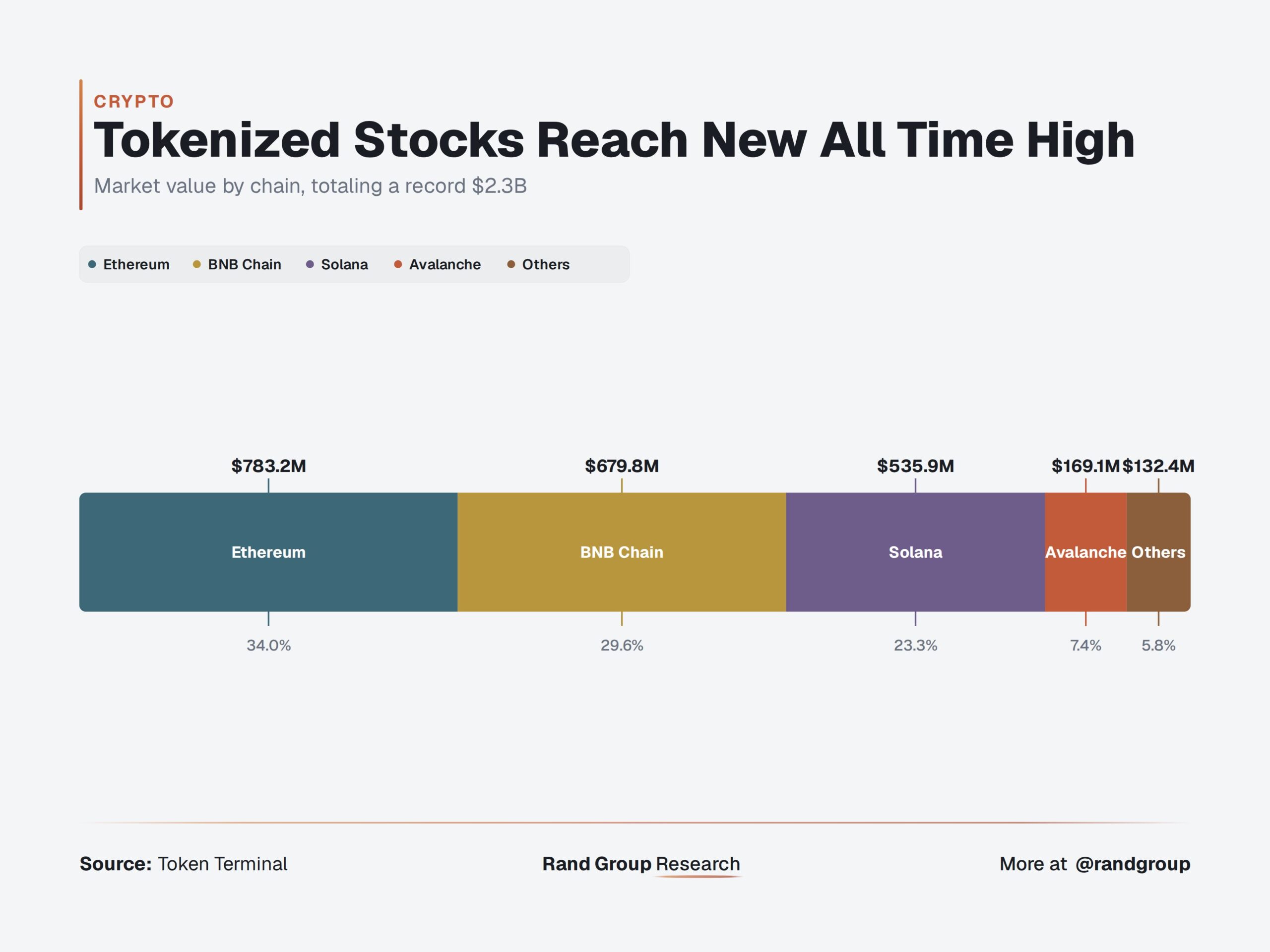
Tokenized stocks have reached a record market value of $2.3 billion, giving the real-world asset sector another sign that traditional finance is moving deeper on-chain. Yet the latest data carries a more important message than the headline figure alone. Ethereum holds the largest share of asset value, while Solana processes most trading activity, showing that custody and execution are starting to split across different networks.
Tokenized stocks expose the limits of TVL
Ethereum hosts about $783.2 million, equal to roughly 34% of the market. BNB Chain follows with $679.8 million, while Solana accounts for $535.9 million. On total value alone, Ethereum appears to lead comfortably. Trading activity tells a different tale, however, because Solana reportedly handles about 95% to 97% of tokenized equity volume.


That gap matters. Total value locked, or TVL, measures how much capital sits inside a blockchain application or network. It does not show how often that capital moves, how easily traders can enter or exit positions, or whether markets have enough depth to absorb larger orders. In simple terms, TVL can show the size of the warehouse, but not how busy the loading dock is.
| Network | Tokenized equity value | Key market signal |
|---|---|---|
| Ethereum | $783.2M | Largest custody base |
| BNB Chain | $679.8M | Strong asset distribution |
| Solana | $535.9M | About 95% to 97% of trading |
Solana turns speed into market utility
The rise of tokenized stocks on Solana highlights the value of quick settlement, low fees and active liquidity. Traders care about execution because even a strong asset can become difficult to use when spreads are wide or transactions are expensive. This is especially important for institutions, where small pricing differences can become costly across large orders.
Solana’s trading share suggests that market participants may store assets on one chain while using another for execution. Traditional finance already works in a similar way. Custody, clearing and trading often involve separate systems, with each chosen for a specific function.
Holder data shows distribution also matters
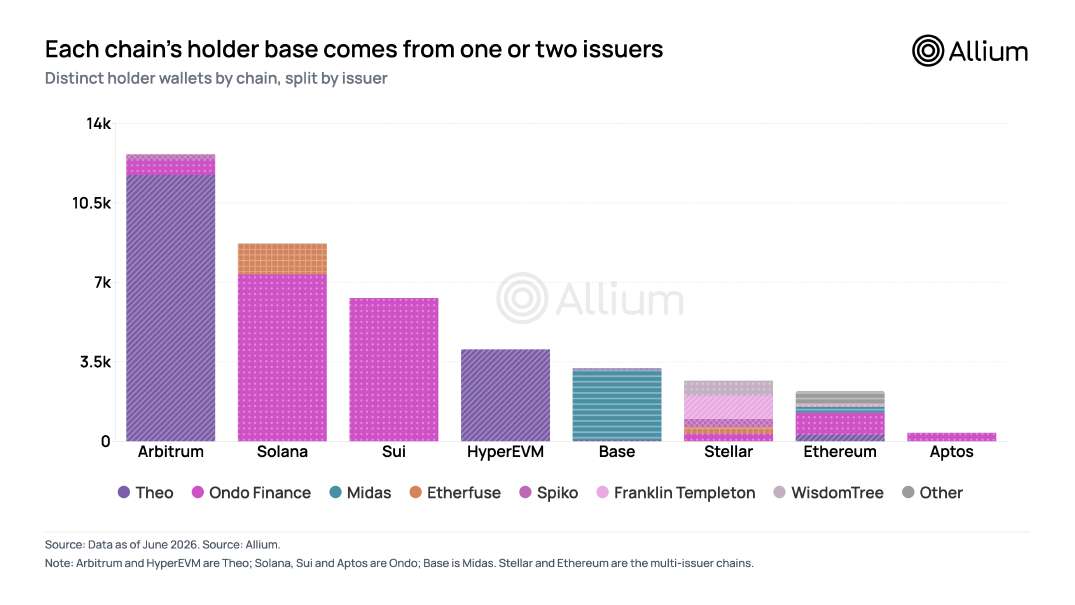
The same pattern appears in tokenized U.S. funds. Arbitrum leads with about 12,500 distinct holder wallets, followed by Solana with nearly 8,200. Sui approaches 6,000, while Ethereum has around 2,000 despite supporting several issuers.
These figures suggest that issuer reach, product access and distribution can matter as much as network size. Tokenized stocks need more than technical infrastructure. They require trusted issuers, clear redemption rules, reliable price feeds and enough buyers and sellers to support regular trading.
Key indicators investors should watch
Market capitalization shows the total value of issued assets, while trading volume measures how much changes hands during a set period. Liquidity reflects how easily an asset can be bought or sold without moving its price sharply. Holder count offers a rough view of adoption, although one investor may control several wallets.
Fee generation can reveal genuine network demand, and transaction count shows activity. Neither should be read alone because automated trading can inflate raw figures. For tokenized stocks, the strongest picture comes from combining value, volume, liquidity, holders and settlement quality.
Conclusion
The $2.3 billion milestone confirms that tokenized stocks are gaining traction, but the network race is no longer decided by TVL alone. Ethereum remains an important custody layer, while Solana has built a powerful lead in execution. As the sector matures, utility will likely carry more weight than passive capital.
Frequently Asked Questions
What are these blockchain-based equities?
They are digital tokens designed to track or represent shares in publicly traded companies.
Why does Solana lead trading?
Its low costs, fast settlement and active markets make frequent transactions easier.
Are these assets the same as shares?
Not always. Their legal rights, backing and redemption terms depend on the issuer and jurisdiction.
Glossary of Key Terms
TVL: The capital deposited within a blockchain network or decentralized application.
Liquidity: The ease of trading an asset without causing a large price movement.
Market capitalization: The total market value of all issued units of an asset.
Settlement: The final transfer of assets and payment after a trade is completed.
Sources