
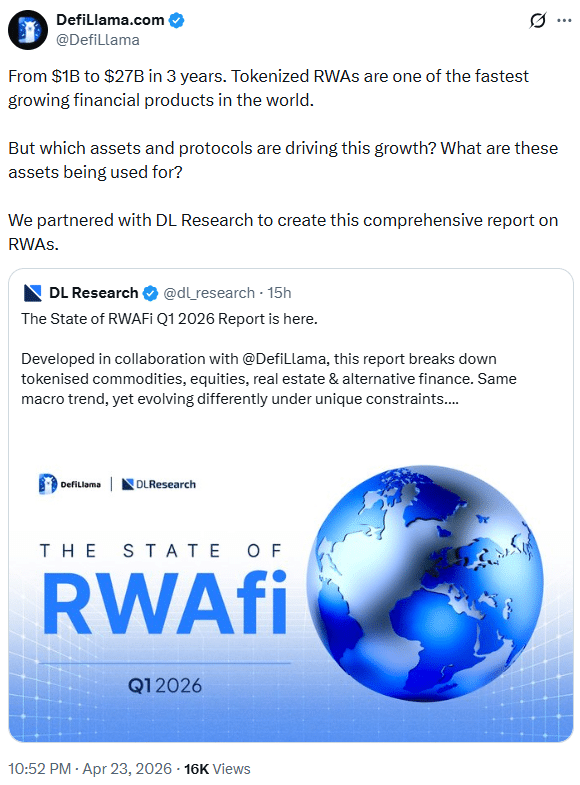
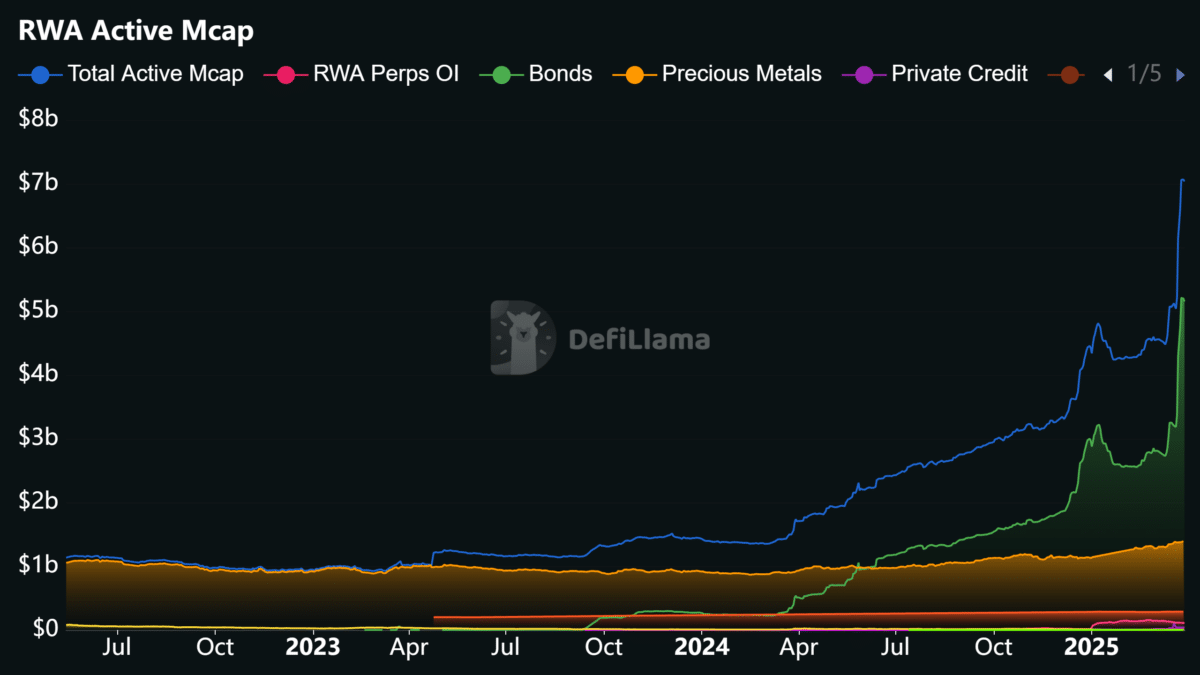
Tokenized RWAs are expanding at a fast pace across the digital asset market. The sector has grown from about $1 billion to $28 billion in three years, based on the data provided. This rise shows stronger interest in blockchain-based versions of traditional financial assets.
The strongest jump came between early 2025 and March 2026. During that period, the active market for real-world assets climbed from about $4.1 billion to $25.2 billion. That marks one of the sharpest growth phases in the sector so far.


Funds and Commodities Lead the Tokenized RWAs Market
The expansion has not been equal across all asset types. Some categories moved quickly, while others remained small. This shows that Tokenized RWAs are developing in separate tracks rather than as one uniform market.
Funds, commodities, private credit, and tokenized equities now make up more than 95 percent of the full sector. These categories have led the rise in value and market activity. Each one has followed a different path based on structure, liquidity, and investor demand.
The broader story is not just about size. It is also about how blockchain is being used to connect with traditional finance. Even with strong growth, Tokenized RWAs still face limits tied to regulation, custody, and off-chain systems.
Tokenized Funds Lead the Sector
Tokenized funds are the largest part of the market today. Their value rose from $2.7 billion to $13.5 billion, based on the material provided. That gives them well over half of the total market capitalization.
This segment has moved ahead because its structure often looks similar to traditional financial products. That makes the tokenization process easier in many cases. It also makes the category easier to understand for institutions and market participants already familiar with conventional investment products.
Commodities Hold the Second Spot
The commodity segment ranks second in market size. It grew from $1.1 billion to $5.9 billion. A large part of that rise came from the tokenization of gold.
Gold has long held a clear role in traditional markets. That may explain why it has translated more easily into blockchain form. As a result, Tokenized RWAs tied to commodities have advanced faster than several other categories.
Private Credit and Equities Expand
Private credit has also recorded major growth. It now stands at about $4.6 billion. Even so, tracking this segment remains difficult because much of the activity sits off-chain.
That creates a visibility issue. On-chain data does not always capture the full picture. Tokenized equities have also grown in the same period. Their value increased from $200 million to $1.2 billion, showing that blockchain-based access to stock market exposure is attracting more interest.
Real Estate Remains a Small Share
Tokenized real estate has grown, but it still represents a small part of the market. The sector rose from tens of millions of dollars to about $300 million. That is progress, but it remains far behind the leading segments.
One reason may be valuation complexity. Real estate does not always fit neatly into on-chain measurement. Not all of its value can be captured through blockchain indicators alone. That may be why Tokenized RWAs in property continue to lag behind other asset classes.
Long-Term Opportunity Stays Large
The long-term potential of the market continues to attract attention. The provided material cites Animoca Research, which said last year that tokenization could unlock major opportunities in finance. Its report estimated the addressable RWA market at about $400 trillion.
The report named private credit, U.S. Treasury bills, commodities, equities, and bonds as key target markets. That estimate has helped support the view that Tokenized RWAs could become a major link between traditional finance and blockchain infrastructure. Still, this remains a forward-looking view rather than current market size.
DeFi Use Remains Low
Despite the growth in valuation, DeFi usage is still limited. Out of a total tokenized asset market capitalization of $28.6 billion, only $2.81 billion is being used in DeFi applications. That is a small share of the broader market.
This gap is important. It shows that issuance and valuation are rising faster than real usage inside decentralized finance. Tokenized RWAs may exist on-chain, but their role in lending, borrowing, and yield strategies remains restricted.
Off-Chain Dependence Shapes the Market
The sector still depends heavily on off-chain systems. These include custody providers, legal frameworks, and regulatory structures. Because of this, tokens do not always represent direct ownership of an asset. In some cases, they only represent a claim tied to an outside arrangement.
That adds another layer of complexity. It can make validation harder and interoperability less smooth across chains and platforms. Liquidity also differs widely between asset types. Some are easier to trade, while others remain split across issuers, chains, and exchanges.
Regulation and Fragmentation Add Limits
Regulation continues to influence how the sector develops. This is especially true in lending and yield farming. Rules can limit how tokenized assets are used, even when market demand exists.
Fragmentation is another issue. Markets are not fully unified across platforms. That means Tokenized RWAs can vary in access, depth, and utility depending on the issuer and blockchain involved. These conditions keep the market from acting like one simple asset class.
Conclusion
Tokenized assets have posted strong growth, but the sector is still uneven. Funds, commodities, private credit, and equities are driving most of the expansion. Real estate remains much smaller and follows a different pace.
The main takeaway is clear. Tokenized RWAs are not evolving as one single market. They are growing as separate asset groups with different structures, liquidity levels, and legal requirements. That distinction will remain important as the sector continues to expand.
Appendix Glossary of Key Terms
Real-world assets: Traditional assets represented on blockchain networks
Tokenized funds: Investment funds issued in token form
Commodities: Physical assets like gold brought onto blockchain
Private credit: Off-chain lending assets tracked through token structures
Tokenized equities: Blockchain-based exposure to stock market assets
DeFi: Decentralized finance applications built on blockchain
Frequently Asked Questions (FAQ)
1- What are Tokenized RWAs?
Tokenized RWAs are blockchain-based versions of real-world assets such as funds, commodities, private credit, equities, and real estate.
2- How much has the market grown?
The sector has grown from about $1 billion to $28 billion in three years, based on the provided material.
3- Which segment is the largest?
Tokenized funds are the largest segment, rising from $2.7 billion to $13.5 billion.
4- Which category ranks second?
Commodities rank second, growing from $1.1 billion to $5.9 billion, with gold helping drive that rise.
Reference