Breaking the Chains of Traditional Banking: What Does DeFi Really Mean?
In a world still dominated by banks, intermediaries, and bureaucracy, decentralized finance, or DeFi, is quietly changing the rules. The core notion is simple but radical: eliminate the gatekeepers. DeFi, based on blockchain technology, enables users to borrow, lend, trade, and earn interest without relying on centralized institutions.


But what is DeFi, exactly? At its core, it is a network of financial apps that run on public blockchains such as Ethereum and are available to anybody with an internet connection and a cryptocurrency wallet.
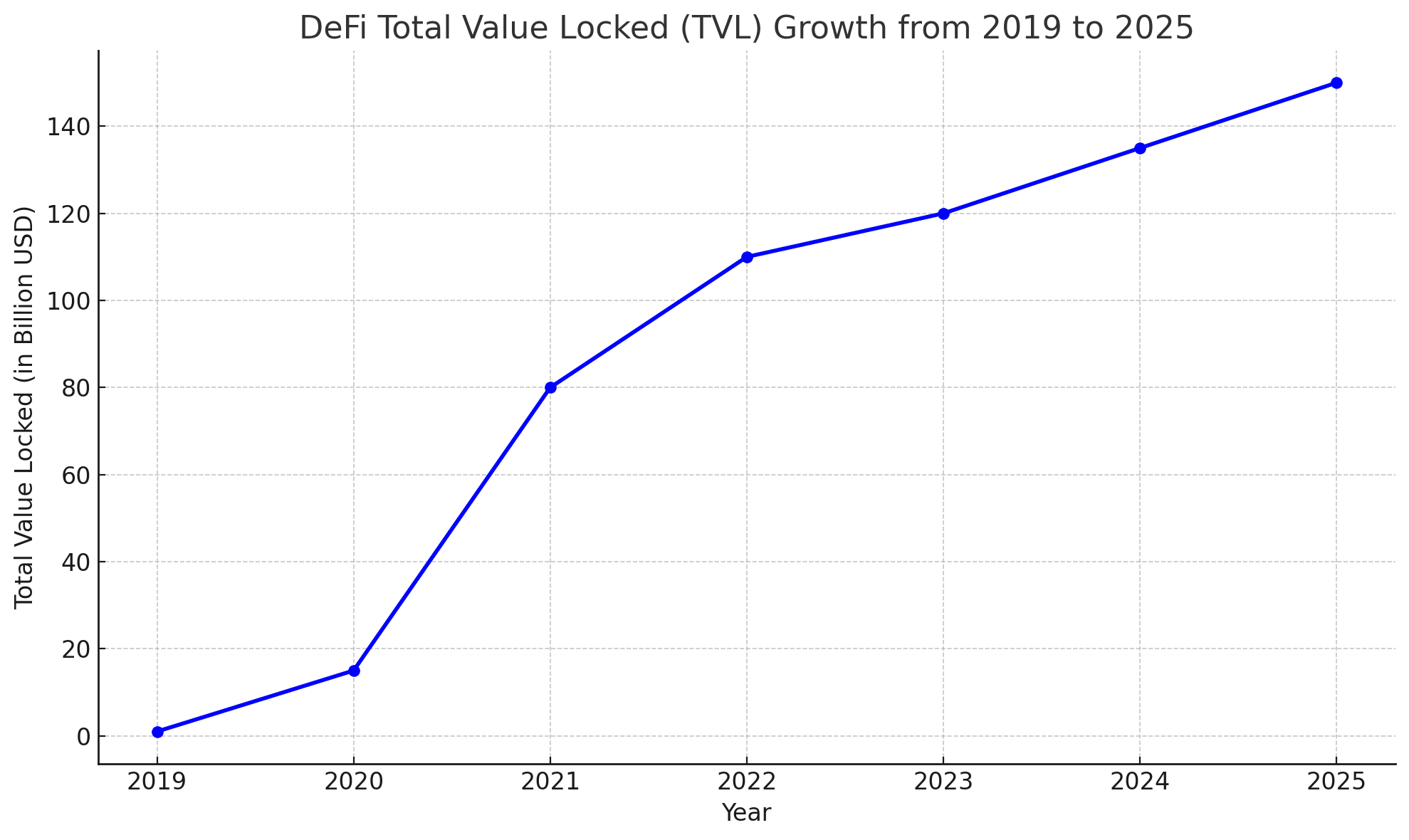
According to a ConsenSys research, DeFi’s Total Value Locked (TVL) increased from less than $1 billion in 2019 to more than $100 billion by 2025. The rapid speed of innovation, along with increased user interest, indicates a move from speculative buzz to mainstream momentum.
Behind the Curtain: How Decentralized Finance Really Works
DeFi’s design is based on smart contracts, which are self-executing programs programmed directly onto blockchains. These contracts eliminate the need for manual supervision while ensuring openness.
For example, instead of requesting for a bank loan, a user may put cryptocurrency as collateral into a DeFi protocol and receive stablecoins in exchange, with the smart contract managing everything.
This automation decreases human mistake, eliminates paperwork, and significantly saves expenses. It also opens up new financial opportunities, such as yield farming, decentralized exchanges (DEXs), and liquidity pools. Platforms like as Aave and Compound, while not included here as suggestions, demonstrate how crypto lending and borrowing are evolving in real time.
Why Crypto Lending Has Caught Fire.
Crypto lending is one of DeFi’s most popular and talked applications. It allows users to earn interest on their digital assets and borrow against them without a credit check. In conventional finance, lenders require a borrower’s identification and financial history. DeFi challenges that paradigm.
DeFi Pulse estimates that major lending procedures will have over $30 billion in locked value by mid-2025. The appeal is strong: high interest rates, 24-hour access, and no gatekeepers. However, it has dangers such as smart contract bugs and collateral liquidation if asset prices fall. Nonetheless, the efficiency and openness of crypto loans are altering money flows in the digital era.


A Global Revolution: The Rise of DeFi in Turkey
Turkey has emerged as an odd yet important hub for DeFi adoption. In the midst of economic turmoil and currency depreciation, Turkish consumers have resorted to decentralized banking to preserve their savings and gain access to dollar-pegged stablecoins. According to Chainalysis, Turkey will be one of the top nations for cryptocurrency transaction volume in 2024 and 2025.
In Turkey, DeFi is no longer considered fringe. Developers are creating local dApps, while educators are teaching consumers how to negotiate DeFi protocols.
From Istanbul’s tech meetups to national Telegram groups, DeFi is seen as more than just innovation. As the Turkish currency fluctuates, blockchain-based financial solutions provide an alternate source of financial stability.
Key Indicators for DeFi’s Global Growth
Analysts examine crucial data to better understand DeFi’s direction. One of the most often mentioned is Total Value Locked (TVL), which will exceed $150 billion in 2025 across Ethereum, Solana, and Layer 2 platforms. TVL indicates the entire capital invested in DeFi protocols and serves as a measure of trust and activity.
Another measure is the number of active wallet addresses. According to Dune Analytics, the number of unique DeFi wallet users reached 10 million this year.
Additionally, development activity has increased. According to Electric Capital’s Developer Report, the number of full-time developers in DeFi climbed by 30% year on year, indicating more ecosystem maturity.
The Other Side of the Coin: Risks and Regulation
DeFi, like every innovative technology, is not without danger. Smart contract flaws have resulted in high-profile exploitation and millions in lost assets. Oracle manipulation, flash loan assaults, and rug pulls are all chronic risks. These technical hazards are combined with regulatory ambiguity.
In the United States, institutions such as the Securities and Exchange Commission and the Commodity Futures Trading Commission are considering how DeFi fits into existing regulatory frameworks.
In Europe, MiCA provides a clearer path for digital assets; however, decentralized initiatives frequently struggle to comply owing to their lack of leadership. Despite this, regulators throughout the world recognize that DeFi has progressed beyond its Wild West period and is now pursuing responsible innovations.
What Analysts and Communities are Saying
DeFi’s ascent is being felt across social media, particularly on sites like as X and Reddit. Analysts applaud the technology’s capacity to democratize finance, while skeptics warn about unsustainable tokenomics and hype-driven ventures. Solana’s involvement in DeFi is also getting traction.
Solana Compass data shows that transaction finality on the chain has significantly improved, making it a suitable basis layer for speedy DeFi applications.
In developer circles, discussions are increasingly centered on multi-chain interoperability, with projects integrating Ethereum, Arbitrum, and Solana to attract users. The future of DeFi looks to be multi-chain and hyper-optimized, rather than just decentralized.
Conclusion: Decentralized Finance is no longer a niche
DeFi has expanded from an experiment into a movement. It enables people to interact with financial institutions in ways that were inconceivable a decade ago. For rising markets such as Turkey, it signifies financial stability. For the global economy, it represents large-scale decentralization.
As usage grows, DeFi will continue to push traditional finance to be more open, accessible, and efficient. Decentralized finance, whether through loan, trading, or saving, is changing not just our perception of money, but also who gets to use it.
“This article is intended for informative purposes only and does not provide financial advice. Readers should do their own research before making any investing decisions.
Frequently Asked Questions (FAQs)
1. What is DeFi and how does it work? DeFi stands for decentralized finance. It uses blockchain and smart contracts to let people use financial services without banks.
2. Is DeFi safe to use? DeFi is transparent and code-based, but not risk-free. Smart contract bugs and market volatility can cause losses.
3. Why is DeFi growing in Turkey? Due to inflation and currency instability, Turkish citizens are adopting DeFi to access stable assets and global financial tools.
4. Can I earn interest with DeFi? Yes, users can earn interest through crypto lending or by providing liquidity to decentralized exchanges.
Glossary of Key Terms
DeFi (Decentralized Finance): Financial services built on public blockchains, without intermediaries.
Smart Contracts: Code-based contracts that self-execute when conditions are met.
TVL (Total Value Locked): The value of assets committed to DeFi protocols.
Crypto Lending: A DeFi function allowing users to lend or borrow crypto without traditional banks.
Yield Farming: Strategy of earning interest by providing liquidity to DeFi platforms.
DEX (Decentralized Exchange): A trading platform that operates without a central authority.