![Sun [New]](https://s2.coinmarketcap.com/static/img/coins/64x64/10529.png)


This article was first published on TurkishNY Radio.
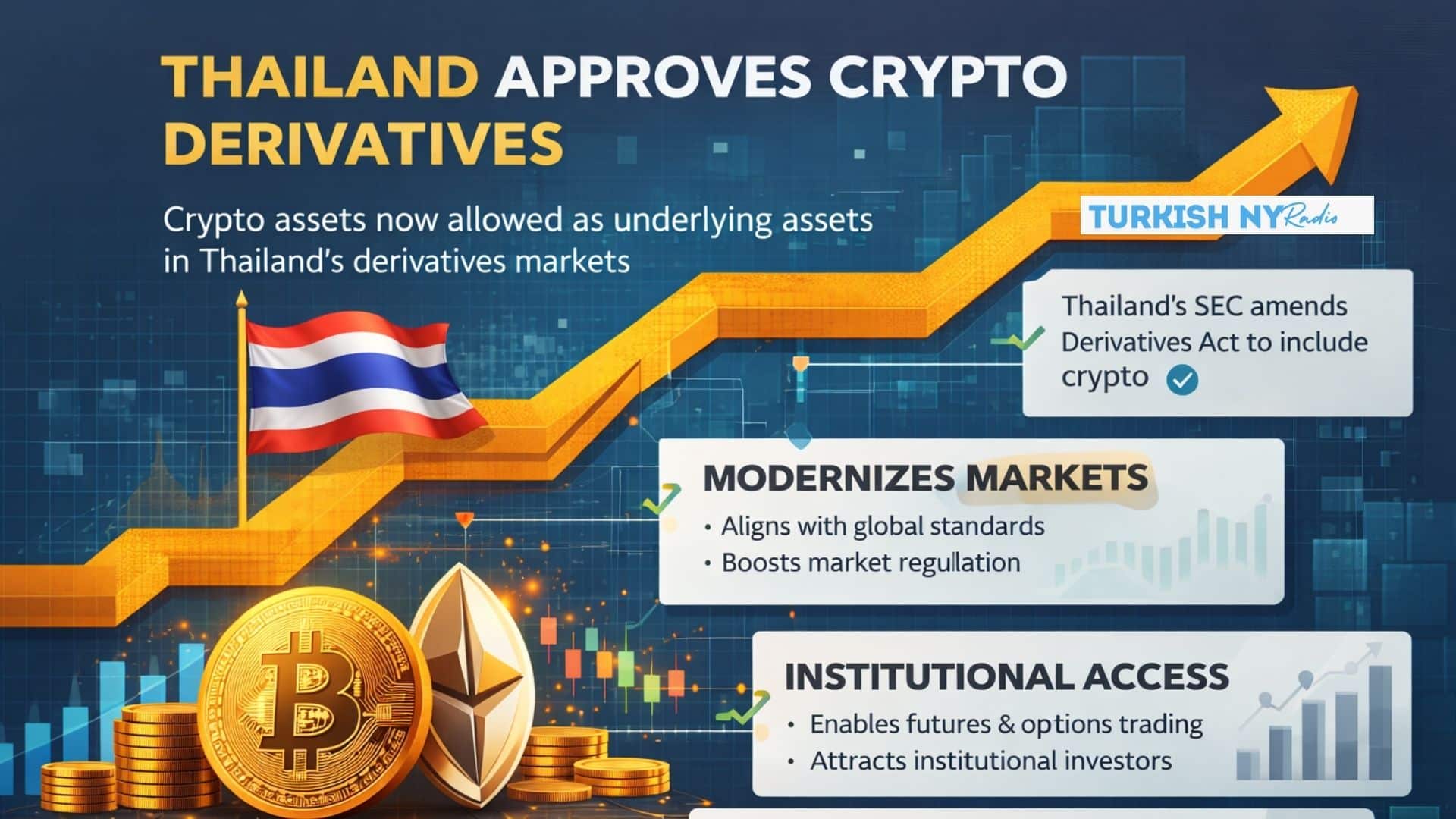
Thailand has formally allowed cryptocurrencies as underlying property in its regulated markets for derivatives, signaling a significant shift in financial policy. The decision improves the nation’s standing as an important center for digital assets while also providing financial institutions with additional risk-management capabilities.


Thailand Crypto Derivatives was approved after the Ministry of Financial Affairs supported modifications to the Derivatives Act that would enable virtual currencies like Bitcoin to be used as reference materials in contract and option transactions. The change is meant to improve financial markets while protecting investors.
Thailand Aims to Improve its Financial System
Under the updated framework, the Securities and Exchange Commission (SEC) of Thailand will oversee crypto-linked derivatives products. This means regulated exchanges will be able to list contracts tied to digital assets under strict compliance rules.
The development of Thailand Crypto Derivatives is designed to align the country with global financial centers that already permit crypto-based financial instruments. Officials say the goal is not speculation, but structured growth under supervision.
A Finance Ministry representative said the reform aims to “enhance Thailand’s capital market competitiveness while ensuring appropriate investor protection.”
By recognizing digital assets as permissible underlying variables, Thailand is integrating crypto into its formal financial infrastructure rather than leaving it in loosely regulated spaces.
Institutional Access and Market Liquidity
Thailand Crypto Derivatives may attract financial institutions looking for hedging tools. Options and futures contracts enable market participants manage price volatility, a key issue in bitcoin markets.
Market observers believe that this move would increase the quantity of trade and volatility on Thai equities. With proper oversight, derivatives markets may reduce extreme price swings by enabling structured risk management.
An analyst at a Bangkok-based brokerage noted, “The approval of Thailand Crypto Derivatives gives institutions confidence. It signals regulatory maturity.”
However, authorities made clear that while investment products are expanding, crypto remains restricted for everyday retail payments. The Bank of Thailand continues to prohibit digital assets as a means of payment.
Strengthening Regulatory Clarity
The expansion of Thailand Crypto Derivatives reflects a broader trend toward clearer digital asset regulation. Instead of banning innovation, regulators are choosing to define rules and compliance standards.
This move places Thailand alongside other Asian financial hubs experimenting with structured crypto markets. Observers say clarity reduces uncertainty for investors and companies alike.
Legal experts believe the updated Derivatives Act will create better transparency and reduce unregulated offshore exposure among Thai traders.
“The framework around Thailand Crypto Derivatives is about oversight, not deregulation,” a regulatory consultant explained.
What This Means for the Region
The approval of Thailand Crypto Derivatives could influence neighboring markets in Southeast Asia. As regional competition intensifies, countries are looking to attract fintech capital and blockchain innovation.
Thailand’s balanced approach, expanding investment products while limiting retail payment risks, may serve as a regulatory model.
Before the full-scale implementation, business players expect the SEC to provide more advice on qualifying digital assets, their trading limitations, and regulations.
For the time being, the information is unambiguous: Thailand is welcoming, not opposing, controlled cryptocurrency financing.
Conclusion
The legal acceptance of Thailand Crypto Derivatives is a watershed point in the country’s financial history. Thailand’s acceptance of virtual currencies as underlying products in authorized trading of derivatives demonstrates belief in organized crypto development.
The reform expands institutional engagement, strengthens market tools, and increases regulatory openness. While retail cryptocurrency payments are still restricted, the investing environment is fast-growing. Thailand is no longer simply monitoring global cryptocurrency trends; it is actively driving them.
Summary
Thailand has authorized cryptocurrency as an underlying asset in legal derivatives markets, establishing an overview for Thailand Crypto Derivatives within SEC monitoring. The change simplifies the capital sectors, attracts large investors, and improves administrative clarity. While cryptocurrency payments remain prohibited, the change establishes Thailand as a prominent virtual currency center in Southeast Asia. Analysts perceive an option as a balanced strategy that promotes innovation while protecting investors.
Glossary of Key Terms
Derivatives: Are monetary agreements whose value is reliant on a base asset.
Underlying Asset: The monetary item that determines the value of a derivative is known as the asset that underlies it.
Futures Contract: Is a commitment to acquire or sell a commodity at a certain price upon a date in the future.


Options Contract: A contract that grants the ability, but not the duty, to acquire or sell a piece of property.
SEC (Securities and Exchange Commission): Is Thailand’s financial sector authority.
Liquidity: Refers to how easily an asset may be purchased or traded without impacting its price.
FAQs for Thailand Crypto Derivatives
1. Which of the following are Thailand Crypto Derivatives?
They include Thai-regulated financial agreements with cryptocurrency as the fundamental asset.
2. Who controls cryptocurrency derivatives in Thailand?
Thailand’s regulator, the Securities and Exchange Commission, controls the financial sector.
3. Can cryptocurrency be used towards payment in Thailand?
No, the system will the central bank continues to limit cryptocurrency for ordinary purchases.
4. Why in the world are derivatives significant in crypto financial markets?
They offer hedging solutions and can assist in controlling price swings.
5. Would this entice institutional capitalists?
Yes, experts anticipate that regulatory certainty and arranged goods will increase institutional engagement.