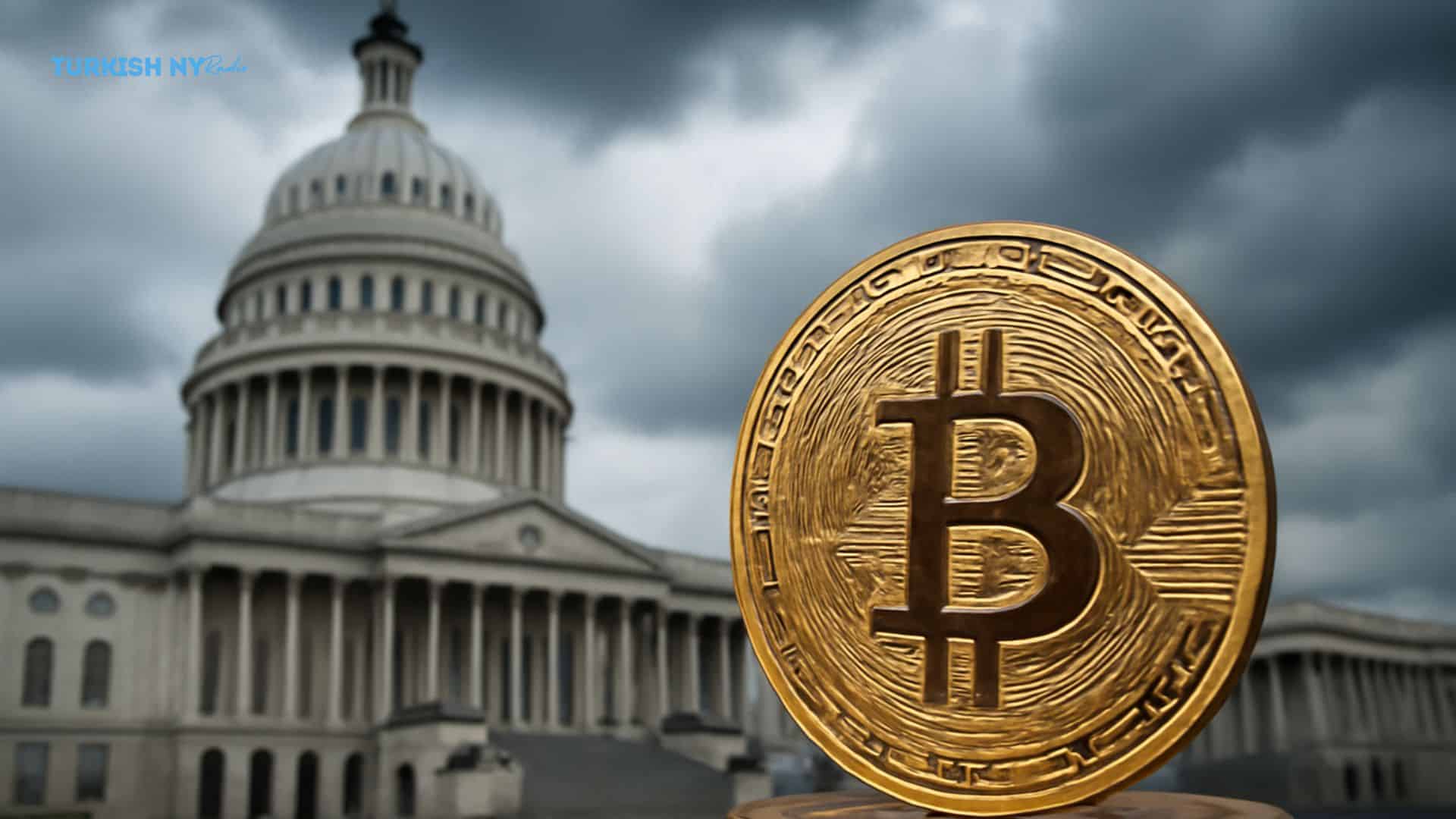
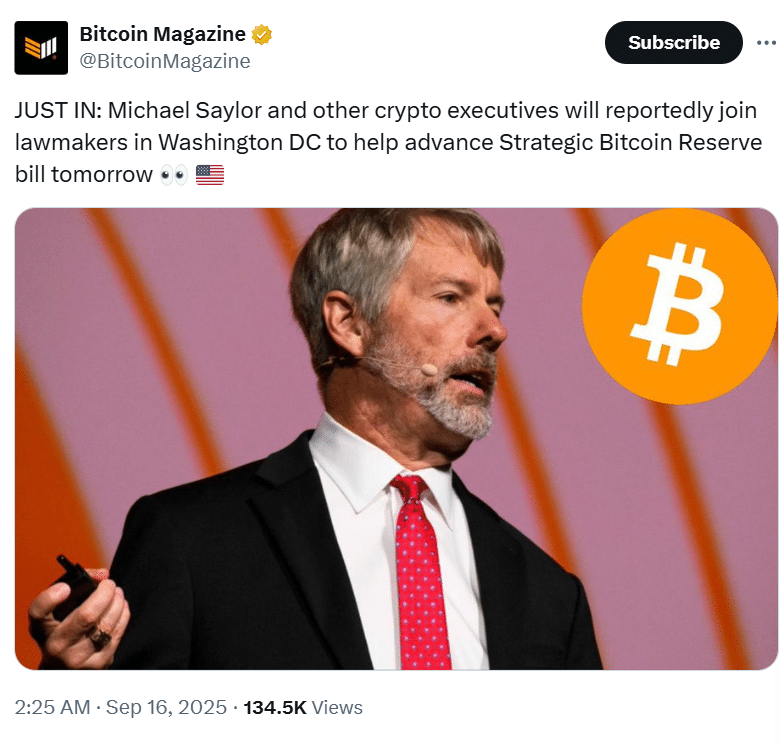
The push for a Strategic Bitcoin Reserve in the United States is gaining momentum. On Tuesday, Michael Saylor, Fred Thiel, and Charles Hoskinson will join a group of advocates on Capitol Hill to support the Bitcoin Act.
This bill aims to designate Bitcoin as a strategic reserve asset for the U.S., similar to how gold is treated. The bill could change the future of U.S. financial policy and Bitcoin’s role in it.


Strategic Bitcoin Reserve Bill
The Bitcoin Act is attracting the interest of legislators and business notables. The legislation is presented by Sen. Cynthia Lummis and Rep. Nick Begich, who are both Republicans. The U.S. government would then be directed to collect one million BTC in five years under its “Bitcoin for Billions” program.
The idea is to use Bitcoin as a strategic reserve asset in the same way that the U.S. holds its gold reserves. This might lend long-term stability to the nation’s financial system.
Also Read: El Salvador to Host Bitcoin Conference 2025: World’s First Government-Backed Crypto Event
The proposal would allow Bitcoin to be acquired with “budget-neutral strategies.” The goal is to establish a permanent digital reserve that strengthens the U.S. economy.
What the Strategic Bitcoin Reserve Means for the U.S.
The Strategic Bitcoin Reserve would reshape the financial system. Bitcoin would cease to be merely an asset used by individuals and companies and would become a cornerstone of national policy.
If the bill succeeds, Bitcoin will be hoarded in a manner that imbues endless financial fundamentals. That would include not just Bitcoin seized from property but also BTC bought anew under the government’s concerted strategy.
The concept here is to improve the underlying U.S. financial position by holding Bitcoin in reserves. Just as the United States holds gold reserves, Bitcoin may become part of a new monetary foundation. This shift represents a dawning realization that Bitcoin’s value to investors is about more than just speculation.
Industry Leaders Backing the Strategic Bitcoin Reserve
Michael Saylor, the co-founder of Strategy, is one of the major advocates for the Strategic Bitcoin Reserve. He believes that Bitcoin could play a key role in stabilizing the economy. Saylor has long argued that Bitcoin is a superior store of value compared to traditional assets.
Charles Hoskinson, founder of Cardano, also confirmed his participation in the roundtable discussions. He sees the Strategic Bitcoin Reserve as a critical step for the United States to maintain its financial leadership.
How the Bill Could Benefit the U.S.
The Strategic Bitcoin Reserve’s major advantage is its ability to bolster U.S. national security. Bitcoin is decentralized, preventing traditional government controls on it.
A reserve holding of Bitcoin could be a safe haven during future economic volatility and inflation that the United States should consider. It would also be an added bulwark against potential digital threats to the financial system.
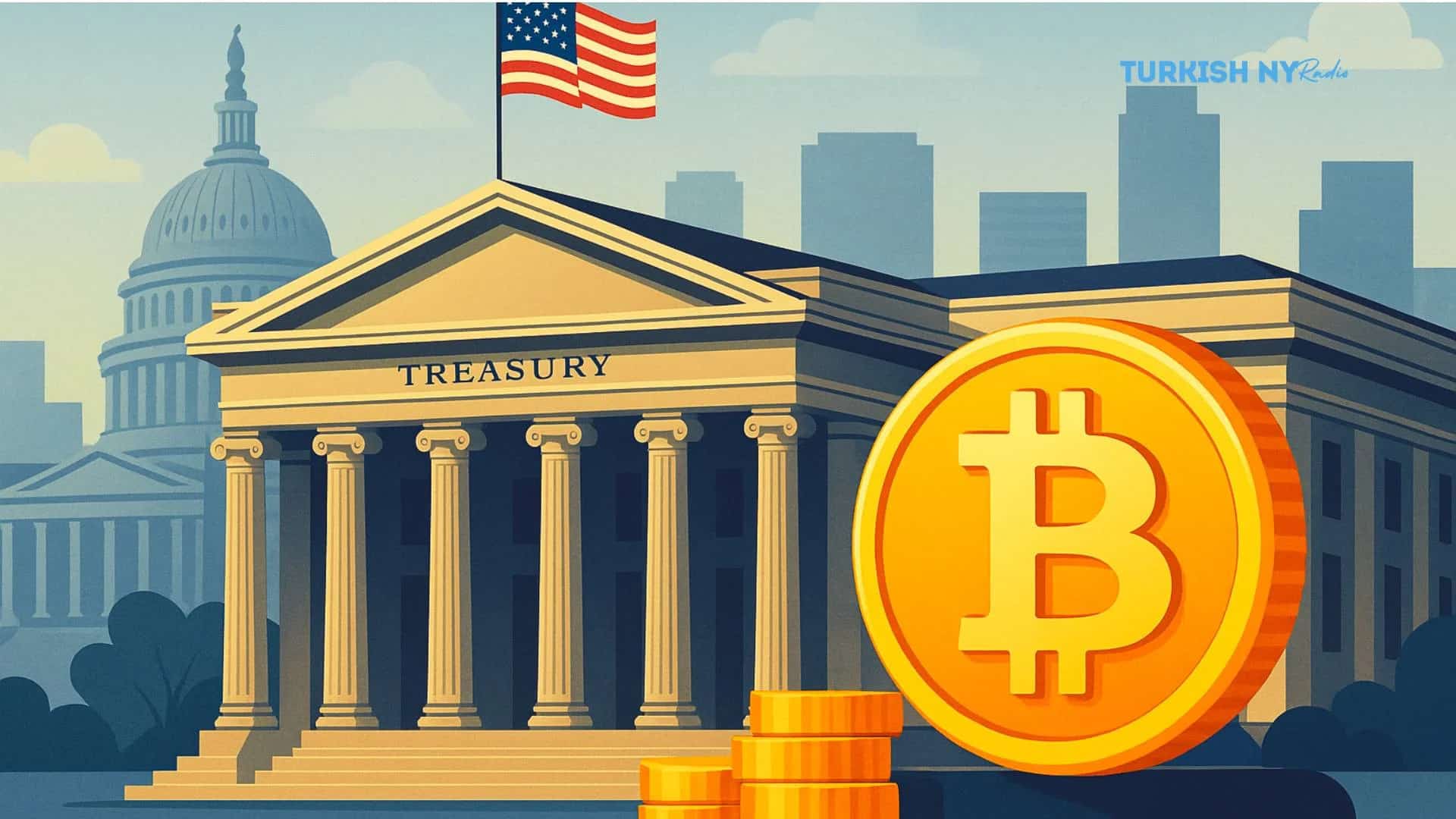
Additionally, supporters argue that Bitcoin could help the U.S. remain competitive in a rapidly evolving global economy. By embracing Bitcoin as a reserve asset, the U.S. would signal to the world that it is ready to lead in the digital financial era.
The Growing Support for the Bitcoin Act
So far, the Bitcoin Act has primarily garnered support from Republican lawmakers. However, there is hope that the bill will gain bipartisan support in the future.
The Digital Power Network (DPN), a key player in promoting the bill, is working to make the Strategic Bitcoin Reserve a unifying issue. DPN views it as a way for both political parties to come together to strengthen U.S. economic policy.
Challenges for the Bitcoin Act
The Bitcoin Act still has a few hurdles to clear, even with growing support. For one thing, it would require hearings in the House Financial Services Committee and the Senate Banking Committee.


The absence of Democratic support could also act as a brake. That said, the approval of a stablecoin regulation bill earlier this year demonstrates that the government is warming up to digital assets.
Bitcoin’s Role in the Future of U.S. Financial Policy
The Strategic Bitcoin Reserve is a big new step for the U.S. financial system. It may become a model that can be adopted by other countries.
Bitcoin would no longer be merely an asset for individual speculators, but a key part of any national policy. That would be a radical change in how governments think about digital currencies.
Conclusion
The Smart Bitcoin Reserve proposal could change the U.S. banking scene here forever. It’s a chance to offer more than a financial Band-Aid, concentrating instead on the future of healthy economic stability and national security.
If passed, it would lay the groundwork for Bitcoin to be incorporated into U.S. policy. The momentum from some of the most important industry leaders and politicians shows that the Bitcoin Act may be a turning point for Bitcoin as a financial resource.
Also Read: Why Bitcoin price prediction depends on US economic signals this week
Summary
The Strategic Bitcoin Reserve advocates for making Bitcoin a reserve asset for the United States, akin to gold. With support from industry heavyweights, including Michael Saylor and Charles Hoskinson, the Bitcoin Act would buy bitcoin over five years to strengthen national security and maintain financial stability.
The bill is strongly supported by Republicans, but other hurdles must be cleared before it would become law; for example, bipartisan backing and formal committee hearings. If passed, that could have major implications for U.S. financial policy — and Bitcoin’s place within it.
Appendix – Glossary of Key Terms:
Strategic Bitcoin Reserve – A proposal to designate Bitcoin as a reserve asset for the United States, similar to gold reserves.
Bitcoin Act – The proposed bill for integrating Bitcoin as a strategic reserve asset for U.S. economic and national security.
BTC (Bitcoin) – The first decentralized digital currency, designed as a store of value and an alternative to traditional currencies.
Budget-Neutral Strategy – A method of acquiring Bitcoin without increasing the federal budget or taxpayer burden.
Digital Power Network (DPN) – A network that advocates for the strategic integration of digital assets into U.S. policy.
National Reserve Asset – An asset held by the government to provide financial security, akin to gold or foreign currency reserves.
FAQs for Strategic Bitcoin Reserve
1- What is the Strategic Bitcoin Reserve?
The Strategic Bitcoin Reserve aims to position Bitcoin as a reserve asset for the U.S., similar to gold.
2- Who supports the Strategic Bitcoin Reserve Bill?
Michael Saylor, Fred Thiel, Charles Hoskinson, and other industry leaders are advocating for the bill.
3- How will Bitcoin be accumulated for the reserve?
The U.S. government plans to acquire Bitcoin over five years using budget-neutral strategies.
4- What does the Bitcoin Act propose?
The Bitcoin Act proposes to designate Bitcoin as a national reserve asset for long-term financial stability.