
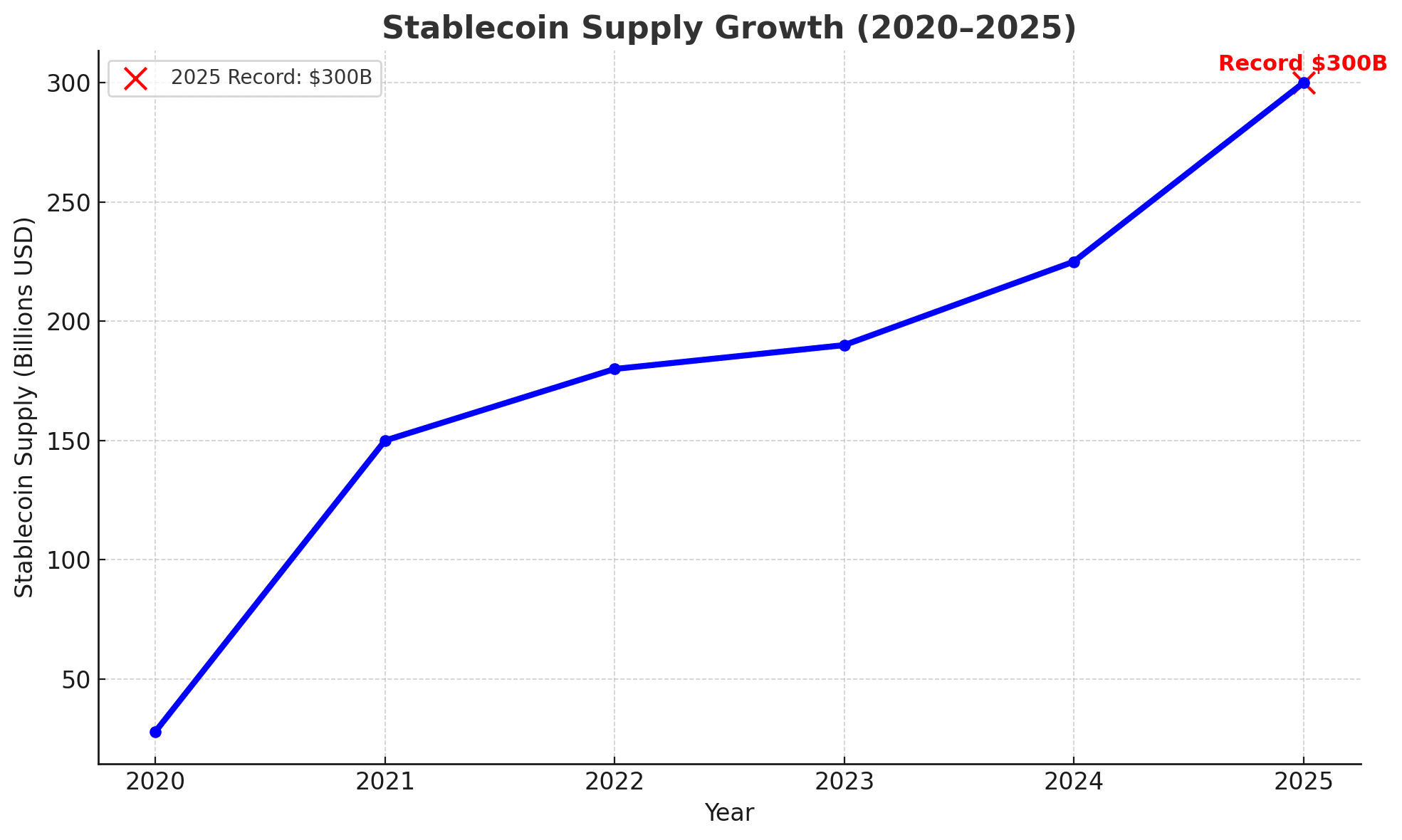
The stablecoin supply has crossed the $300 billion mark for the first time, signaling that these digital assets are no longer niche instruments but central pillars of modern finance.
What was once considered a convenient tool for traders has matured into a system rivaling money market funds and regional banks in scale.


This development reflects more than numbers on a chart. It shows how the stablecoin supply has become the backbone of liquidity in crypto markets and a bridge for capital flowing between traditional finance and decentralized ecosystems. In simple terms, stablecoins are now critical financial plumbing.
Institutional Appetite Drives Stablecoin Supply
The record high in stablecoin supply is driven largely by institutional adoption and a rise in use cases beyond speculative trading. Stablecoins are increasingly employed by funds, payment processors, and even multinational corporations.
Their ability to provide instant settlement and dollar exposure without relying on legacy banking rails has made them indispensable.
Tether and USDC continue to dominate, but newer entrants are finding their place. Data shows that inflows have been steady, not just from crypto-native platforms but also from financial institutions testing blockchain integrations. As one analyst posted on X, “Stablecoins are no longer just a crypto story, they’re becoming a macro story.”
Regulation, Legitimacy, and the Policy Angle
The rise in stablecoin supply is also closely tied to regulatory shifts. Lawmakers across the United States and Europe are introducing frameworks aimed at legitimizing and supervising stablecoin issuers. By treating them more like regulated money market funds, governments hope to balance innovation with investor safety.
Donald Trump Jr. recently commented, “Stablecoins will preserve U.S. dollar dominance,” pointing to how dollar-backed tokens extend the greenback’s reach in the digital age.
This view underscores how geopolitical implications are becoming part of the conversation. A growing stablecoin supply doesn’t just affect traders; it affects global currency competition.
Technology and Payments: Visa Steps In
Major payment players are also entering the stablecoin arena. Visa recently expanded its experiments with blockchain-based payments, integrating stablecoins into settlement flows.
This marks another step toward mainstream adoption and shows how the stablecoin supply is fueling real-world financial services.
With transaction costs lower and processing speeds faster than traditional systems, payment companies see stablecoins as tools to modernize outdated infrastructure. This shift also feeds back into crypto liquidity, keeping the supply relevant across multiple industries.
Tether, Funding Rounds, and Market Dynamics
Adding to the momentum, reports suggest that major global investors like SoftBank and Ark are in talks to take a stake in Tether, the largest issuer of stablecoins. If confirmed, such deals would represent not only financial backing but also a signal of confidence from the traditional investment world.
The stablecoin supply milestone coincides with this news, reminding the market that stablecoins are both a high-growth sector and a battleground for dominance among issuers. The combination of institutional capital, regulatory clarity, and user demand is driving supply to unprecedented levels.
Conclusion
Crossing $300 billion in stablecoin supply is more than just a headline. It’s proof that stablecoins have cemented their role as digital dollars, powering both crypto markets and traditional finance integrations.
The journey from being trading tools to becoming systemic instruments shows just how quickly digital finance is evolving.
With regulators sharpening their frameworks, investors pouring in, and payments giants adopting the technology, stablecoins are not just here to stay, they are shaping the next era of global finance.
Frequently Asked Questions
Q: What does it mean that stablecoin supply hit $300 billion?
It means the total value of issued stablecoins in circulation has surpassed that mark, showing record adoption and demand.
Q: Which stablecoins dominate the market?
Tether (USDT) and USDC make up the majority of the stablecoin supply, though new entrants are growing.
Q: Why are institutions interested in stablecoins?
They offer instant settlement, dollar exposure, and efficient cross-border payments, making them useful for both crypto and traditional finance.
Glossary of Key Terms
Stablecoin: A cryptocurrency pegged to a stable asset, like the U.S. dollar, to reduce volatility.
Liquidity: The ease with which assets can be traded without impacting price significantly.


Settlement: The process of completing a financial transaction, where assets and payments are exchanged.
Regulatory Framework: Laws and rules that govern financial products, including digital assets.
Institutional Adoption: The involvement of large organizations, banks, and funds in crypto markets.