
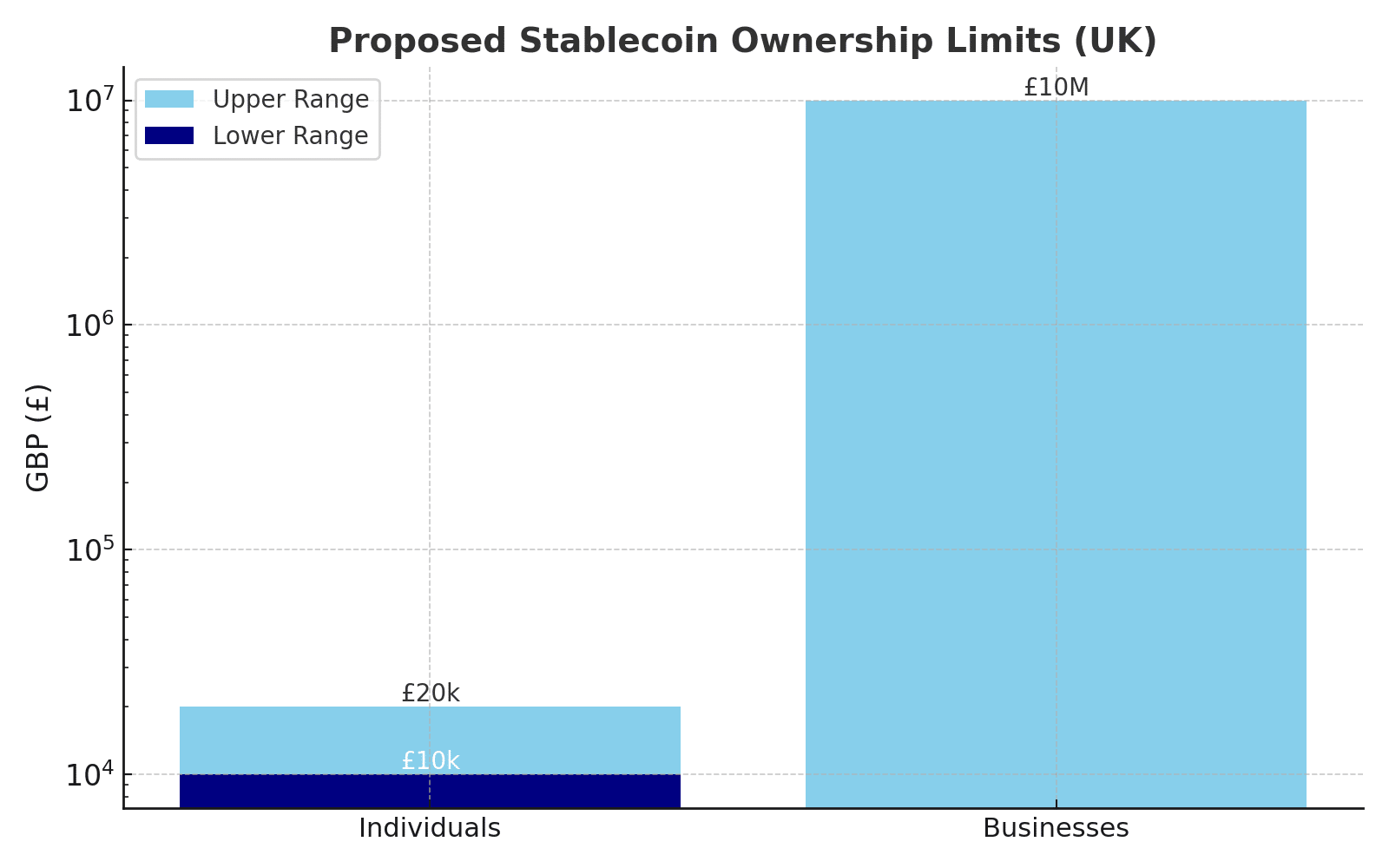
The Bank of England has set off a storm in the crypto world with its latest idea: capping how much stablecoin people and businesses can own. For individuals, the proposed ceiling would be between £10,000 and £20,000, while companies would be limited to around £10 million.
Officials say the move is about protecting the banking system. The industry says it’s a step backward. The fight over stablecoin regulation UK shows just how tricky it is to balance financial safety with innovation.


Why the Bank Wants Caps
The Bank’s argument is straightforward. If too much money flows out of bank deposits and into stablecoins, the system could become unstable. By putting limits on ownership, the Bank hopes to stop shocks to credit markets and prevent payment systems from scaling too quickly without safeguards.
Regulators stress these rules wouldn’t necessarily last forever. They call them “transitional measures” meant to ease the market into a safer structure. As one central bank spokesperson explained, “We want stability first. Innovation comes after we know the system is safe.”
Pushback from the Industry
Crypto groups aren’t buying it. To them, the plan is unworkable and tone-deaf. Stablecoins trade globally, and wallets are often pseudonymous. That makes enforcing hard limits nearly impossible. Businesses say the rule would be costly, confusing, and would push users toward friendlier jurisdictions.
A fintech CEO wrote on X, “Caps like this don’t solve risk. They just send growth overseas.” The criticism isn’t just about practicality. Many argue that stablecoin regulation UK should focus on clear rules for issuers and reserves, not ownership caps that may discourage adoption.
Why This Matters for Crypto Markets
Stablecoins are more than just tokens, they’re the glue of the digital economy. Traders rely on them for liquidity, cross-border payments, and access to decentralized finance. If the UK enforces strict caps, liquidity could dry up, making markets choppier and trading riskier.
For Bitcoin and Ethereum, the impact could be direct. Key crypto indicators, support and resistance levels, trading volume, and market depth, depend heavily on stablecoin flows. When stablecoin supply tightens, volatility rises. In that sense, the stablecoin regulation UK proposal doesn’t just target payments. It strikes at the heart of crypto’s daily operations.
A Question of Global Competitiveness
The UK has been vocal about wanting to become a leader in digital assets. But heavy restrictions risk making the opposite true. Other regions, like the US and EU, are moving toward clearer, more practical frameworks. If the UK goes too far, it could lose fintech startups, payment providers, and crypto innovators to rivals.
A payments association director said it best: “Markets reward clarity, not caps. The UK risks trading leadership for control.” The debate over stablecoin regulation UK is now as much about national competitiveness as it is about financial safety.
Conclusion
The Bank of England’s proposed stablecoin ownership limits have opened a sharp divide. Regulators want to shield the system, while the crypto industry fears the rules will choke growth.
With the stablecoin regulation UK debate heating up, the question is whether the country can find a middle ground. If the caps go ahead, the UK may keep its banks safe, but it could also send the next wave of crypto innovation elsewhere.
FAQs about stablecoin regulation UK
1. What is the Bank of England proposing?
It wants to cap stablecoin ownership at £10,000–£20,000 for individuals and £10 million for businesses.
2. Why are these limits controversial?
Critics say they’re unenforceable, expensive, and could push innovation outside the UK.
3. How could it affect crypto markets?
Caps may reduce liquidity, leading to higher volatility in Bitcoin, Ethereum, and other assets.
4. What does this mean for the UK’s ambitions?
It could hurt the UK’s chances of becoming a global hub for fintech and digital assets.
Glossary
Stablecoin: A digital token tied to fiat money, like the pound or dollar.
Systemic Stablecoin: A widely used stablecoin considered large enough to affect financial stability.


Liquidity: How easily assets can be traded without big swings in price.
Support and Resistance Levels: Key price points that show where markets tend to hold or stall.
Whale Activity: Movements by large crypto holders that can sway markets.
Stablecoin Regulation UK: The current proposal by the Bank of England to cap stablecoin ownership.