
This article was first published on TurkishNY Radio.
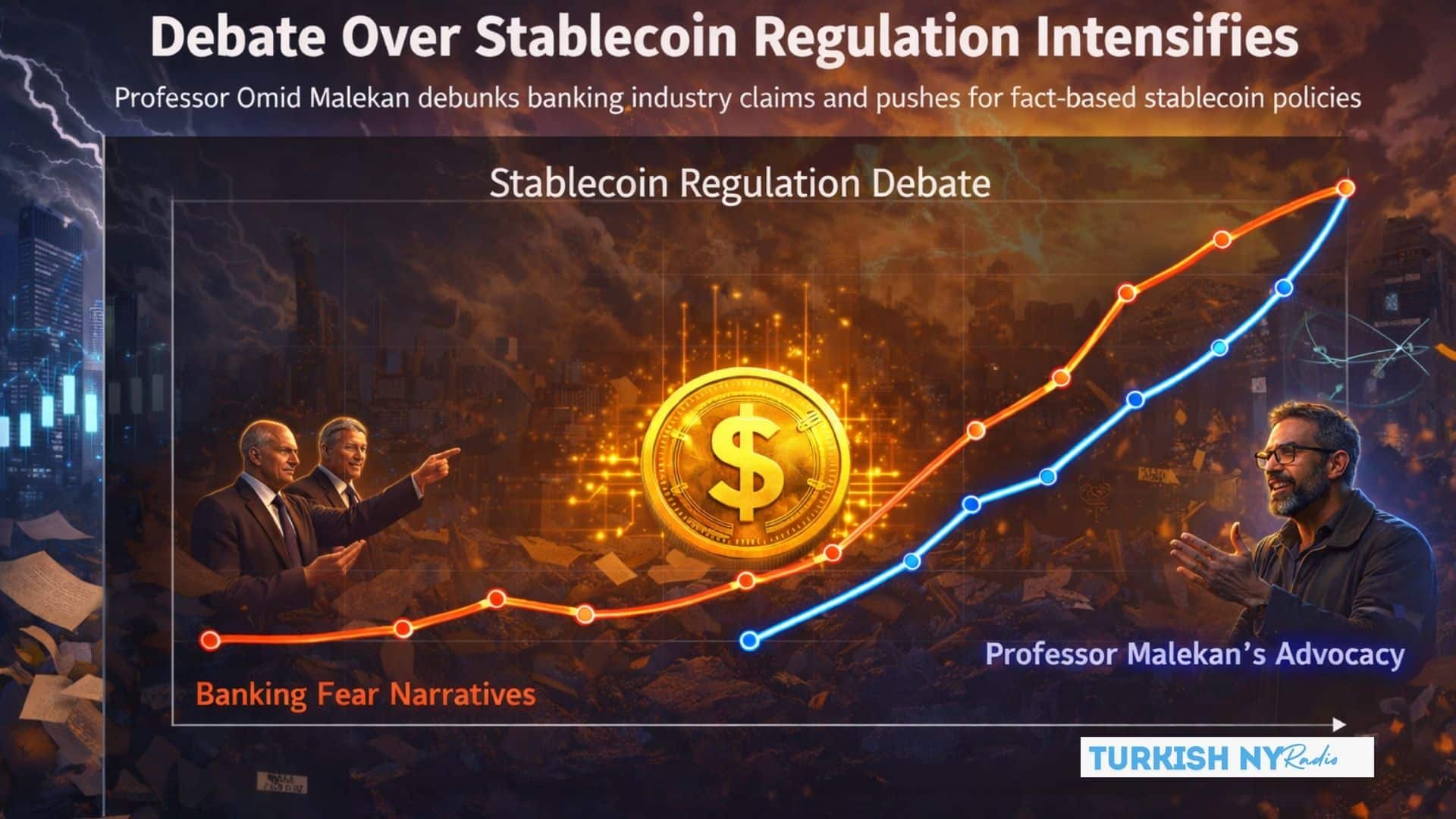
The public debate around stablecoin regulation has expanded quickly in the United States, and Columbia Business School professor Omid Malekan has emerged as one of the few academic voices directly addressing concerns raised by major banking groups.


In his recent commentary, Malekan argues that several claims about stablecoins, particularly fears about deposit flight and lending disruption, are not supported by data. As policymakers consider new rules, his perspective adds balance to a conversation often dominated by industry lobbying.
Banks’ Concerns Don’t Match the Data
Malekan challenges the idea that stablecoins pose a systemic threat to banks, describing many of the industry’s warnings as “misunderstandings or exaggerations.” His analysis notes that demand for stablecoins often originates outside traditional banking channels, meaning they do not automatically replace consumer deposits.
Also read: IMF Sounds Alarm on Stablecoins, Calls for Urgent Global Regulation
According to Malekan, the suggestion that stablecoins undermine lending capacity is especially misleading. Banks create credit through their own balance sheets, not just through deposits. As the discussion around stablecoin regulation continues, he emphasizes that critics often overlook these basic mechanics of modern banking.
“If stablecoins affect anything, it’s bank profits, not their ability to lend,” Malekan said in his commentary.

Yield Competition, Not Stability, Is the Real Issue
A central point in Malekan’s analysis is that the banking industry’s true concern relates to competition. Stablecoin reserves are typically invested in highly liquid government assets, which generate interest. Some policymakers are exploring whether future stablecoin regulation should allow issuers to pass this yield to users.
Malekan contends that competition in interest profits might help customers, particularly in a nation where standard savings accounts frequently provide low returns. Rather than portraying stablecoins as a disruptive factor, he believes the discussion should be on how the banking system can grow responsibly under explicit stablecoin regulation.
A Legislative Turning Point
Several legislative initiatives are now being considered in Washington, including several which seek to specify reserve criteria, reporting requirements, and consumer safeguards. Research from Malekan suggests that intelligent stablecoin regulation might stimulate entrepreneurship while maintaining financial stability, as long as the laws are based on economic realities instead of industry concerns.
He underlines that governments must strike the right balance between creativity and caution: “We can acknowledge risks yet avoid expecting the worst.” Legislation needs to be centered around facts rather than misunderstandings.
Melanie Malekan’s policy urges parliamentarians to investigate how much lobbying groups’ problems are motivated by real concerns for society or by pressure from competitors. His views come at a vital time, as Congress considers multiple options to stablecoin legislation, which may set the course for years yet to come.
Conclusion
Malekan’s position adds clarity to conversations about stablecoin legislation, which are sometimes muddled by alarmist terminology. By focusing the argument on how financial institutions and the creation of credit actually function, he encourages policymakers to prioritize realistic precautions above speculative risks.
His idea that competition, rather than instability, is the central issue adds clarity to a debate that will influence the future of internet money as well as its role in the wider economy.
Also read: Why Coinbase Is Concerned About Stablecoin Reward Restrictions in the CLARITY Act
Summary
The Columbia School of Business professor Omid Malekan disputes widely disseminated banking-industry accusations concerning stablecoins, claiming that many worries are exaggerated or misinterpreted. His study indicates that stablecoins offer greater market pressure than systemic danger, and he advocates for evidence-based stablecoin regulation that preserves consumers while without impeding innovation. As Congress examines new laws, Malekan’s viewpoint emphasizes the importance of balanced policymaking based on how the financial system actually works.
Glossary of Key Terms
Stablecoin: A digital token with a fixed value, usually tied to a monetary unit.
Reserve Assets: Treasury bills or funds utilized to back up the purchasing power of a stablecoin.
Lending Capacity: The willingness of banks to extend credit, as determined by their capital demands and risk models.
Liquidity Capacity: The ease with which an asset may be turned into cash while maintaining its worth.
Regulatory Framework: A comprehensive collection of regulations that control how a particular sector runs.
FAQs for Stablecoin Regulation
1. Who is Omid Malekan?
A Columbia Business School professor who specializes on digital assets and new financial systems.
2. What concerns does Malekan raise concerning stablecoins?
He claims that several banking industry fears are overblown and unsupported by financial evidence.
3. In what way would stablecoin regulation effect clients?
Clear guidelines might boost competitiveness and improve access to yield-bearing items.


4. Are stablecoins threatening bank lending?
Malekan claims that lending is determined by capital and risk management, not deposits alone.
5. For what reason is stablecoin regulation essential at even at all?
While stablecoins grow in acceptance, it becomes essential to preserve transparency, safeguard consumers, and set up clear standards.