
The race to build global stablecoin payment rails is intensifying as both traditional finance and crypto infrastructure firms target the rapidly growing digital money market.
Blockchain companies and legacy financial institutions are working to create systems that offer faster, more compliant, and programmable ways to move money.


Fireblocks Unveils Global Network
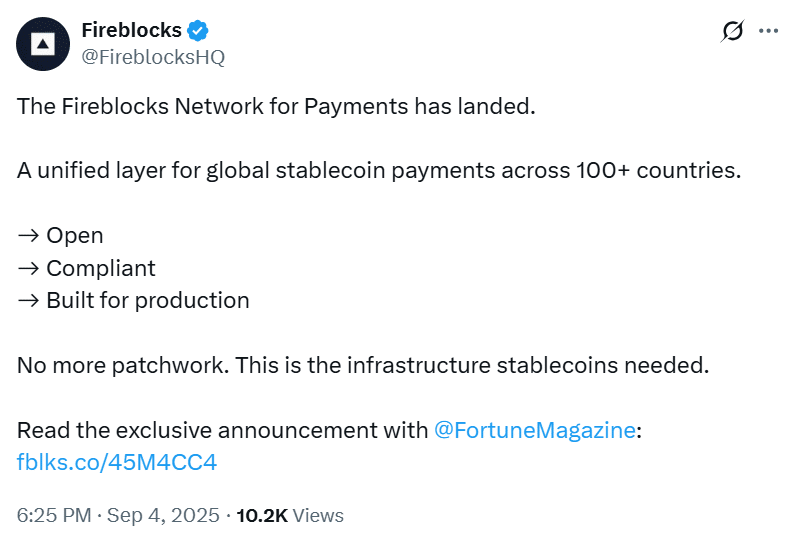
On Wednesday, Fireblocks launched a global stablecoin payment network. The system focuses on compliance, interoperability, and real-time programmable money transfers.
Ran Goldi, senior vice president of Payments and Network at Fireblocks, emphasized that the platform will simplify stablecoin adoption by connecting businesses to over 40 pre-vetted providers across 100 countries.
Stripe Introduces Tempo Blockchain
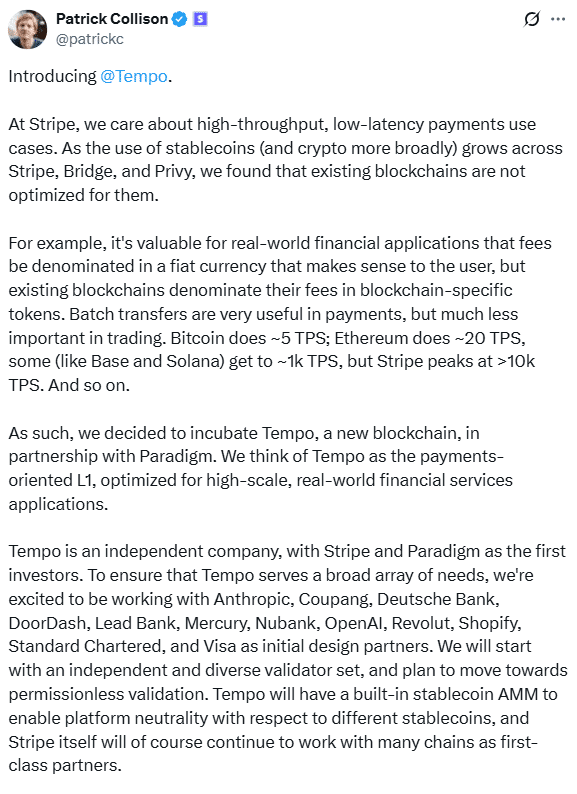
Stripe CEO Patrick Collison unveiled Tempo, a new layer-1 blockchain designed to support high-scale payment transactions. Tempo aims to serve as a payments-focused infrastructure for businesses.
Also read: Will Stablecoins Replace Fiat? Citi Tokenization Forecast Suggests a Tipping Point
Collison described it as optimized for real-world financial applications, helping companies move stablecoins efficiently while competing with traditional processors and emerging crypto networks.
Stablecoin Market Momentum Expands
The stablecoin market is still picking up steam, with fiat-pegged cryptocurrencies with a total capitalization of $281.2 billion, according to DefiLlama. As each blockchain network has its own stablecoin, issuers increasingly turn their attention to interoperability, aiming to make stablecoins interoperable across different blockchain networks.
Traditional Finance Joins the Movement
Major financial institutions are entering the payment arena. Visa recently expanded its settlement platform to include more stablecoins, responding to growing competition. JPMorgan Chase and Citigroup have also explored stablecoin issuance.
Crypto-Native Networks Expand Globally
Crypto native companies are also growing. While Stellar remains an open infrastructure for cross-border payments, Ripple is on the path to taking over Rail, a payment platform.
These companies seek to simplify cross-border payments, further showcasing the utility and importance of stablecoin payment infrastructure in driving international commerce.
Transaction Volumes Reflect Adoption
According to the data from Artemis, in May the payment volumes of stablecoins reached $94 billion. Growth is powered by B2B (business-to-business) transfers and card-linked payments. Analysts say that this surge reflects growing confidence in the power of payment rails to efficiently support large-scale, real-world financial activity.
Advantages of Stablecoin Payments
Once again, stablecoin payments have distinct benefits over traditional fiat systems. Smart contracts make money programmable so it can minimize friction and counterparty risk.


Companies that issue stablecoins can embed logic into payments, automating operations and reducing operating costs. Payment rails offer the following benefits that make them an alluring alternative for cross-border money transfers.
Onboarding Challenges Remain
While stablecoins are growing in popularity as a method of payment, there are challenges related to its adoption. Many firms experience fractured banking relationships, regulatory mandates, and liquidity problems.
Platforms like Fireblocks and Tempo are also trying to solve this by providing pre-vetted providers and out of the box compliance processes.
Stablecoin Payments: The future of stablecoin payments holds great promise, but adopting them requires a greater understanding of the technology and its scalability. Networks like Fireblocks and Tempo are leading the way in terms of compliance, interoperability and efficiency.
If payment rails continue to be adopted by businesses, they could revolutionize cross-border money transfers, decrease dependence on traditional banking institutions, and emerge as a financial mainstream solution.
Conclusion
Stablecoin payments are rapidly evolving into a significant part of the finance infrastructure across the world. There is a growing competition in the sector as businesses ranging from traditional banks to crypto-native networks to infrastructure companies invest in this space.
With the advent of compliant, programmable, and scalable payment rails, we are on the cusp of a future where global money flows are faster, more efficient, and have the potential to reshape the financial landscape.
Also read: Deposit Flight Fears Explode as GENIUS Act Puts Banks vs Stablecoins
Summary
As the demand for payment systems continues to grow worldwide, crypto companies and conventional banks alike are striving to make digital money transfers as seamless as possible. Fireblocks rolled out a compliant, programmable network, and Stripe has unveiled its Tempo blockchain for scalable transactions.
Though there are issues around liquidity, interoperability, and regulatory compliance, volumes of Stablecoin have reached $94 billion, and adoption is steadily increasing. These advancements indicate that stablecoin payments have the potential to revolutionize cross-border finance.
Appendix – Glossary of Key Terms
Stablecoin – A digital currency pegged to a fiat currency to reduce volatility.
Payment Rail – Infrastructure enabling the transfer of money between parties.
Programmable Money – Funds that can execute predefined actions via smart contracts.
Interoperability – Ability of different blockchain systems to work together.
Layer-1 Blockchain – The base blockchain network supporting transactions natively.
Cross-Border Payments – Transactions between parties in different countries.
Liquidity – Availability of funds to facilitate smooth transactions.
Compliance – Adherence to regulatory and legal standards in finance.
FAQs for Stablecoin Payemnts
1- What is a stablecoin payment?
A stablecoin payment is a transaction using cryptocurrency pegged to a stable asset, such as the U.S. dollar.
2- Why are stablecoin payments networks important?
They enable fast, secure, and programmable transactions across borders with lower costs than traditional methods.
3- Which companies are developing stablecoin payments system?
Fireblocks, Stripe (Tempo), Ripple, Stellar, Visa, and Mastercard are major developers in this field.
4- What are the benefits of stablecoin payments?
Stablecoin payments reduce counterparty risk, automate processes with smart contracts, and allow faster cross-border transfers.