This Article Was First Published on TurkishNY Radio.
South Korea is preparing a new wave of penalties for major virtual asset exchanges. The move marks a sharp escalation in the country’s crypto regulation efforts.

Officials say repeated failures in anti-money laundering systems threaten the stability of the nation’s fast-growing digital asset market. The Korea Financial Intelligence Unit, or FIU, is close to finishing its latest reviews.
These reviews follow months of field inspections at leading exchanges. Regulators are now ready to issue personal and institutional sanctions.
They also plan to impose fines on platforms that breach key rules. This stage of enforcement highlights how central crypto regulation has become in South Korea.
Tighter Standards Drive South Korea’s Crypto Regulation Push
Crypto regulation in the country has tightened each year as trading volumes grow. Authorities want stronger controls on Know Your Customer checks and suspicious transaction reporting. They believe these steps will help reduce money laundering risks.
Also Read: Trump South Korea Submarine Pact Hits Roadblock Over Nuclear Submarine Plans
The FIU says it is committed to making each exchange meet the same standards.The FIU is following a first-in, first-out system. This means decisions arrive in the same order that inspections took place.
This method has become a core feature of South Korea’s broader crypto regulation strategy. It creates a clear sequence for enforcement and avoids sudden shifts in timing.
Inspections Completed at Major Exchanges
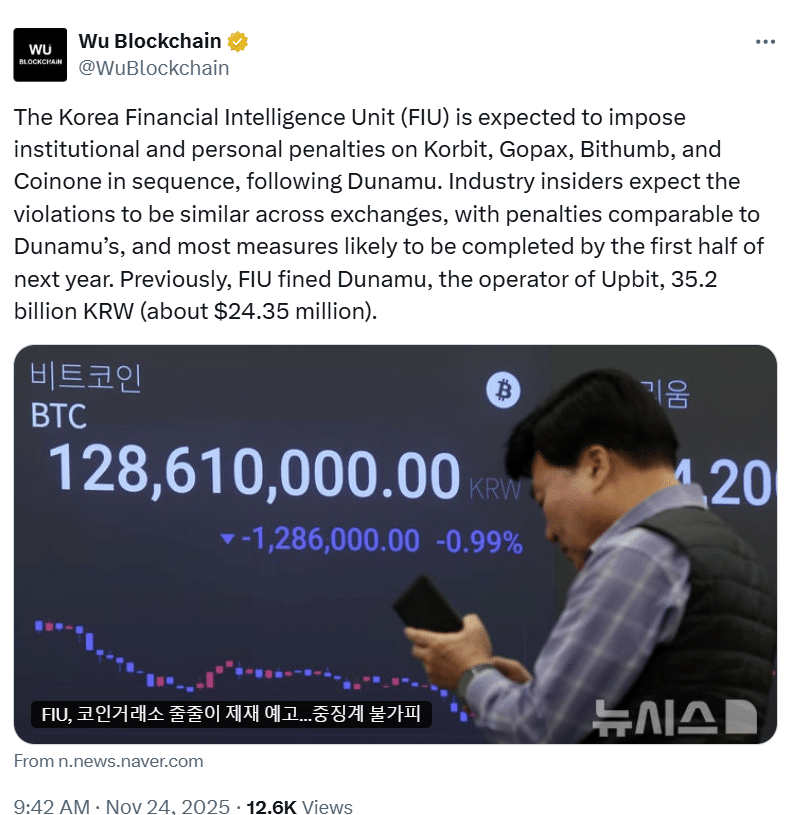
The FIU has already inspected Upbit, Bithumb, Coinone, Korbit, and GOPAX. These visits covered KYC processes and reporting systems. Fieldwork is now done. Legal reviews and sanctions committees are moving forward.
Dunamu Case Sets the Tone for Future Penalties
The FIU’s earlier action against Dunamu, the operator of Upbit, offers a clear preview. Officials first issued personal and institutional sanctions. Then they imposed limits on new deposits and withdrawals.
Later, the FIU added a fine of 35.2 billion won. Market watchers expect similar outcomes for other exchanges. The Dunamu case has become a key model in the current crypto regulation wave.
More Sanctions Expected Across Major Platforms
Regulators are likely to issue more personal and institutional sanctions soon. They may also impose large fines. Some estimates suggest total penalties could reach hundreds of billions of won.
The final amounts will depend on the severity of each violation. The current climate suggests that crypto regulation will remain strict and far-reaching.
Four exchanges still await final decisions. Officials say the FIU will not finish its sanctions schedule this year.
Most remaining actions will likely arrive in the first half of next year. This prolonged phase means crypto regulation pressure will stay high. It also comes at a time when global markets are facing tighter controls.
Crypto Tax Delay Adds More Uncertainty
South Korea is also dealing with uncertainty around its crypto tax rule. The tax is planned for January 2027. But officials now warn that the country is not ready.
They cite missing infrastructure and unclear technical guidance. Some lawmakers believe another delay is likely. Crypto regulation debates are now tied to the future of this tax plan.
Government Still Signals Support for Innovation
Despite strict enforcement, leaders say they want the sector to grow. The ruling Democratic Party has launched a new task force to support blockchain development.
They claim the goal is to create a safer but more innovative market. This dual approach reflects South Korea’s attempt to blend crypto regulation with long-term industry support.
Conclusion
South Korea’s latest enforcement campaign marks a major moment for crypto regulation in the country. The FIU is ready to issue new sanctions. More fines are expected. And several exchanges remain under review.
Through these decisions, crypto regulation will determine how the industry develops in the year to come. Many analysts say the next phase will set the standards for the broader Asian market.
Also Read: Experts Slam Bank of Korea Stablecoin Policy for Favoring Banks Over Fintechs
Appendix: Glossary of key terms
Crypto Regulation: The rules and policies that decide how digital asset trading operates, followed by compliance and consumer protection guidelines.
FIU : South Korea’s Financial Intelligence Unit, the authority enforcing AML rules in the crypto sector.
Virtual Asset Exchange : A platform allowing users to purchase, store, or sell digital assets.
KYC : The identity verification processes that exchanges should maintain to prevent misuse.


STR : The mandatory report an exchange has to submit when it identifies unusual or high-risk transactions.
AML: The systems and rules set to prevent illicit funds from flowing through legal financial channels.
Institutional Sanctions: The penalty imposed on the exchange or company per regulatory violations.
Personnel Sanctions : The punitive measures against the executives and stuff that have caused the bad compliance.
Frequently Asked Questions About Crypto Regulations
1-What is crypto regulation?
Crypto regulation refers to laws and rules that govern digital asset trading, compliance, taxation, and consumer protection.
2- What is the FIU’s main focus?
The FIU is focusing on anti-money laundering failures and KYC compliance as part of broader crypto regulation.
3- Which exchanges were reviewed?
Upbit, Bithumb, Coinone, Korbit, and GOPAX have completed inspections.
4- What penalties are expected?
Institutional sanctions, personal penalties, and significant fines.