This article was first published on TurkishNY Radio.
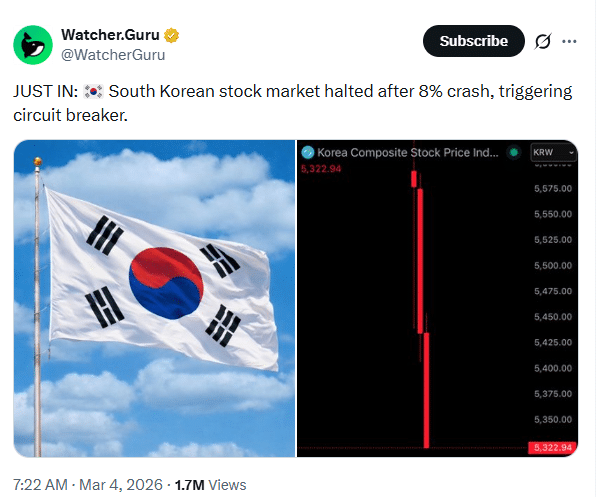
The South Korean stock market crash has caught the attention of global investors after the country’s stock exchange index fell by over 8% within a short period of time.


The South Korean stock market crash happened at a time when the country’s stock exchange had been performing remarkably over the past few months.
South Korean Stock Market Crash Triggers Circuit Breaker Halt
As a result of the stock exchange index falling by over 8%, the stock exchange suspended trade on the stock exchange. The halt happened after the stock exchange index fell by over 8%. The halt is meant to help investors analyze the situation before trade can resume.
Several factors contributed to the South Korean stock market crash. The factors include geopolitical tensions, inflation, and margin debt levels.
The chances of a South Korean stock market crash have a great potential to affect investor sentiments across Asia and even globally. This is because South Korea is one of the key economies in the Asian continent.
At a time when there is increased volatility in the South Korean stock exchange market, investor sentiments across the world are affected. This is because fund managers across the world invest their funds accordingly.
Circuit Breaker Activated to Calm Markets
The exchange activated a circuit breaker after the market plunged past the critical level. During a South Korean stock market crash, this mechanism pauses trading for a short period.
The goal is to slow panic selling. It also prevents automated trading systems from accelerating losses. Once trading resumes, investors often reassess prices and risks.
Iran Conflict Adds Pressure to Global Equities
Geopolitical tensions have also contributed to the market’s decline. The ongoing conflict with Iran has made investors fear an increase in oil prices. This could impact inflation and economic growth.
These issues have impacted stock exchanges across the globe. The South Korean stock market crash has resulted because of global investors’ cautious attitude.
Margin Debt Amplifies Market Losses
One major reason behind the sharp fall is record levels of margin debt. Many retail investors had borrowed money to buy stocks during the recent rally.
When markets dropped, these leveraged positions faced forced liquidation. This triggered additional selling pressure. As a result, the South Korean stock market crash accelerated quickly.


AI Boom Previously Drove Market Rally
Earlier in the year, the Korean stock market showed impressive gains. The optimism of investors regarding the prospects of artificial intelligence helped boost the stock market.
South Korea is known to be one of the biggest manufacturers of semiconductor chips in the world. The companies that specialize in the technology sector showed impressive gains in the stock market. The Kospi stock exchange index showed gains of almost 50% before the decline in the stock market.
Analysts Warn of Uncertain Market Outlook
The current state of the stock market is hard to predict, according to market experts. The rapid fluctuations in the stock prices have made it hard to forecast the market in the short term.
According to An Hyungjin, the chief executive of Billionfold Asset Management in Seoul, the stock market has been showing extreme moves. According to him, the stock market has seen cautious investors as bids in the market begin to dwindle. The stock market crash in Korea has seen a sudden shift from optimism to fear among the investors.
Economic Risks Add to Market Concerns
Economic uncertainty has also added pressure on Korean stocks. The assumption is that the Bank of Korea may choose to hike interest rates to curb inflation.
Energy imports are one sector in which the Korean economy may feel the pinch. The Korean economy has to rely heavily on energy imports, and any rise in oil prices is a matter of concern.
These are the factors that led to the South Korean stock market crash and may be responsible for its performance in the near future.
Government Policy Under Scrutiny
Government policies may also be one of the factors that contribute to the stability or lack of stability in the stock exchange market. The South Korean government, led by President Lee Jae Myung, has been encouraging investment in the stock exchange market.
The government has been encouraging people to invest in the stock exchange market instead of investing in real estate. However, the South Korean stock market crash has raised questions regarding the government’s intervention in the market if the situation persists.
Conclusion
The South Korean stock market crash is a clear indicator that markets can change in a very short period. High levels of optimism, fueled by the demand for technology and investors’ leverage, can easily turn into fear if there are market risks.
Appendix Glossary of key terms
Circuit Breaker: It is a system that is used by stock exchanges to stop trading in a market when a sharp decline is noted.
Kospi Index: It is a key stock index of the Korean stock market.
Margin Debt: It is money borrowed by an investor from a broker for investing in stocks or any other security.
Market Volatility: It is a sudden and unpredictable fluctuation in financial markets.
Sell-Off: It is a sudden and wide-scale sale of stocks that results in a sharp decline in their prices.
Frequently Asked Questions About South Korean stock market crash
1- What caused the South Korean stock market crash?
The crash was driven by geopolitical tensions, high margin debt, and rising inflation concerns.
2- Why was trading halted?
Trading stopped because the exchange triggered a circuit breaker after the index dropped more than 8%.
3- What is a circuit breaker in stock markets?
It is a system in which trading is halted during high volatility in the market.
4- How does the crash affect global markets?
South Korea is one of the biggest technology and manufacturing centers in the world. Large fluctuations in the stock market have a global effect on investors.