
This article was first published on TurkishNY Radio.
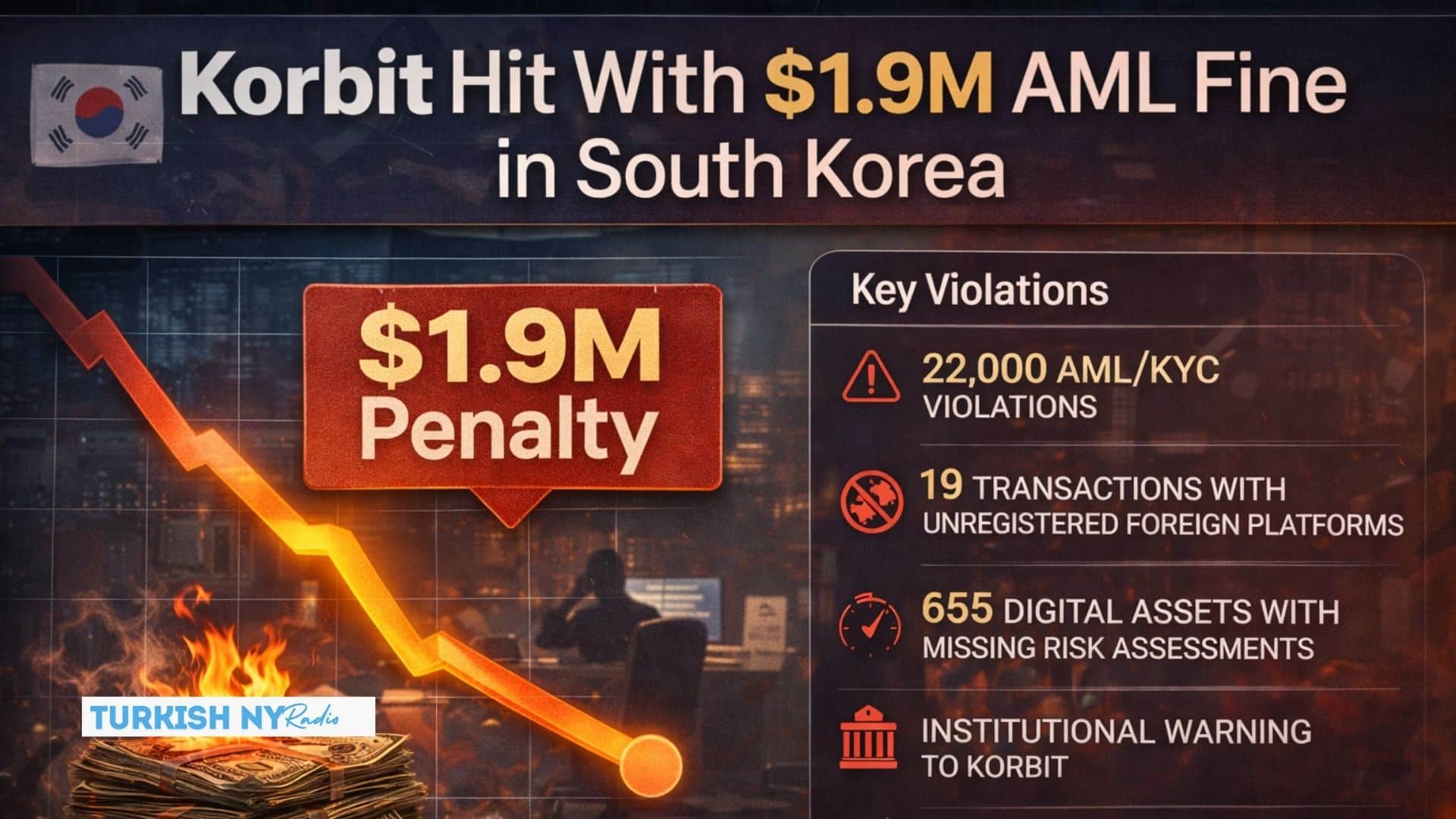
South Korea’s Financial Intelligence Unit (FIU) has handed down a significant Korbit AML fine, totaling roughly $1.9 million, after uncovering widespread compliance lapses at the well-known cryptocurrency exchange. The decision marks one of the firmest regulatory actions taken against a digital asset platform in the country.


For many observers, the Korbit AML fine reflects how quickly the expectations for responsibility and transparency are evolving in the crypto landscape.


FIU Flags Serious Compliance Gaps
The FIU’s investigation began with an on-site inspection in October 2024, and what it found ultimately shaped the reasoning behind the Korbit AML fine. According to regulators, Korbit logged nearly 22,000 violations, many of which stemmed from inadequate KYC practices and incomplete identity verification.
Also read: How to Use Paper Trading in Crypto to Build a Repeatable Trading System
When Customer Checks Fall Short
Investigators said Korbit approved accounts using unclear or incomplete documentation, sometimes missing essential information like full customer addresses. These lapses raised significant concerns, given how essential proper verification is in preventing money-laundering activity. The severity of these findings was one of the central reasons behind the Korbit AML fine.

Overseas Transactions Trigger Red Flags
Another major issue involved 19 transactions tied to unregistered overseas virtual asset platforms. South Korean law requires exchanges to interact only with legally registered foreign entities, and the FIU made it clear that Korbit had failed to uphold this requirement. This oversight factored heavily into the Korbit AML fine, emphasizing the importance of international compliance tracking.
Risk Assessments for New Assets Were Missing
In addition to documentation issues, regulators found that Korbit allowed trading in 655 digital assets, including NFTs, without conducting the mandatory risk assessments. These assessments help ensure that new listings do not introduce fresh vulnerabilities to the financial system.
A regulatory official commented, “Exchanges must treat compliance as an ongoing responsibility, not a box-ticking exercise. The rules exist to protect users and the broader market.” This sentiment echoes the intent behind the Korbit AML fine, which serves as a reminder for exchanges to maintain continuous vigilance.
Leadership also has consequences.
The FIU did not stop with the cash punishment. Korbit got a company warning, while the CEO was formally admonished and the accountable reporting officer was chastised. These measures support the view that manager accountability is crucial in preventing recurring conformance failures. As authorities pointed out, the Korbit AML punishment was intended not simply to reprimand but also to spur internal transformation.
Ripple’s broader impact on the cryptocurrency industry
The Korbit AML penalties come at a moment of greater oversight of digital resource platforms in South Korea. As the country tightens monitoring and aligns more closely with worldwide AML requirements, companies of all sizes will be pushed to review their compliance procedures.
Some experts feel the penalties might have an impact on Korbit’s long-term institutional interest. Large corporations, like Mirae Asset, have already considered acquisitions, and the Korbit AML fine may affect the path of any future discussions.
Conclusion
The Korbit AML fine serves as an obvious signal that the cryptocurrency industry is no longer a loosely regulated environment. As the FIU’s standards become more stringent, platforms like Korbit are going to be compelled to modernize their systems, increase supervision, and improve internal controls. While the punishment is hefty, the long-term consequences might be much greater as South Korea transitions to a more organized, responsible digital asset economy.
Also read: Vitalik Buterin Calls for Human-Centric AI to Preserve Human Relevance
Summary
South Korea’s FIU issued a Korbit AML fine of $1.9 million after finding extensive compliance failures, including incomplete KYC checks, unreported overseas transactions, and missing risk assessments for hundreds of digital assets. Regulators also issued warnings to the company’s leadership. The Korbit AML fine reflects increased demands for better supervision and enhanced internal controls in the cryptocurrency business. As regulatory pressure grows, online asset platforms in South Korea are entering a new era of responsibility.
Glossary of Key Terms
AML (Anti-Money Laundering): Procedures designed to prevent unlawful investments.
FIU: An official agency in charge of tracking and enforcing anti-money laundering compliance.
KYC: Processes for verifying consumer identification.
Digital Asset Exchange: An online marketplace for trading digital currency.
Risk Assessment: Is the process of assessing pecuniary or operational hazards to assets.
FAQs for Korbit AML fine
1. What is Korbit AML fine?
The South Korean FIU assessed a $1.9 million fine for regulatory and financial crime violations.
2. What offenses were determined?
Almost 22,000 concerns include inadequate KYC checks, unlawful transactions, and lacking risk evaluations.
3. Did Korbit incur any non-financial penalties?
Actually, the CEO issued a warning, and the compliance manager was chastised.
4. Where is this particular item significant?
It indicates South Korea’s stepped-up regulatory measures in the cryptocurrency business.
5. Can the Korbit AML fine impact future acquisitions?
It may alter investor perception, but institutional interest remains conceivable.