
Sonic (formerly Fantom, ticker S) is a high speed EVM compatible Layer-1 blockchain built by the Fantom team. It launched a new mainnet in 2024 and replaced Fantom’s FTM token 1:1 in early 2025.
With up to 400,000 transactions per second and sub-second finality, Sonic has a “Fee Monetization” model that pays developers up to 90% of on-chain fees. The token (S) is used for gas, staking and governance, same as Fantom’s original 3.175 billion supply.


Since launch, Sonic’s price has been volatile. It spiked to an all-time high of $1.03 in January 2025 (during airdrop and listings) and then dropped to a low of $0.33 by February.
Recent Developments
Sonic has seen massive inflows of capital, leading the pack with over $1.3 billion in net inflows so far this year since the January 2025 rebrand from Fantom. This outpaces Ethereum and Solana. Notably, Sonic integrated Circle’s USDC, which boosted cross-chain liquidity and ecosystem growth.
Coinbase added Sonic, so investors can now trade Sonic tokens (subject to liquidity). A major exchange listing means more accessibility and institutional interest.
By late April to May 2025, Sonic TVL hit $1 billion for the first time. This was after Binance Wallet added Sonic token and native support for Sonic dApps. Open interest and trading volumes also skyrocketed. Earlier in January and February, TVL was at $11 million and then $414 million post-rebrand.
Binance Wallet added Sonic and the price surged 15% and trading volume 130% as a result. Speculation around a 200 million Sonic token airdrop only added to the hype, although details are still unconfirmed.
Sonic Summit 2025 is coming in September in Singapore and will feature new dApp partnerships and ecosystem milestones. With Sonic’s numbers at 400,000 TPS, $1 billion TVL and 14% DeFi yields, this event is generating a lot of buzz.
Technical Analysis
The token peaked at $1.03 in Jan 2025 before a big drop, and has since consolidated around $0.40-$0.70. The RSI has come up from deeply oversold to 40-50, meaning selling pressure is easing. Price has been oscillating in a range, currently below the mid-Bollinger Band ($0.33).
Each Sonic rally has hit resistance at $0.65-$0.70 and overall momentum is bearish. Support at $0.40 has held multiple times and buyers are stepping in on dips. Until Sonic breaks above $0.60 on strong volume, the trend looks neutral to bearish. Any upside will need sustained volume and positive catalysts.
Sonic Price Prediction Table for 2025
Sonic (S) predicted trading range for Aug–Dec 2025:
| 2025 Month | Min Price ($) | Avg Price ($) | Max Price ($) |
| August 2025 | 0.1975 | 0.2248 | 0.2938 |
| September 2025 | 0.2147 | 0.2223 | 0.2298 |
| October 2025 | 0.2114 | 0.2186 | 0.2281 |
| November 2025 | 0.1943 | 0.2061 | 0.2156 |
| December 2025 | 0.2056 | 0.2101 | 0.2152 |
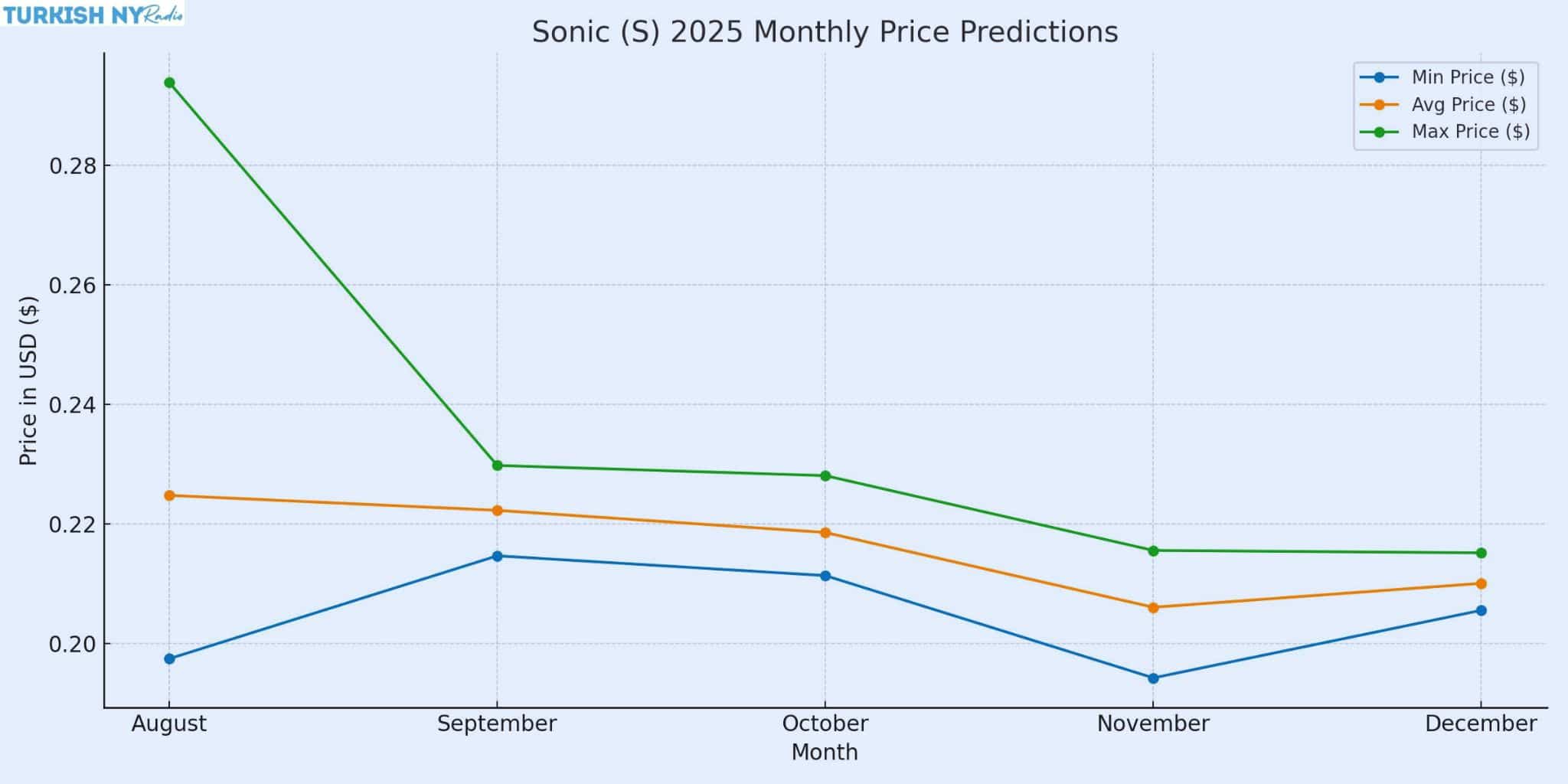
Analysis: For late 2025, the table shows Sonic trading around $0.20–$0.29, with an average rage probably at $0.23. This is just a mild recovery or stabilization after mid 2025 drop. Sonic’s price will depend on network adoption, market cycles and how its unique economics play out.
Sonic Price Prediction Table for 2026
| Year | Min Price ($) | Avg Price ($) | Max Price ($) |
| 2026 | 0.7263 | 0.7477 | 0.8779 |
Analysis: For 2026, Sonic is projected to reach $0.75 on average, as some analysts expect broader adoption and a bullish crypto market. In reality prices may vary; these are speculative scenario ranges not actual foreseen values.
Expert Sonic Price Prediction
Sonic price predictions vary wildly. CCN (using Elliott Wave analysis) has Sonic ending 2025 at $0.06-$0.085, or more decline. By end of 2026, CCN sees a range of $0.40-$0.62 under its base case. CoinCodex has Sonic averaging $0.21 by Sept 2025.


CoinStats analysts have Sonic averaging $0.5349 in 2025 with a low of $0.517, and a high of $0.583. For 2026, they have Sonic averaging $0.7477 with a low of $0.726 and a high of $0.878. That’s gradual growth if broader crypto markets improve.
Coinpedia’s mid-2025 analysis has Sonic’s 2025 high at $0.96. One CryptoPolitan report has Sonic at $0.953 by end of 2025 wih a range of $0.926–$1.03 and $1.37 by end of 2026. Some forecasts even have Sonic reclaiming previous highs ($1+) by late 2025.
A price target of $0.76 by end of 2026 has been mentioned by venture capitalist Tim Draper. Bitget’s model has Sonic at $0.28–$0.29 from Aug–Dec 2025 and $0.29–$0.31 by mid-2026.
As analysts say, Sonic’s price could be anywhere from well below $0.10 to over $1 in 2025 depending on adoption and market cycles. Investors should take these as speculative, not actual targets.
Key Factors Affecting Sonic’s Price
Several things can impact Sonic’s long term price. Sonic’s new incentive model could attract developers. Over 150 projects (including stablecoins like USDC) are building on Sonic thanks to grants and hackathons. Fee Monetization already reportedly paid out over 1.3 M S to app developers, an unusual incentive in crypto.
If more DeFi apps move to Sonic, TVL and usage could increase and demand will follow. Key metrics will be on-chain revenue, gas volume and capital locked. Without “sticky” user growth, Sonic’s fee-sharing is meaningless and the token will trade as a liquidity play.
Like all altcoins, Sonic’s price is tied to broader crypto trends. A bull cycle will lift Sonic, a bear market will keep it down. Regulatory confidence (e.g. compliance focus) and institutional interest (e.g. GSR as market-maker) can impact sentiment.

If Bitcoin and ETH go up strongly, high-throughput L1s like Sonic will get spillover demand.
Ongoing development (e.g. SDKs, bridges) could also drive confidence. Sonic already has a native Ethereum bridge (the “Gateway”) and partnerships (e.g. Pendle protocol) that increase utility. Major integrations like Circle (USDC) or Chainlink will expand usage.
Conclusion
Based on the latest research, Sonic price prediction for 2025–2026 is highly uncertain. If Sonic’s new blockchain gains traction through dApp migrations, TVL growth, and airdrop momentum, the token can recover to or above $1 by late 2025.
Under bullish scenarios, analysts have priced Sonic at $0.75–$1.75 by 2025 and above $1 in 2026. But if adoption falters and crypto market stays weak, Sonic may struggle; several forecasts have it under $0.10 by 2025 or range bound at $0.20.
Sonic’s long term depends on execution and usage. Investors are advised to track on-chain metrics (fees, developers, TVL) and wider market trends when evaluating Sonic’s outlook.
Stay up to date with expert analysis and price predictions by visiting our crypto news platform.
Summary
Sonic (S) is Fantom’s new Layer-1 blockchain with fee-sharing for developers. Price has been volatile after early 2025 peak at $1.03, it dropped to $0.30–$0.45. Predictions for 2025–2026 vary. Some see a minor bounce to $0.20–$0.50, others $1+ if adoption picks up.
FAQs
Is Sonic the same as Fantom (FTM)?
Not exactly. Sonic was built from scratch by the Fantom team, replacing Fantom Opera’s chain. While it inherited FTM’s token supply, Sonic uses a new consensus model and has unique features like the Fee Monetization model. In effect, FTM holders received Sonic (S) tokens, but the base networks are separate.
When did Fantom rebrand to Sonic?
Fantom officially rebranded its mainnet to “Sonic” in early 2025 (around Jan 16, 2025) as part of launching the new chain. The token swap (FTM to S) completed on major exchanges by January 2025.
What affects Sonic’s price?
Sonic’s price is driven by crypto market cycles, developer adoption, network activity (fees and TVL), and general sentiment.
Will Sonic reach $1 in 2025 or 2026?
Opinions vary. Some predict $1+ by 2025, others are bearish. Currently, Sonic would need 2× gains to hit $1 from mid-2025 levels. Always do your own research.
Glossary
Sonic (S): A high-performance Layer-1 blockchain launched in 2024 by the Fantom team.
Fantom (FTM): The original blockchain project whose token supply was used to seed Sonic.
Layer-1 (L1): A base blockchain network (like Ethereum, Solana). Sonic is an L1 for high speed and low fees.
TPS (Transactions Per Second): Network throughput.
TVL (Total Value Locked): The dollar value of crypto assets staked or used in DeFi protocols on the network.
Airdrop: Distribution of tokens to users, often for marketing or rewards.
Fee Monetization: Sonic’s model where up to 90% of transaction fees go to the developer of the smart contract generating the fee.