
The Solana Network has achieved a significant milestone by reaching over 100,000 transactions per second (TPS) for the first time.
Developer Mert Mumtaz of Helius confirmed that a single block on the network processed 43,016 successful transactions, with a 1.5% failure rate, ultimately reaching a remarkable 107,540 TPS. This feat is the first of its kind for any major blockchain network on its mainnet.


Solana’s TPS Surge Driven by Synthetic Load, Not User Activity
While the headline number is impressive, the spike in Solana’s TPS was not driven by user activity. Instead, it was largely the result of no-operation program calls. These lightweight instructions are appended to transactions to test the network’s capacity, without involving complex payments or computations.
Despite the synthetic nature of the test, Mumtaz noted that Solana network could potentially process between 80,000 and 100,000 TPS for real-world use cases, such as transfers or oracle updates.
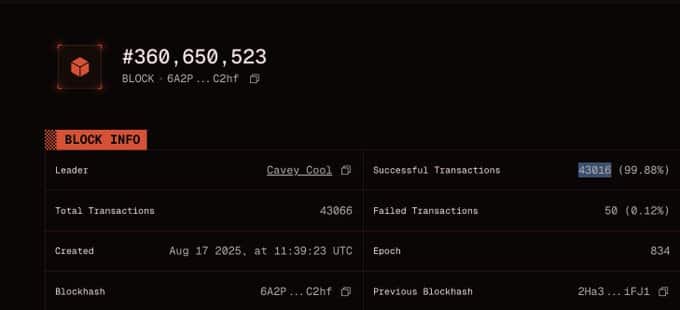
Solana Network’s Synthetic Load vs. Real-World Usage
The Solana Network’s performance spike is subject to debate within the blockchain community. Despite the significance of the test numbers, the real-world usage figures present a different picture.
Solscan reports that the Solana network’s average TPS is just under 3,700, mostly driven by validator voting transactions crucial to consensus.
In fact, independent tracking platforms report even lower figures. Chainspect, for example, measures Solana’s real throughput at approximately 1,004 TPS, while Solscan’s estimate is slightly higher at around 1,050 TPS.
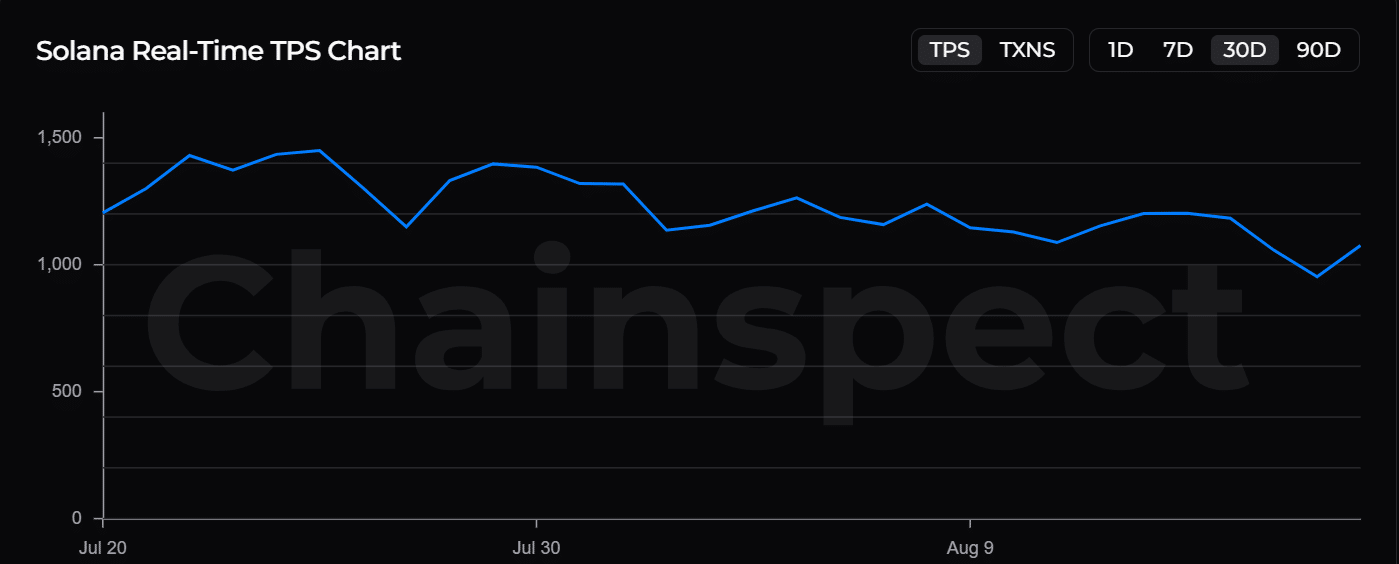
This discrepancy has raised concerns among blockchain researchers, who caution that using synthetic TPS data to showcase performance could mislead the public about the network’s true capacity.
Solana Network’s Scaling Approach
Solana Network has its mechanism of scaling that is distinct unlike other Layer-1 blockchains such as Ethereum and Avalanche. Whereas Ethereum pursues rollups and modular approaches to scalability, Solana attempts to make scalability efficient in just a single chain.
The Solana scaling technique has been able to withstand stress tests performed on the network already. An investment company, Bitwise, has drawn attention to the network supporting high-demand conditions, which makes Solana network interesting for applications in trading, gaming, and high-frequency transactions.
Solana Network’s Path to Real-Time Use Cases
Many developers believe that achieving higher throughput is key to enabling real-time applications like decentralized finance (DeFi) and gaming. However, these uses remain hypothetical until Solana can consistently prove that it can maintain high throughput under organic, real-world conditions, not just synthetic load tests.
Investor Sentiment: Concerns Over TPS and Market Confidence
The recent drop in Solana network price indicates that investors are wary of the network’s future performance. There is a clear distinction being made between TPS spikes caused by artificial means and the true scalability of the network under real-world conditions.


Despite this, the 107,540 TPS milestone is significant in the context of Solana’s growth. However, it highlights why TPS numbers alone cannot be the sole measure of scalability.
The real test for Solana will come when it demonstrates the ability to perform under natural demand, without the artificial influence of no-operation program calls.
Solana’s Roadmap for the Future
In July, a technical roadmap outlined by Solana stakeholders, including Samani, set ambitious goals for the network, with improvements planned over the next few years. These improvements are designed to make Solana network the platform of choice for the world’s best financial markets.
However, some industry insiders believe that major throughput improvements, similar to the recent experiment, could be achieved much sooner. As validator Cavey suggests, the network could see significant upgrades in as little as three months, with a six-month timeline at worst.
Conclusion
While Solana’s 107,540 TPS milestone is undoubtedly impressive, the network’s true scalability remains in question. The difference between synthetic stress test results and real-world performance will determine whether Solana can truly achieve the high throughput needed for decentralized finance and gaming applications.
Also read Solana Price Eyes Momentum Ahead of 2025 Alpenglow Governance Vote
Summary
Solana performed synthetic load tests that achieved a 107,540 transactions per second (TPS) performance milestone, and though the data point is not exactly reflective of real-world transaction rates, it indicates the possibility of scaling to that level. Although people claimed the test was artificial, even at the real conditions, Solana managed to handle as many as 100,000 TPS.
Nevertheless, the actual throughput of the network is much lower and the blockchain community waits to identify whether Solana is capable of maintaining high performance when faced with organic demand.
Frequently Asked Questions (FAQ)
1- What is Solana’s TPS?
Solana’s TPS measures the number of transactions it can process per second, with recent tests reaching over 100,000 TPS.
2- How does Solana achieve scalability?
Solana focuses on efficiency and execution within a single chain rather than relying on modular frameworks like Ethereum.
3- Why are Solana’s TPS numbers controversial?
Recent TPS spikes were driven by synthetic tests, not real user activity, raising concerns about network capacity.
4- What’s next for Solana’s scalability?
Solana plans continuous improvements, with potential real-world scalability expected in the coming months.
Appendix: Glossary of Key Terms
TPS (Transactions Per Second): The measure of how many transactions a blockchain can process per second.
Solana Network: A high-performance blockchain designed for decentralized applications and crypto transactions.
Validator Voting: Transactions required to maintain the consensus and validate blocks on the Solana blockchain.
Synthetic Load: A test process that simulates transaction activity without actual user engagement to assess network capacity.
No-Operation Program Calls: Lightweight instructions appended to transactions for testing purposes, without performing real computations or transactions.
Consensus Process: The method by which Solana nodes agree on the state of the blockchain.
Real Throughput: The actual processing capacity of a blockchain based on organic user transactions rather than synthetic stress tests.
References
Decrypt – decrypt.co
CoinCentral – coincentral.com