
This article was first published on TurkishNY Radio.
A silent but serious EVM wallet drain is spreading throughout Ethereum and other Ethereum-compatible blockchains, leaving average cryptocurrency users perplexed, upset, and out of pocket. ZachXBT, a well-known blockchain investigator, initially raised the issue, warning that many wallets are being emptied using an unknown assault mechanism.


What exactly makes the EVM wallet drain so alarming is how commonplace it appears on the surface. There are no obvious exploits or faulty smart contracts. Instead, modest sums of money are missing from numerous pockets, frequently without the victims’ knowledge until it is too late.
ZachXBT Sounds the Alarm
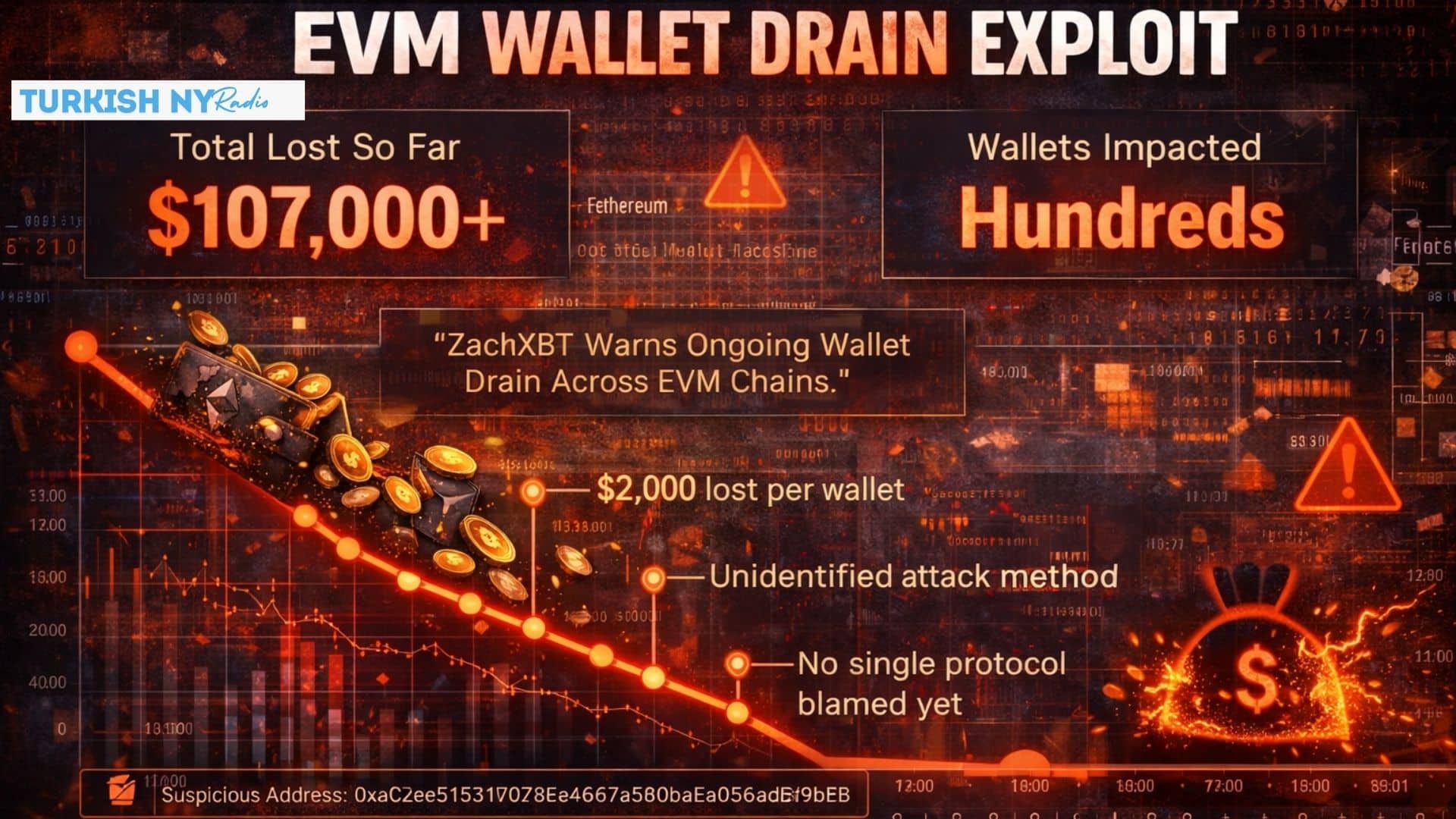
ZachXBT took to X to warn the crypto community about an active EVM wallet drain affecting multiple chains at the same time. According to his findings, most victims lost under $2,000, but the total damage has already crossed $100,000.
Also read: Is Apple Turning the iPhone Into the Safest Crypto Wallet Yet?
“Each individual loss is small, but the number of affected wallets keeps growing,” he wrote, warning users to stay alert.
This pattern suggests the attacker may be deliberately keeping losses low to avoid detection, an approach that allows the EVM wallet drain to continue quietly in the background.
Why Does That EVM Wallet Drain Look Different?
Unlike big hacks that affect exchanges or DeFi systems, the EVM wallet drain seems to target consumers directly. So yet, no dApp, connection, or clever contract has been officially recognized as the cause of the issue.
Security specialists suspect the drain is caused by expired token approvals, exploited plugins for browsers, phishing sites, or exposed private keys. The lack of understanding is what renders the EVM wallet drain so dangerous: users don’t know what to do.
Growing Anxiety Around Wallet Security
The timing of this EVM wallet drain is adding to broader concerns about wallet safety. As more users rely on browser-based wallets for daily transactions, attackers are shifting focus away from complex smart contract exploits and toward simpler human mistakes.
“Wallet security is no longer just about code,” one blockchain security researcher noted. “It’s about habits, permissions, and where users click.”


As the EVM wallet drain continues, experts are urging users to review wallet permissions, disconnect from unknown sites, and avoid signing transactions they don’t fully understand.
Conclusion
For the time being, the EVM wallet drain continues unsolved, and there is no proven technical explanation of how the attacker gained access. What is evident, yet, is that this instance demonstrates how susceptible users may become when basic financial hygiene is overlooked.
Until more answers are revealed, remaining watchful may be the best protection. Monitoring transactions, rejecting unneeded approvals, and safely storing cash may assist users avoid being the next victim of the continuing EVM wallet drain.
Also read: Trust Wallet Hack 2025: How a Compromised Chrome Extension Led to Millions Lost
Summary
ZachXBT’s detection of an EVM wallet drain demonstrates how current cryptocurrency vulnerabilities are turning toward subtle, user-focused assaults. With modest losses distributed among several hundred wallets, the harm accumulates swiftly while remaining under the radar. The issue serves as a warning that even seasoned users can be vulnerable if payment access, extensions, and security practices are not periodically checked.
Glossary of Key Terms
EVM (Ethereum Virtual Machine): A mechanism for running intelligent agreements on Ether and other distributed ledgers.
Wallet Drain: The illegal draining of money from an online cryptocurrency wallet.
Token Approval: Authorization for an intelligent contract to utilize tokens on the user’s authority.
Browser Wallet: A wallet for cryptocurrency accessed via a web internet application.
On-chain activity: Refers to actions and information that are generally recorded on the digital ledger.
FAQs for EVM wallet drain
1. What precisely constitutes an EVM wallet drain?
This means unlawful payments from wallets that run on compatible Ethereum digital ledgers.
2. Which individual was the first to report the problem?
ZachXBT, a smart contract investigation firm, issued the initial alert.
3. How much cash has been wasted so far?
The losses alleged in several wallets surpass $100,000.
4. Does a certain protocol bear responsibility?
There is no particular method or app was recently formally attributed to the assault.
5. In what way can users remain secure?
To limit the risk of an EVM wallet drain, revoke permissions on a regular basis, avoid shady websites, and consider using physical wallets instead.