
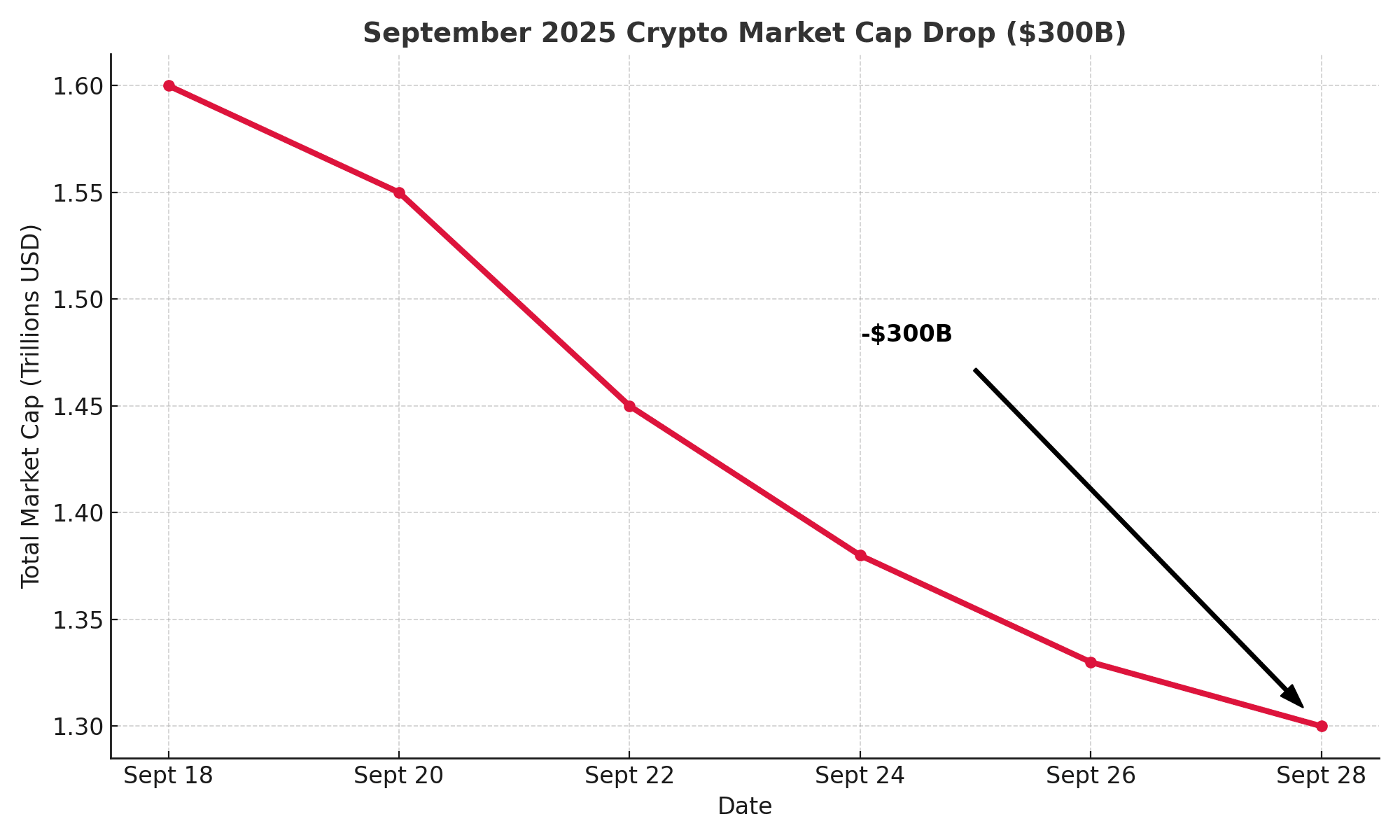
The past month delivered a jarring reminder of how fragile digital markets can be. Between September 18 and September 28, the global market cap lost more than $300 billion, marking one of the sharpest declines of 2025.
The crypto crash not only wiped out portfolios but also forced the industry to reassess how it handles leverage, liquidity, and risk management.


Liquidations and the Domino Effect
The most brutal part of the crash was the scale of forced liquidations. More than $7.3 billion in leveraged positions vanished within days, leaving retail traders and institutions equally exposed. Ethereum, Bitcoin, and altcoins bore the brunt, with long positions collapsing under the weight of rapid sell pressure.
Observers on X described the selloff as “a bloodbath not seen since early 2022,” noting how thin order books amplified volatility. Prices slipped through support levels as if they weren’t there, dragging even the strongest projects into red territory.
This cascading effect is what made the crypto crash so destructive — one failure feeding the next until billions disappeared almost overnight.
What Triggered the Slide
Pinpointing a single cause is difficult. Rising global bond yields, nervous macro sentiment, and leveraged bets combined to form the perfect storm.
Analysts argue that much like the dot-com bust of the early 2000s, this downturn highlights the dangers of euphoric optimism unchecked by sound fundamentals.
An institutional desk strategist explained, “When you’ve got open interest running ahead of liquidity, all it takes is a sharp move to topple the house of cards.” His words capture the vulnerability of a system increasingly dependent on speculative leverage.
The crypto crash of September thus became less about fundamentals and more about structure, magnifying systemic weaknesses.
Investor Sentiment and Recovery Hopes
Despite the turmoil, optimism is not lost. History shows that every major crash sets the stage for innovation and recalibration. Analysts point to the upcoming quarter as a potential rebound period, citing possible catalysts like central bank easing, ETF inflows, and improved regulatory clarity.
Market commentators suggest that if macro conditions stabilize, the crypto crash could be remembered less as an end and more as a reset. Trading desks already report gradual accumulation in Bitcoin and Ethereum, hinting that institutional money is quietly preparing for a recovery.
As one analyst noted on X, “Q4 is shaping up to be a make-or-break moment. If capital flows return, the September crash could mark the turning point investors were waiting for.”
Long-Term Lessons in Risk Management
If September’s rout proved anything, it’s that the industry’s approach to leverage and liquidity must change. Exchanges are now under pressure to refine liquidation protocols and boost transparency in derivatives markets.


For investors, the lesson is equally clear: overexposure to leverage can be fatal, no matter how strong the underlying asset.
The crypto crash also accelerated conversations about regulation. U.S. lawmakers are expected to revisit market structure rules, with security experts already warning that unchecked leverage poses national security risks.
As crypto integrates further into the global financial system, the push for oversight is only going to grow louder.
Conclusion
September’s crypto crash was a harsh reminder that markets don’t climb forever. The loss of $300 billion underscored the risks of leverage and weak market structure, but it also set the stage for reform.
With Q4 on the horizon, investors face a fork in the road: either treat this as another temporary shock or recognize it as a turning point in how crypto aligns with global finance. Whichever path unfolds, the crash has already rewritten the narrative for 2025.
FAQs
Q1: What caused September’s crypto crash?
A mix of high leverage, thin liquidity, and macroeconomic pressures such as rising bond yields triggered the selloff.
Q2: How much was lost during the crash?
Over $300 billion in market value was erased, with $7.3 billion in leveraged liquidations reported.
Q3: Will the market recover in Q4?
Analysts see potential for recovery driven by ETF approvals, regulatory clarity, and improved macro conditions, though risks remain.
Q4: What lessons can investors learn?
The crash highlights the dangers of excessive leverage and the need for better risk management in crypto trading.
Glossary of Key Terms
Crypto Crash: A sudden, steep decline in cryptocurrency market value.
Leverage: Borrowing capital to amplify trading positions, increasing both potential gains and losses.
Liquidation: The forced closure of leveraged positions when collateral falls below maintenance levels.
Market Cap: The total value of all cryptocurrencies combined, calculated by multiplying price by circulating supply.
ETF (Exchange-Traded Fund): A financial instrument that tracks the value of an asset or group of assets, tradable on traditional exchanges.
Liquidity: The ease with which assets can be bought or sold without causing significant price changes.