
This article was first published on TurkishNY Radio.
WhiteBIT, a cryptocurrency exchange, has been formally labeled as an “undesirable organization” in Russia, thereby prohibiting it from conducting business there. The decision was taken after Russian officials accused the exchange of ties to Ukraine of aiding Kyiv in the ongoing conflict, according to a report by CryptoNews.


The case demonstrates how geopolitical sensitivities are increasingly influencing crypto law and enforcement as Russia Blacklists WhiteBIT.
The designation places WhiteBIT among a growing list of foreign entities barred from Russian activity under strict national security laws.
Russian prosecutors explain the decision
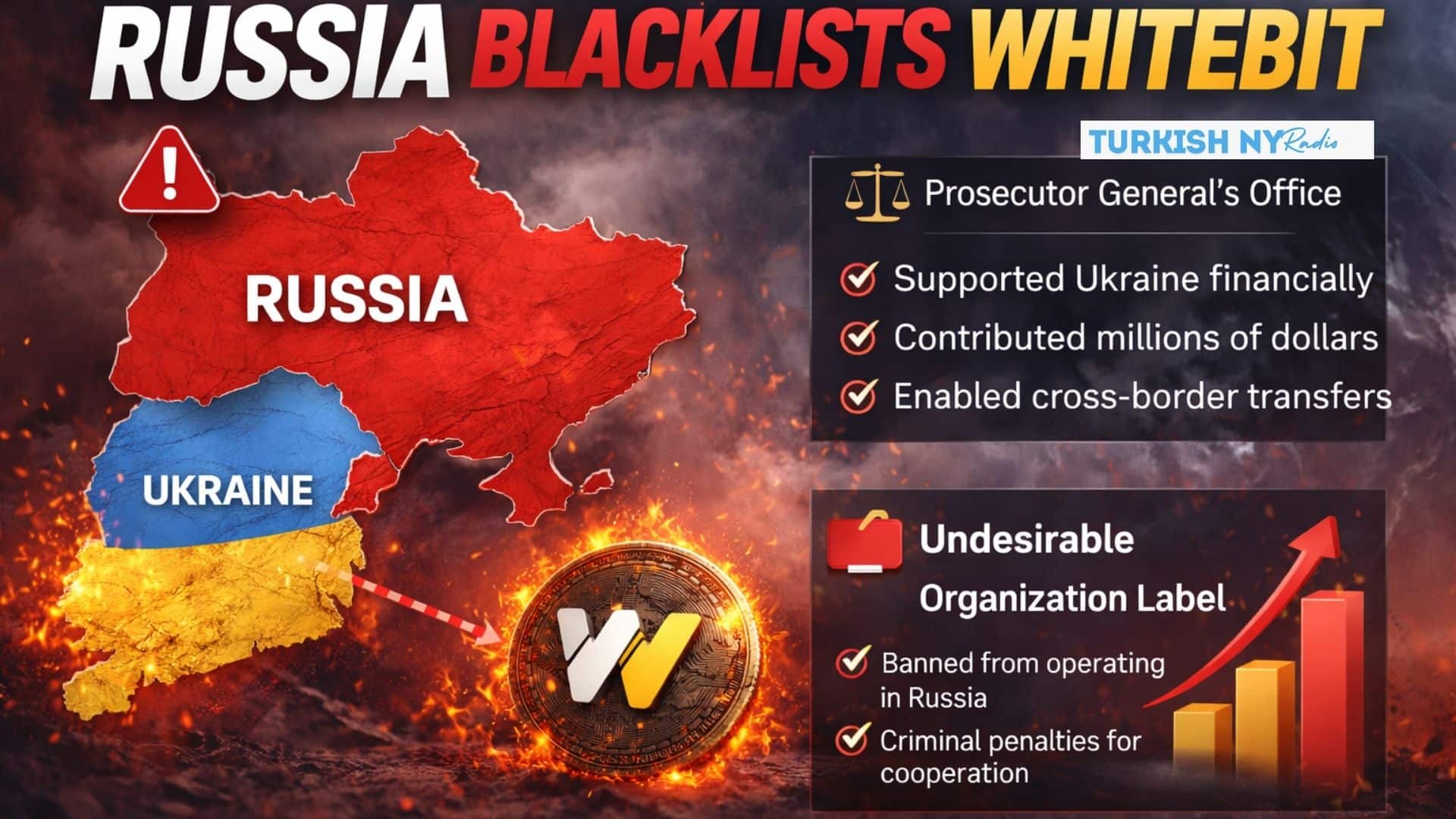
CryptoNews reports that Russia’s Prosecutor General’s Office added WhiteBIT and its parent company, W Group, to the official blacklist after alleging the exchange financially supported Ukraine. Authorities claim WhiteBIT leadership contributed millions of dollars to Ukrainian causes following the 2022 invasion.
Also read: Why Russia Rejects Crypto Payments Despite Allowing Digital Asset Investment
In its statement, the regulator said Russia Blacklists WhiteBIT because the platform allegedly enabled cross-border financial activity that Moscow views as threatening to state security. Russian officials also accused the exchange of facilitating “gray schemes” that allowed funds to move out of the country.
Legal consequences under Russian law
When Russia Blacklists WhiteBIT, the impact extends beyond blocking access to its services. Under Russian legislation, any cooperation with an “undesirable organization” is prohibited. Individuals or businesses found interacting with WhiteBIT could face administrative penalties or criminal charges.
Legal analysts cited by CryptoNews note that this designation is among Russia’s most severe enforcement tools. It sends a clear warning to crypto platforms with political or humanitarian involvement tied to Ukraine.
WhiteBIT’s position and prior exit
WhiteBIT has not disputed that it supported Ukraine but has consistently framed its actions as transparent and values-driven. The exchange previously stated that it exited the Russian market in early 2022, disabling accounts linked to Russia and Belarus and removing ruble trading pairs.
From the company’s perspective, the fact that Russia Blacklists WhiteBIT now does not affect its current operations, as it no longer serves Russian users. However, the label carries reputational and legal weight, particularly in jurisdictions aligned with Russian policy.
Why is this important for the cryptocurrency sector
The ruling highlights a broader trend in how governments view cryptocurrency exchanges. The premise that platforms are now viewed as organizations whose political conduct may result in regulatory repercussions rather than as neutral infrastructure is strengthened by Russia Blacklists WhiteBIT.
According to industry watchers, this trend could force exchanges to clarify their geopolitical stances, and consumers would see greater accessibility fragmentation based on where they are.
Conclusion
Russia’s larger attempt to regulate digital banking in the midst of the current war with Ukraine is reflected in the decision to blacklist WhiteBIT. The reality that Russia blacklists WhiteBIT shows how cryptocurrency platforms are becoming more and more involved in geopolitical conflicts, despite WhiteBIT’s insistence that its acts were legitimate and open.
The case also acts as a warning to the global cryptocurrency industry that the risk of regulation now encompasses foreign policy issues in addition to compliance.
Also read: Russia Crypto Regulation Tightens as Moscow Exchanges Prepare for 2026 Trading Rollout
Summary
According to CryptoNews, Russia has formally banned WhiteBIT by labeling the exchange an “undesirable organization,” citing alleged financial support for Ukraine. As Russia Blacklists WhiteBIT, any interaction with the platform inside Russia becomes illegal. According to WhiteBIT, it left the Russian market in 2022 and considers its donations to be ethical and fair. The case demonstrates how geopolitical tensions are changing cryptocurrency regulations and raising risks for exchange globally.
Glossary of Key Terms
Undesirable organization: A Russian legal status that bans an entity’s activities and criminalizes cooperation with it.
WhiteBIT: A global cryptocurrency exchange founded in 2018 with Ukrainian roots.
Prosecutor General’s Office: Russia’s federal authority overseeing law enforcement and legal compliance.
CryptoNews: The primary source reporting on Russia’s decision to blacklist WhiteBIT.
Cross-border transfers: the exchange of money between nations, which is frequently examined under penalties.
FAQs for Russia blacklists WhiteBIT
1. Why was WhiteBIT placed on a Russian blacklist?
According to CryptoNews, Russian officials claim the exchange provided financial support to Ukraine.
2. What does the legal term “blacklist” mean?
It is legally forbidden to collaborate with WhiteBIT within Russia.


3. Is WhiteBIT still active in Russia?
No. In 2022, WhiteBIT left the Russian industry.
4. Was the donation to Ukraine confirmed by WhiteBIT?
Yes, but it also states that the gifts were legal and fair.
5. What makes this crucial for cryptocurrency users?
It demonstrates how usage of cryptocurrency platforms may be directly impacted by geopolitical actions.