The evolving Ripple Gemini IPO tale is altering discussions about liquidity, regulation, and stablecoins’ place in mainstream banking.
With Ripple giving a $75 million credit facility to Gemini, which may be expanded to $150 million, the relationship demonstrates how smart financial partnerships are growing at the core of cryptocurrency institutionalization. T


he addition of Ripple’s stablecoin, RLUSD, adds another layer of interest, implying new dynamics in the race for stablecoin domination.
Ripple Gemini IPO: $75 Million Lifeline
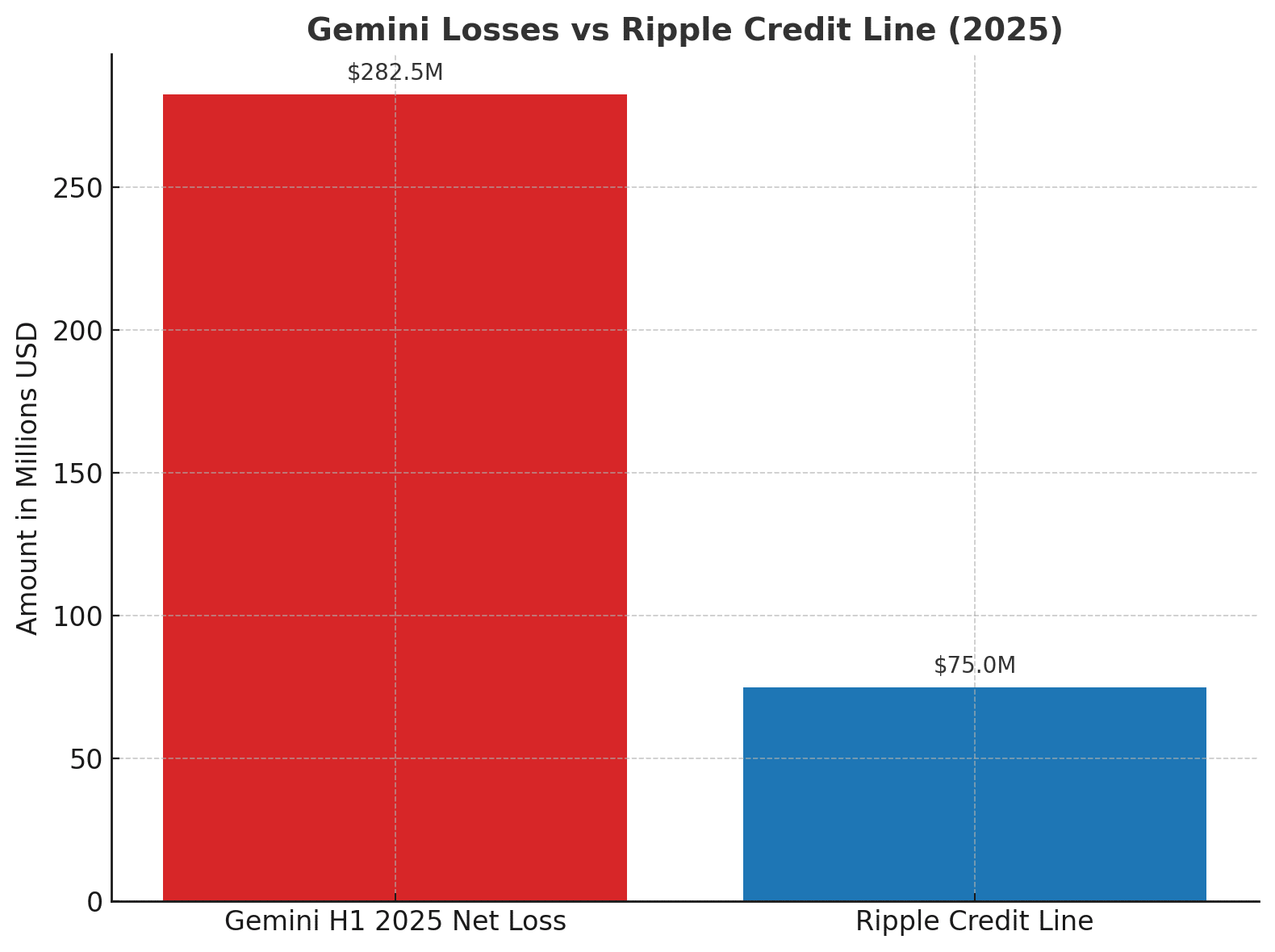
At the heart of the Ripple Gemini IPO announcement is a financial backup meant to offer Gemini with stability at a vital period. The exchange recorded large losses in the first half of 2025, making the injection of accessible capital critical to its IPO plans.


The loan arrangements, with interest rates ranging from 6.5% to 8.5% and tranches starting at $5 million, provide structured support, highlighting market maturity.
What makes the arrangement stand out is Ripple’s decision to include RLUSD as an option for loans over the first $75 million. This provides an instant use case for the stablecoin, firmly establishing RLUSD in the workflows of a significant exchange.
Regulatory Navigation and IPO Strategy
The Ripple Gemini IPO file also disclosed a redesigned company model. Gemini will divide its operations between Gemini Trust in New York and a new firm, Moonbase, in Florida. T
he decision indicates a thoughtful approach for navigating New York’s rigorous BitLicense environment while pursuing national expansion goals. Gemini may portray itself as compliant yet flexible by using a dual-entity structure, which is critical for investor trust prior to an IPO.
With prominent underwriters like as Goldman Sachs, Citigroup, and Morgan Stanley on board, Gemini is demonstrating that, despite financial difficulties, it has the support of Wall Street giants. This duality, financial hardship countered by strategic support, defines the delicate balance of the Ripple Gemini IPO story.
RLUSD comes into the spotlight.
Stablecoin competition is strong, with USDT and USDC leading worldwide markets. Ripple RLUSD, albeit being new, acquires legitimacy as a result of this relationship. If Gemini borrows more than $75 million, RLUSD will instantly join exchange operations.
This step might boost acceptance and awareness, especially if RLUSD extends worldwide, including experimental initiatives in African markets.
The Ripple Gemini IPO demonstrates how stablecoin integration is becoming a component of bigger institutional strategies. By connecting RLUSD to Gemini’s financial infrastructure, Ripple is effectively testing adoption in a real-world, regulated setting.
Market Implications for Investors
For investors, the Ripple Gemini IPO is more than just a headline; it reflects the expanding crypto infrastructure. While Gemini’s losses raise concerns, the collaboration with Ripple reassures investors that targeted credit lines and institutional relationships may mitigate volatility.
If the IPO goes well, it might establish a precedent for how exchanges can manage regulation, liquidity, and innovation in public markets.
Conclusion
The $75 million credit line signals a watershed moment in the Ripple Gemini IPO process. It emphasizes Ripple’s desire to bring RLUSD into public circulation while also supporting Gemini’s IPO story despite financial challenges.
For investors and experts alike, this transaction exemplifies how liquidity, stablecoins, and regulation are coming together to shape the future of crypto exchanges in the public eye.
FAQs
Q1: What is the Ripple Gemini IPO deal?
It is a $75 million credit facility from Ripple to Gemini, expandable to $150 million, with RLUSD stablecoin integration.
Q2: Why is RLUSD included in the agreement?
Ripple added RLUSD as a borrowing option beyond $75 million to encourage its adoption within exchange operations.
Q3: How is Gemini preparing for its IPO?
The exchange is restructuring operations between New York and Florida to navigate regulatory requirements.
Q4: Who is underwriting the IPO?
Major financial firms, including Goldman Sachs and Morgan Stanley, are listed as underwriters.
Q5: What does this mean for crypto investors?
It signals institutional confidence and shows how stablecoins like RLUSD are being positioned in mainstream markets.
Glossary
Ripple Gemini IPO: The planned public offering of Gemini, backed by Ripple’s $75M credit line.
RLUSD: Ripple’s dollar-backed stablecoin aimed at competing with USDT and USDC.
BitLicense: A New York regulatory framework for crypto businesses.
Credit Facility: A pre-approved borrowing arrangement for liquidity management.
Underwriter: Financial institutions that manage and guarantee IPO stock issuance.