![Sun [New]](https://s2.coinmarketcap.com/static/img/coins/64x64/10529.png)


![BitTorrent [New]](https://s2.coinmarketcap.com/static/img/coins/64x64/16086.png)



This article was first published on TurkishNY Radio.
Financial markets exist because people try to understand what will happen next. Investors buy stocks because they believe companies will grow. Commodity traders purchase contracts when they expect shortages or price increases. Every trade reflects an opinion about the future.


Prediction markets take this idea one step further. Instead of trading the future price of assets, participants trade contracts tied to real-world events. These events might involve elections, sports competitions, economic announcements, or technological milestones.
In a prediction market, traders buy or sell contracts that represent the outcome of a specific event. The price of those contracts reveals how likely the market believes the event is to occur. A higher price means greater confidence in that outcome, while a lower price signals doubt.
Economists often describe these markets as tools for gathering information. When people risk money on their beliefs, they tend to examine data carefully and respond quickly to new information. As thousands of traders react to news and analysis, the market price evolves into a constantly updated estimate of probability.
Research from the Iowa Electronic Markets at the University of Iowa has shown that markets built around event forecasting can sometimes rival traditional polling in predicting election outcomes. The reason is simple: traders have financial incentives to interpret information accurately.
A Simple Sports Example Shows How Prediction Markets Work
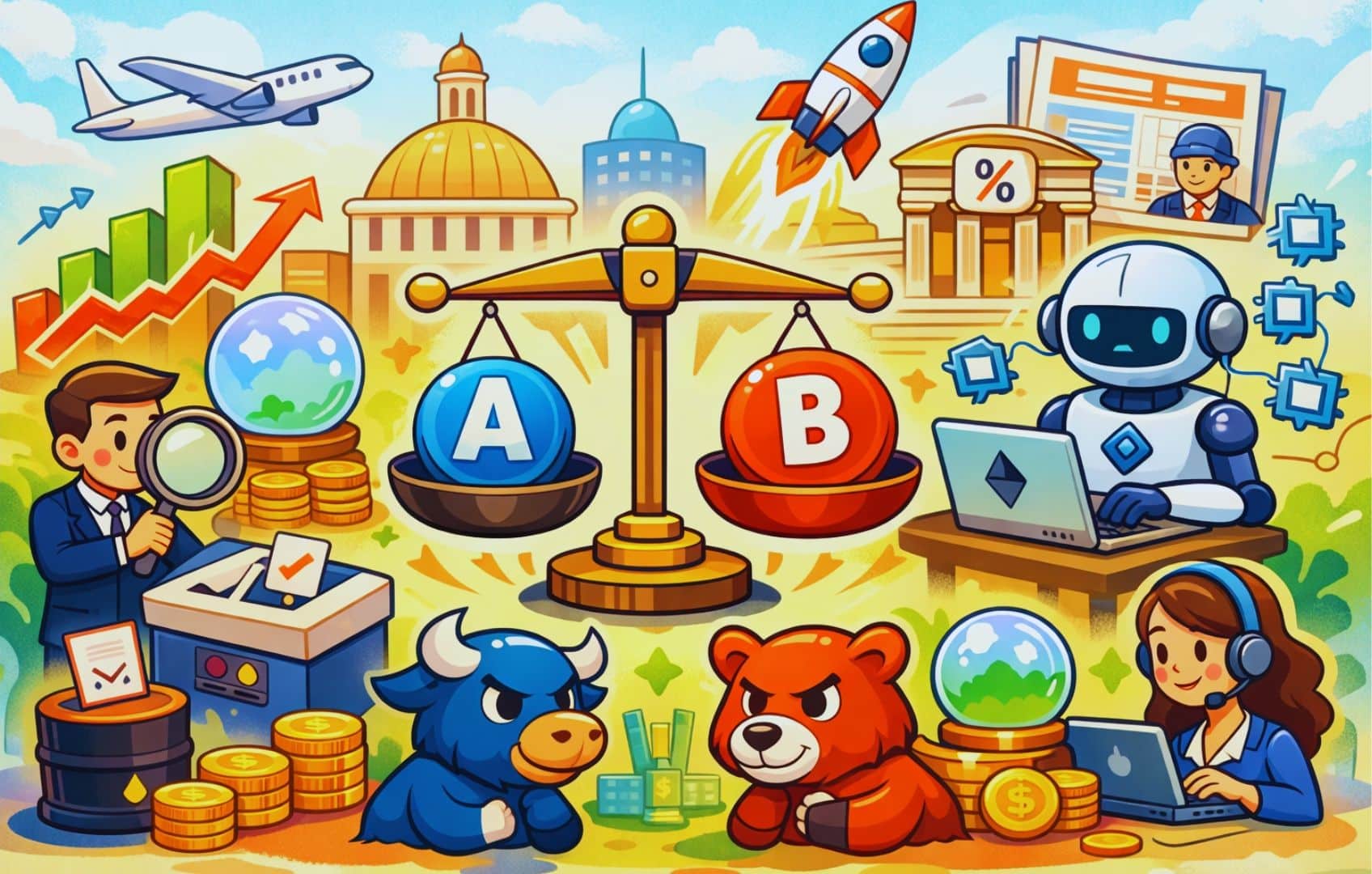
The mechanics of prediction markets become easier to understand through a sports example. Imagine a market created for a championship match between two teams. The platform issues two tokens representing the possible outcomes. One token corresponds to Team A winning the game, while the other token corresponds to Team B winning.


Participants purchase the outcome they believe will happen. As trading continues, prices change to reflect the collective expectations of the market.
Most prediction markets operate using binary contracts. This means that each contract will eventually settle at either zero or one hundred percent depending on the final outcome. Before the result is known, however, contracts trade somewhere between those values.
Suppose the token representing Team A trades at $0.30, while the token representing Team B trades at $0.70. In this situation, the market is effectively signaling that Team B has roughly a 70 percent probability of winning the match.
If new information appears, traders react quickly. A key player injury, weather conditions, or team strategy changes can influence expectations. As traders buy or sell contracts based on these updates, prices adjust and the market’s probability estimate changes. This process transforms collective opinions into a measurable probability signal.
How Prediction Markets Extend the Logic of Derivatives
Prediction markets did not emerge in isolation as they grew from ideas that already exist in financial derivatives markets. Derivatives such as futures and options allow investors to speculate on the future price of assets. Traders use these contracts to anticipate movements in commodities like oil and gold, financial assets such as stocks, and digital currencies, including Bitcoin.
Prediction markets apply similar principles but focus on events rather than prices. Consider political forecasting. A trader who believes a particular political party will win the United States presidency could express that view directly through a prediction market contract tied to that outcome. If confidence in that candidate increases, the contract price rises. If expectations decline, the price falls.
Without prediction markets, traders might attempt to express the same belief indirectly by buying or selling assets that could benefit from a particular administration’s policies. Event markets simplify the process. They allow participants to trade directly on the probability of the election result.
Because the contracts correspond directly to real-world outcomes, economists often describe prediction markets as a clearer way to express expectations about the future.
Why Businesses, Banks, and Media Follow These Markets
Prediction markets have gradually attracted attention beyond the trading community. Researchers and organizations now study them as forecasting tools.
Large technology companies have experimented with internal event markets to estimate project timelines and product launches. For example, engineers at Google once tested internal prediction markets that allowed employees to trade contracts tied to company milestones. According to internal research shared by Google, these markets often produced accurate forecasts about whether projects would launch on schedule.
Financial institutions also observe prediction markets closely. Traders frequently monitor contracts tied to economic events such as central bank interest rate decisions. The price of these contracts reflects how market participants interpret economic data and policy signals.
News organizations watch prediction markets as well. During election seasons, journalists often reference them when discussing public expectations about political races. Because traders react quickly to new information, these markets can update forecasts faster than traditional polling.
For these reasons, some economists describe prediction markets as a form of public good. Even individuals who never trade in these markets can benefit from the information they generate.
Why the Prediction Market Industry Is Still Emerging
Despite their potential, prediction markets remain a relatively young sector. For many years, regulatory uncertainty limited their expansion. Governments often debated whether contracts tied to real-world events should fall under financial regulation or gambling laws. Industry research has also highlighted how prediction markets are gradually evolving from early experiments into structured financial exchanges
Participation levels have also been smaller than in traditional financial markets. When only a limited number of traders participate, markets may struggle to reflect the full range of available information.
However, technological advances are beginning to change this situation. As participation grows and more individuals contribute insights, the forecasting ability of these markets tends to improve.
The principle resembles the idea often called the “wisdom of crowds.” When people with diverse backgrounds analyze the same problem independently, their combined judgment can become remarkably accurate.
Centralized Prediction Markets and Their Constraints
Some prediction markets operate within traditional financial systems under strict regulatory oversight. One example is Kalshi, which functions as a federally regulated exchange supervised by the U.S. Commodity Futures Trading Commission.
Regulated platforms offer credibility and legal clarity. Institutional investors often prefer these environments because they operate under established financial rules.
However, centralized markets face structural limitations that can affect forecasting accuracy. One common restriction involves position limits. Traders may only place bets up to a certain amount, sometimes below $1,000. Even when someone believes the market price is incorrect, these limits prevent them from committing larger amounts of capital to correct the mispricing.
Identity verification rules also create barriers. Know-Your-Customer requirements can exclude many potential participants around the world, which reduces the diversity of information entering the market.
Fees represent another concern. Some platforms charge significant withdrawal costs. The political event trading platform PredictIt, for example, has received criticism for relatively high withdrawal fees that discourage active trading.
How Decentralized Prediction Markets Expand Access
Blockchain technology has introduced a different approach through decentralized markets. Instead of relying on a central exchange, these platforms operate using smart contracts that execute automatically on blockchain networks. Traders interact with the system through digital wallets rather than traditional financial accounts.
Smart contracts manage trade execution, settlement, and payouts without requiring intermediaries. Because transactions occur on a public blockchain, the process remains transparent and verifiable.
Decentralized markets offer several advantages. Participation tends to be broader because users can join from anywhere with an internet connection. Many platforms also operate without mandatory identity verification, which lowers barriers to entry.
Lower transaction fees can also improve market efficiency. When trading becomes cheaper and more accessible, more participants contribute information to the market.
Many decentralized prediction platforms connect directly to Web3 tools. The Bitcoin.com Wallet, for example, allows users to connect to decentralized applications where they can trade derivatives, manage digital assets, and interact with event-based markets across multiple blockchain networks.
By enabling direct connections between wallets and decentralized applications, these tools make it easier for users to participate in prediction markets built on blockchain infrastructure.
Risks and Regulatory Considerations
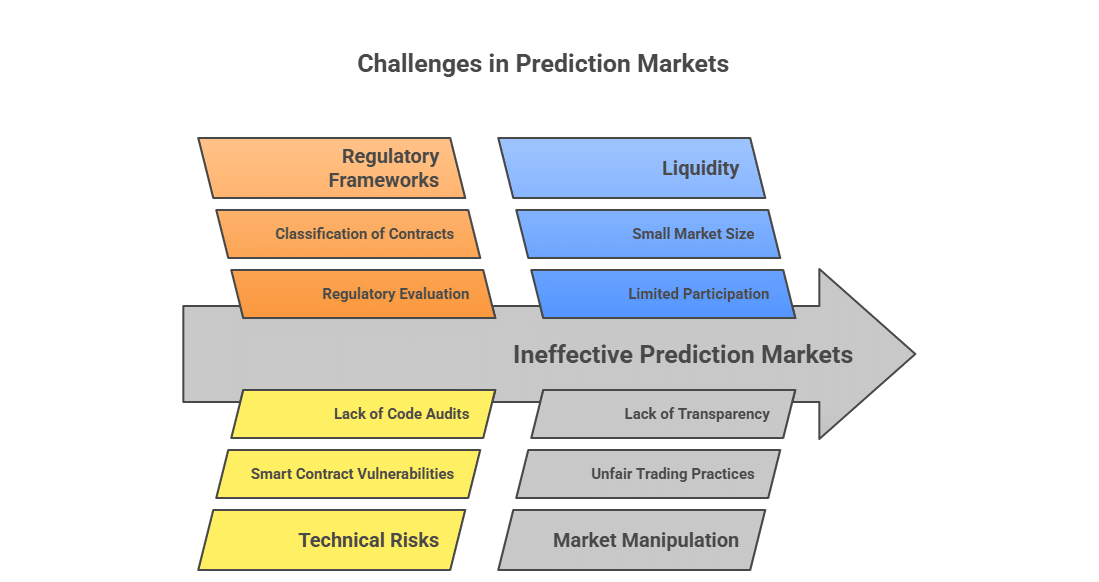
Although prediction markets offer valuable forecasting signals, they also raise several concerns. Regulators continue to debate how event-based contracts should be classified. Some policymakers view them as financial derivatives, while others see similarities to betting markets. The classification affects how governments regulate these platforms.
Security risks also exist in blockchain-based markets. Smart contracts can contain coding vulnerabilities if developers fail to audit them thoroughly. In such cases, attackers may exploit flaws to steal funds.
Liquidity represents another challenge. Smaller markets with fewer participants can experience significant price swings that do not necessarily reflect accurate probabilities.
Because of these risks, analysts emphasize that users should approach prediction markets carefully and conduct thorough research before participating.
A Market Built on Collective Insight
Prediction markets transform scattered opinions into structured signals. By allowing participants to trade on outcomes, they convert individual beliefs into probabilities that update continuously as new information appears.
As blockchain technology expands access and decentralized platforms grow, these markets may play an increasingly important role in forecasting political, economic, and technological developments.
Whether predicting election outcomes, interest rate decisions, or sports results, prediction markets offer a powerful way to understand how people collectively interpret the future.
Glossary
Prediction Markets: Trading platforms where participants speculate on the outcomes of future events.
Binary Contract: A financial contract that settles at $1 if an event occurs and $0 if it does not.
Decentralized Markets: Blockchain-based trading systems that operate through smart contracts rather than centralized intermediaries.
Smart Contract: Self-executing blockchain code that automatically enforces agreements.
Liquidity: The ability to buy or sell assets without significantly affecting the market price.
FAQs About Prediction Markets
What are prediction markets used for?
They help forecast outcomes such as elections, economic policies, sports results, and technological developments.
How do decentralized markets work?
They use blockchain smart contracts to automate trading and settlement without centralized intermediaries.
Are prediction markets reliable?
Academic studies suggest they can provide accurate forecasts because they aggregate diverse information from participants.
Are prediction markets legal?
Legality varies by country. Some jurisdictions regulate them as derivatives, while others treat them as forms of betting.