This article was first published on TurkishNY Radio.
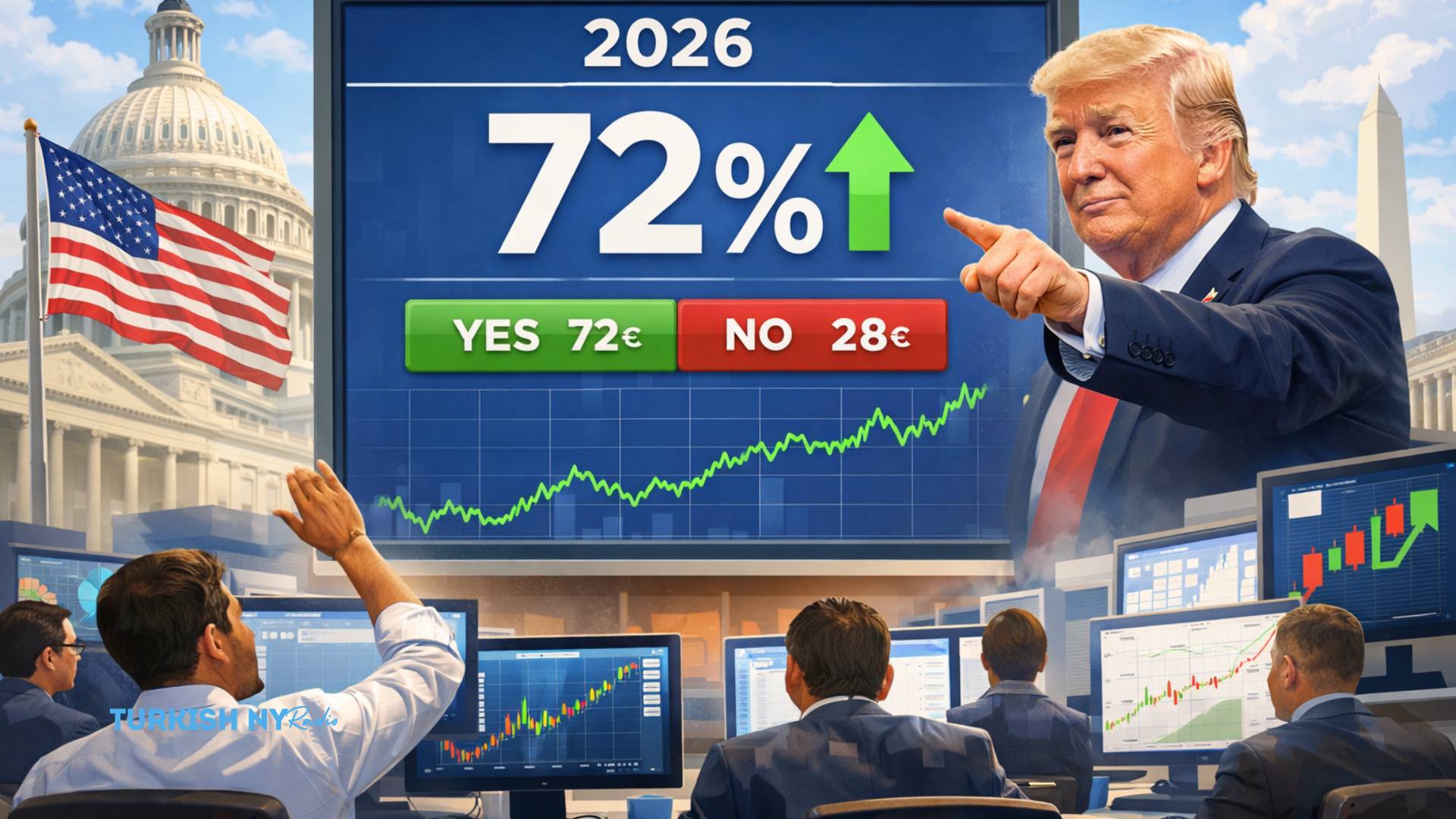
A niche but closely watched prediction market has lifted the implied probability that CLARITY Act 2026 becomes law to about 72%, after fresh political pressure from Donald Trump to move U.S. crypto rules forward.


That number is not a vote count, and it is not a whip list. Still, it is a useful temperature check because it updates in real time as traders react to headlines, committee signals, and backroom bargaining. The market’s own rules say the “yes” outcome requires the bill to pass both chambers and be signed by December 31, 2026, with resolution tied to official legislative tracking.
Why CLARITY Act 2026 odds are moving right now
The recent jump is being linked to Trump urging lawmakers to advance crypto legislation, a push that traders interpreted as reducing the odds of a long stall. The message to markets is simple: the political cost of doing nothing on crypto may be rising, and a headline friendly timeline is back on the table.
The signal also lands in the middle of active negotiation around thorny issues that tend to slow bills down. One current flashpoint reported in mainstream financial coverage is whether certain products, including yield features tied to stablecoins, should be allowed and how they should be supervised. If that fight gets resolved, it clears a path. If it does not, it becomes the familiar pothole that keeps lawmakers circling the block.
What the bill is trying to fix
The core problem is the gray zone. For years, the U.S. has relied heavily on enforcement actions and court fights to decide whether an asset looks more like a security or more like a commodity. That uncertainty makes everything harder: listing decisions, custody choices, disclosure standards, even basic risk management.
Supporters say CLARITY Act 2026 is designed to build a durable framework that tells the market who regulates what and under which rules. One detailed legal breakdown describes a structure that categorizes digital assets and splits oversight across agencies, aiming to reduce the tug of war and make compliance less like walking through fog.
Another policy analysis frames it as a serious attempt to create a workable rulebook for trading venues, token disclosures, and investor protection, rather than leaving the industry to guess where lines are drawn.
For crypto investors, the relevance is straightforward. If CLARITY Act 2026 passes, it may reduce the constant fear that a token, a platform, or a market activity is suddenly reclassified after the fact. That does not eliminate risk, but it can change the kind of risk that dominates.
The indicators that matter more than a headline percentage
The prediction market also shows meaningful participation, with total traded volume listed around $332,300, which is enough to take seriously but not enough to treat as destiny. Traders can be early, and they can be wrong. So the better approach is to watch the same indicators professional investors track for any major policy shift.

First, the calendar. When committees schedule markups and leadership signals floor time, probabilities tend to harden. Second, the language. If amendments start narrowing disagreements instead of widening them, confidence rises. Third, the coalition. CLARITY Act 2026 needs not only loud endorsements, but durable votes that survive procedural traps and rival priorities.
Finally, watch market behavior around U.S. listed crypto equities, custody providers, and the liquidity profile of major tokens. When legislation feels real, positioning often shifts before the final vote, not after.
Conclusion
The 72% signal is best read as momentum, not certainty. Still, CLARITY Act 2026 has become a central storyline because it speaks to something the market has wanted for years: a clearer U.S. rule set that replaces improvisation with predictable compliance. Whether the odds keep climbing will depend on the unglamorous work of drafting, negotiating, and counting votes, the part of politics that never fits neatly into a chart.
Frequently Asked Questions (FAQs)
What does the 72% figure actually represent for CLARITY Act 2026? It reflects the current price of a “yes” outcome in a prediction market, meaning traders collectively assign roughly that probability, based on information and sentiment at the moment.


What must happen for the market to resolve “yes”?
The bill must pass both chambers and be signed into law by December 31, 2026, according to the market’s published resolution rules tied to official tracking.
Why do traders react so quickly to political comments?
Because public pressure from powerful figures can change the likelihood of scheduling, compromise, and leadership prioritization, even if it does not guarantee passage.
Does CLARITY Act 2026 guarantee crypto prices go up?
No. A clearer framework can reduce some regulatory uncertainty, but price still depends on adoption, liquidity, macro conditions, and project fundamentals.
Glossary of key terms
Prediction market: A marketplace where participants trade contracts tied to real world outcomes, with prices implying probabilities.
Market structure: The rulebook for how trading, intermediaries, disclosures, and oversight work across a financial market.
Regulatory perimeter: The boundary that determines which activities fall under which regulator and which compliance rules apply.
Oversight split: A framework that assigns responsibilities across regulators based on asset type and activity, aiming to reduce overlapping claims.
Sources
Disclaimer
This article is for informational purposes only and does not constitute financial, investment, or legal advice.