![BitTorrent [New]](https://s2.coinmarketcap.com/static/img/coins/64x64/16086.png)



This article was first published on TurkishNY Radio.
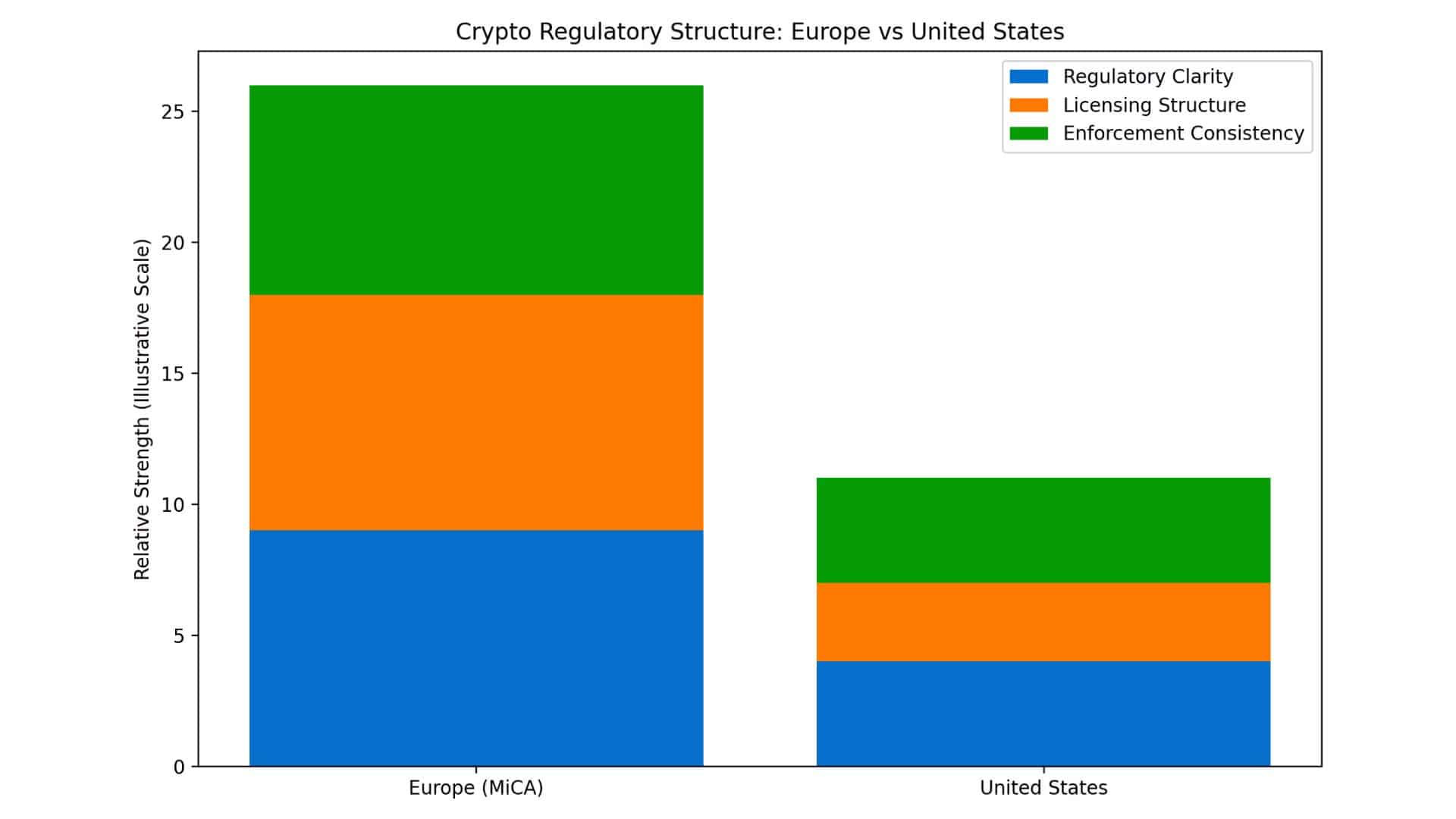
In digital finance, there is nothing more significant than how regulators define the rules of play. In early 2026, Europe changed track from preparing to implementing a comprehensive crypto framework, MiCA.


But the US crypto regulatory environment is divided and hesitant, creating a foreign market divide that will determine where companies build, where money flows, and how users behave towards all aspects of cryptocurrency services.
Current regulatory updates from Europe put the establishment of a clear timeline well before all EU member states and regions through which to regulate MiCA, so that businesses will have a predictable framework if they choose to formulate their strategies abroad.
Elsewhere in the United States, regulators and legislators are still arguing over how to build an architecture for crypto law. They have yet to resolve questions about the classification of assets, the degree of authority various agencies should exercise, and also, how effective a market should function.
MiCA’s Comprehensive Framework Takes Effect Across the EU
The Markets in Crypto-Assets Regulation (MiCA) represents a landmark shift in Europe’s approach to oversight of digital assets. It creates a uniform regime across all European Union member states for crypto assets not already covered by existing financial services laws, such as securities or banking regulations.
By setting the conditions for issuers and providers of CASPs (crypto asset services, including exchanges, brokers, custodians, and intermediaries), MiCA seeks to protect investors, market integrity, and transparency in digital assets.
MiCA has been formally adopted and gradually implemented since 2023. Asset-referenced tokens were regulated in mid-2024, with regs varied for e-money tokens in late 2024.
Firms that operated under old national licenses were given a deadline up until the end of 2026 to comply with new standards, or so as not be left in the cold. Now that the implementation has a planned timeline, firms can also start planning product launches, compliance budgets, and strategies for expansion, which was impossible in an opaque regulatory environment.
The regulation also introduces a European-wide ‘passporting’ system. This means that a license issued by the competent authority in a single Member State is valid throughout the Union, no separate approvals are needed from authorities in every nation in which the company wishes to do business. Such coordination eliminates overlapping requirements and breaks down hurdles to cross-border activities. For industries aiming at size within the EU market, this is a major plus.
Enforcement Replaces Fragmentation and Ambiguity
Under MiCA, enforcement is not optional or advisory; it is legally binding. National regulators apply uniform criteria at least across the EU., working in a broader system coordinated by the European Securities and Markets Authority (ESMA). So firms can prepare for “the day after” to remain in compliance-and what consequences follow if they don’t quite make it.
This clarity in regulations provides a lower barrier to entry to financial markets, market participants are better able to build infrastructure, list assets, innovate services.Then as a result of clarity on rules institutional participation in financial markets has historically been increased, because weak courts do not come across as natural allies in many other ways yet. Such clarity in rules lowers barriers to entering the financial markets.
Therefore, infrastructure can be built, assets listed, and services designed with less regulatory risk. In historical terms, where there is this kind of clarity of rules on one hand, there usually also tends to be better institutional participation from the other side, so that Weak courts do not feel like much of an ally after all.
MiCA also strengthens anti-money laundering (AML) and counter-terrorism financing measures for crypto activities. The EU’s wider AML packages now dovetail with MiCA’s anti-money laundering rules for crypto, with its risk-centred approach to supervision and enhanced investment protection.


Through such a comprehensive alignment, we can see society today treating digital assets as an integral part of financial systems rather than as merely a by-product of regulation.
The United States: Fragmented Rules and Delayed Clarity
While Europe consolidates rules, the United States continues to debate the structure and scope of its crypto law. There is no single federal regulatory framework in the US equivalent to MiCA. Oversight is split among multiple federal and state authorities.
The Securities and Exchange Commission (SEC) controls securities markets, while the Commodity Futures Trading Commission (CFTC) manages futures and selected commodities, and the Financial Crimes Enforcement Network (FinCEN) operates anti-money laundering programs, and the Internal Revenue Service (IRS) handles tax-related matters. On top of this, individual states issue money transmitter licenses with varying requirements.
The dispersed regulatory framework creates legal inconsistencies and results in unpredictable outcomes. Organizations such as the SEC carry out enforcement actions which function as unofficial rule establishment but these actions fail to deliver the dependable long-lasting standards that companies require before they can invest in new products or market entry.
As a result, many US-based exchanges and service providers have taken a conservative approach to asset listings and feature offerings, wary of legal interpretation risk.
Efforts to define a more transparent US framework continue. The Digital Asset Market Clarity Act and Financial Innovation Technology for the 21st Century Act both aim to clarify which tokens are securities rather than commodities and federally assign corresponding regulatory authority.
Meanwhile, the GENIUS Act, agreed in mid-2025, creates a federal regime for payment stablecoins that focuses on the issuer’s oversight, reserve requirements and consumer protections.However all of these measures are still piecemeal and do not add up yet to the comprehensive legal environment that competitive markets require.

Token Classification: A Central Point of Contention
In the United States, one of the most controversial as yet undecided problems is token classification. Standards like the Howey Test, a court ruling from nearly a century ago, are meant to define securities, but they did not take into consideration assets in a blockchain-native form. As a consequence, in law, many tokens are in a legal gray area, whether the community dares list them on exchanges or developers do not pull the trigger on securities law violations.
Regulators such as the SEC have admitted these woes and are contemplating new taxonomies for digital assets. These efforts aim to categorize tokens more exactly, possibly with exemptions or new definitions that reflect the decentralized nature of networks and their utility functions.
However, without new laws in place the lack of clear legal definitions will still hinder innovation and prevent features that require them, such as staking and yield products.
Stablecoin Regulation and Transatlantic Contrasts
Stablecoins, whose value is determined by legal tender currencies, are one area of relative co-ordination between Europe and America, but they have different objectives. The GENIUS Act, for example, establishes a federal benchmark for payment stablecoins in the US, which includes reserve requirements and issuer qualifications. It aims to enable stablecoins to be used in everyday transactions, but also to strike a balance between innovation on the one hand and consumer protection on the other.
At EU level, the stablecoin regime of MiCA covers both asset-reference tokens and e-money tokens with definite reserves guidelines, redemption privileges, disclosure obligations and operational standards. Europe’s stability-oriented approach, transparency and integrated markets are juxtaposed against the United States’ payment-oriented perspective up till now confined within a narrow federal domain.
This divergence means that different stablecoins may be the focus in either jurisdiction, and their distribution strategies will moreover inherit various national compliance requirements.
How Firms Adapt to Regulatory Divergence
Given these different regulatory environments, firms are adjusting their strategy. Many now seek European authorization first because MiCA offers a predictable, unified compliance path. US expansion often comes later, as companies assess risks associated with asset classification and agency enforcement practices.
This strategy appears increasingly common among global crypto firms, which view MiCA compliance as a stable starting point before tackling US complexities.
In the US, exchanges often narrow their offerings or restrict certain features to avoid potential legal issues. By contrast, in Europe, firms can build richer product suites under MiCA’s clearer asset categories and disclosure requirements. However, this richness comes with higher compliance costs, which smaller companies must absorb or risk exiting specific markets.
Market Impact: Liquidity, Competition, and Developer Focus
Regulatory clarity influences market behavior. Liquidity flows tend to concentrate in jurisdictions with known and enforceable rules. EU-regulated venues may increasingly attract institutional and retail interest due to their consistent standards. In the US, deep capital markets remain, but are more selective in what assets and features they support.
Compliance costs also reshape competition. Larger firms can spread the burden of meeting rigorous rules across their enterprises. Smaller firms, particularly startups, face pressure to merge, specialize, or pivot to less regulated areas.
Risks, Education, and Informed Participation
Nonetheless, dangers still remain, despite the progress in regulation. Price fluctuations, loopholes in the code governing smart contracts, and problems with execution intensify risk. Regulatory measures do not reduce these risks but cannot avoid market uncertainty, technical default and other issues. When users have access to educational resources, open disclosure, and public opinion works for them as a watchdog, it will help them make what can be considered rational decisions, given their current knowledge and capacities.
Users and institutions in the crypto community must understand the context of regulation in order to properly assess both platform credibility and products. Europe’s MiCA regime reduces uncertainty for companies and users, but the larger world of cryptos will still continue to evolve.
A Turning Point With Lasting Effects
Enforcement of MiCA could change the way digital currencies are governed. It puts regulatory certainty into the center of participation in markets and long-range planning. Europe’s clear-cut method contrasts with America’s slower, debate-driven process, highlighting a trend towards competition in how to regulate.
The fate of US crypto rules will determine whether global markets remain fragmented or whether they come into conformity. Until that discussion unfolds, the crypto industry will continue to adapt to a landscape in which Europe has strong and clear rules while America’s supervision grows and changes.
This article is for informational purposes only and does not constitute financial advice. Readers should conduct their own research before making investment decisions.
Glossary
MiCA: Markets in Crypto-Assets Regulation, a comprehensive EU framework for crypto assets.
Crypto asset service provider (CASP): A firm offering crypto-related services like trading or custody.
Token classification: Legal process of defining whether a digital asset is a security or commodity.
Stablecoin: A cryptocurrency pegged to a stable asset like a fiat currency.
Passporting: EU system where a license in one country allows company-wide operations across the bloc.
Frequently Asked Questions
What is MiCA?
It is the EU’s comprehensive regulatory regime that standardizes crypto rules across member states.
Why is US crypto regulation delayed?
US laws remain fragmented among multiple agencies and pending legislation.
Does regulation remove crypto risk?
No regulation removes all risk, but more explicit rules can reduce legal and operational uncertainty.
Will US rules align with Europe?
Future alignment is possible but not guaranteed, as each region prioritizes different goals.