
When the world’s largest democracy hesitates on a financial frontier, the ripples are felt far beyond its borders. India’s latest decision to hold back from enacting a full crypto law has ignited discussions across policy circles, investor communities, and the tech world.
The government, citing systemic risks and monetary sovereignty concerns, has opted for a wait-and-watch approach, a move that reflects both caution and calculation. For millions of Indians engaged in digital assets, this pause adds another layer of uncertainty to an already complex regulatory environment.


Why India Stalled the Full Crypto Law
The Reserve Bank of India (RBI) has consistently voiced its worries over cryptocurrencies becoming too deeply embedded in the economy. Officials argue that a comprehensive crypto law might inadvertently legitimize an industry still fraught with volatility and illicit activity.
According to a Reuters report, a government document stated that “regulating crypto could give legitimacy and lead to systemic implications,” highlighting the fear that digital assets could grow into a financial behemoth too big to control.
The Systemic Risks in Focus
Systemic risks are at the heart of this cautious stance. Unlike equities or bonds, cryptocurrencies are decentralized and global by nature.
While banning crypto completely is not considered effective, peer-to-peer and decentralized exchange trading would continue underground, a full crypto law could create new vulnerabilities.
Stablecoins, especially those pegged to the U.S. dollar, are a primary worry. Analysts warn they could challenge India’s widely adopted Unified Payments Interface (UPI).
As one India Today report explained, stablecoins might “fragment payment systems and erode the strength of domestic monetary policy.”
What the Numbers Say
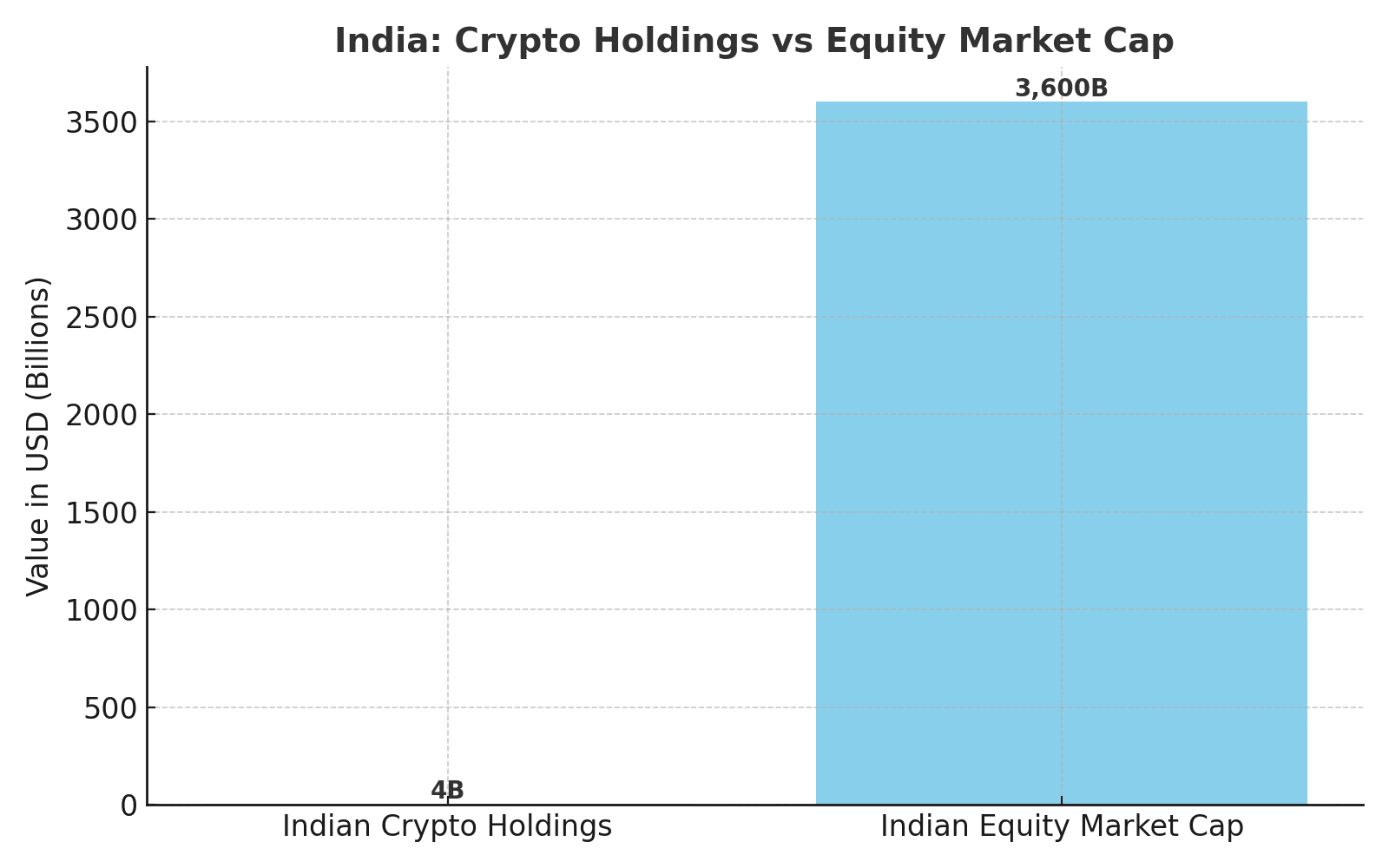
Despite the concerns, India’s crypto footprint is notable. Rough estimates suggest Indians collectively hold about $4.5 billion in crypto assets.
The figure is significant but not yet deemed “systemic.” For comparison, equity market capitalization in India stands at trillions.
Yet, policymakers argue that it’s not the present scale but the potential future surge that makes a strong crypto law risky.
A Patchwork of Partial Regulations
Instead of a sweeping framework, India relies on targeted measures:
-
A 30% tax on crypto gains.
-
Mandatory registration for global exchanges operating locally.
-
Anti–money laundering compliance for service providers.
These steps provide oversight without handing the sector full legitimacy. As a result, India remains one of the world’s most intriguing crypto markets, a hub of activity operating in regulatory limbo.
Industry and Public Reaction
Crypto entrepreneurs in India are pushing back. On X (formerly Twitter), Nischal Shetty, co-founder of WazirX, posted: “We need clarity, not confusion. Holding back a full crypto law only prolongs uncertainty for builders and investors in India.”
International observers echo this frustration. CoinTelegraph quoted analysts who argue that regulatory clarity is essential to prevent brain drain, as Indian developers and startups increasingly move abroad.
The Road Ahead
For now, the government appears unwilling to risk the financial ecosystem with a sweeping crypto law. Yet the conversation is far from over. India’s cautious posture may evolve as global standards emerge and domestic demand continues to rise.
In the words of one senior policymaker, as quoted by Reuters: “The risks are not systemic today, but legitimization through a comprehensive law could make them systemic tomorrow.”
Conclusion
India’s decision to delay a comprehensive crypto law reflects a strategic balance between innovation and financial stability.
While taxation and oversight continue, the absence of a legal framework leaves uncertainty for investors and innovators alike. The future of India’s digital asset journey remains unwritten, and the world is watching closely.


For more news, visit our platform.
FAQs about crypto law
1. Why is India delaying a full crypto law?
Because of concerns that regulation could legitimize cryptocurrencies and create systemic financial risks.
2. Does India ban crypto trading?
No, trading is allowed but taxed heavily, and exchanges must follow compliance rules.
3. Why are stablecoins a concern?
They could undermine India’s payment systems like UPI and affect monetary control.
4. How much crypto do Indians hold?
Roughly $4.5 billion in assets, according to government estimates.
Glossary
-
Crypto Law: A legal framework to regulate digital assets and related activities.
-
Systemic Risks: Threats that can destabilize an entire financial system.
-
Stablecoin: A cryptocurrency pegged to a stable asset like the U.S. dollar.
-
UPI (Unified Payments Interface): India’s widely used real-time digital payments system.