![Sun [New]](https://s2.coinmarketcap.com/static/img/coins/64x64/10529.png)



This article was first published on TurkishNY Radio.
Hyperliquid has emerged as one of the most active crypto trading platforms by volume. According to the data, Hyperliquid trading volume was higher than that of Coinbase in 2025.


The change reflects a larger evolution in how traders select places to do derivatives trades. Decentralized exchanges are becoming increasingly popular as users demand speed, transparency and control.
Hyperliquid Trading Volume Tops Coinbase
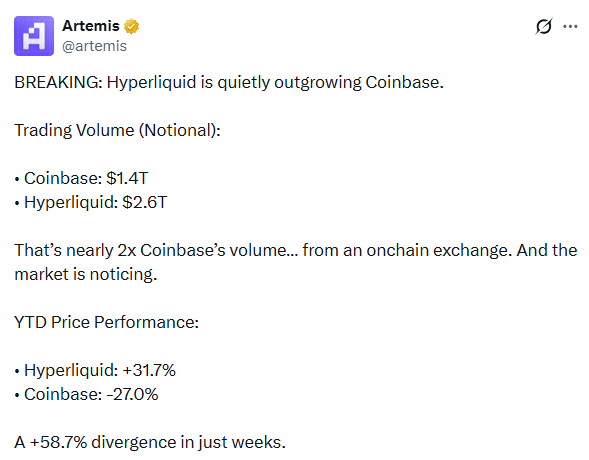
On-chain analytics data shared on Feb. 10 shows Hyperliquid processed about $2.6 trillion in notional trades during 2025. Coinbase recorded roughly $1.4 trillion in the same period.
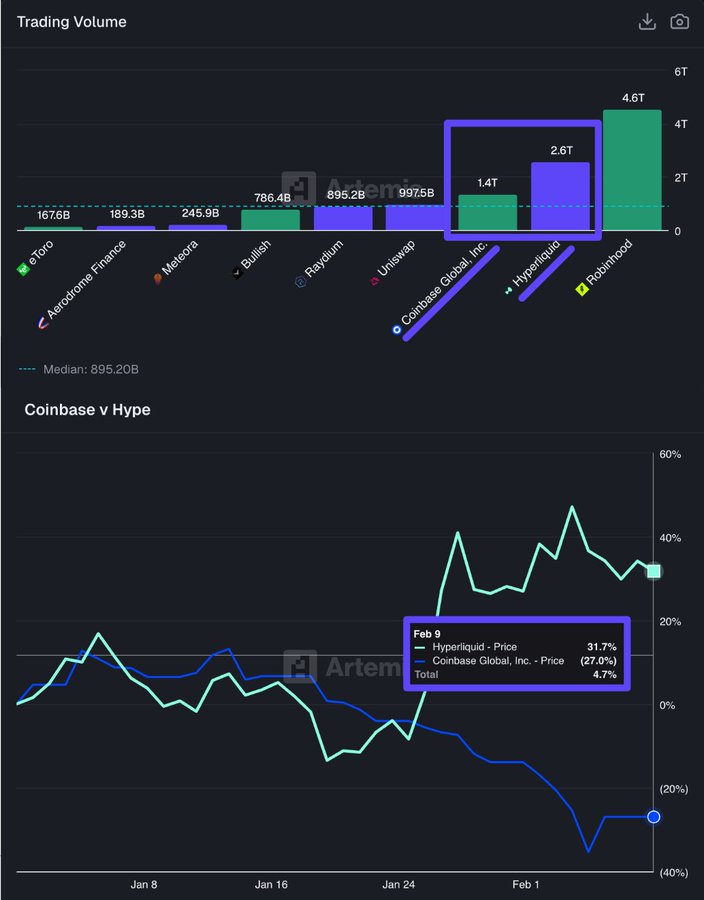
The figures suggest Hyperliquid trading volume was almost double that of one of the largest centralized exchanges. The milestone has attracted attention across the crypto sector.
Despite launching only a few years ago, the platform has scaled rapidly. Analysts say the growth in Hyperliquid trading volume reflects changing trader preferences rather than short-term speculation.
Built for Perpetual Futures
Hyperliquid concentrates on derivatives trading rather than spot markets. This focus has helped it attract active and professional traders. Fast execution and low fees are key draws.
Direct access to on-chain liquidity also appeals to users who prefer transparency. These factors have played a major role in driving Hyperliquid trading volume higher.
Strong Growth Through 2025
The platform expanded steadily throughout last year. Daily trading activity sometimes approached $30 billion. Monthly volumes often reached into the hundreds of billions.
Total value locked moved closer to $6 billion. Open interest peaked near $16 billion. Each of these indicators supported the continued rise in Hyperliquid trading volume.
Rapid User Adoption
User growth accelerated alongside trading activity. Active users increased from about 300,000 to more than 1.4 million in one year. Much of this growth came through word-of-mouth. The platform relied less on paid marketing.
Consistent performance helped reinforce trust. Higher Hyperliquid trading volume also signaled deepening liquidity to new users.
Token Incentives and Ecosystem
Fees collected on the platform are partly used for buybacks and burns of the HYPE token. This structure has supported long-term interest in the ecosystem.
As of early 2026, HYPE was up around 31.7% on the year. Traders often point to this model as one factor behind sustained Hyperliquid trading volume.
Comparison With Coinbase
Coinbase follows a very different model. It operates as a centralized exchange with higher fees and strict compliance rules. These features make it accessible for retail users.
However, professional traders often seek flexibility and lower costs. Coinbase stock is down about 27% so far this year. The contrast highlights why Hyperliquid trading volume has gained momentum.
Self-Custody and Transparency
Hyperliquid allows traders to keep custody of their funds. Smart contracts manage risk and settlement. Trades are recorded on-chain. This reduces reliance on a central operator.
For users cautious after past exchange failures, this approach is appealing. Many analysts see this as a key driver of rising Hyperliquid trading volume.
Product Development and Attention
The platform is also testing new products. These include outcome-based contracts and limited-risk options. Such experiments aim to expand use cases without compromising core functionality.
Well-known industry figures have taken notice. This attention has further boosted confidence in the platform and supported Hyperliquid trading volume growth.
Competition and Regulation
Challenges remain. Decentralized derivatives are starting to get more competitive. Aster and Lighter, among others, have been moving into that realm.
Regulators are also monitoring on-chain trading more closely. This could affect future expansion. That being said, present figures indicate the Hyperliquid trading volume has gained some solid ground.
Conclusion
Hyperliquid’s ascension is a sign of change in crypto market structure. Decentralized exchanges are no longer just fringe alternatives. They’re going head-to-head with platforms that are already established.
The platform garnered an increasing proportion of derivatives activity by offering usability and on-chain settlement combined. How far this trend will go is a question of regulation, competition and market dynamics.
Appendix: Glossary of Key Terms
Volume: The total amount traded in a given period on the platform.
Perpetual Futures: A derivative product with no expiration date, which follows the price of an underlying asset.
DEX (Decentralized Exchange): A trading platform which is not run by a central entity but uses blockchain technology to complete transactions.
Layer 1 Blockchain: The underlying blockchain that can process transactions and smart contracts by itself.
Total Value Locked (TVL): The sum of value of all assets that are staked in a protocol or application.
Open Interest: The amount of contracts entered into, in which there has not been a settlement transaction completed.
Self-Custody: A process where the users have a direct influence with their funds, instead of entrusting it to someone else.
Frequently Asked Questions Hyperliquid Trading Volume
1- What is Hyperliquid?
Hyperliquid is a decentralized exchange focused on perpetual futures trading.
2- How did Hyperliquid compare to Coinbase in 2025?
Hyperliquid processed about $2.6 trillion in notional trades, while Coinbase handled around $1.4 trillion.
3- Why are traders choosing decentralized platforms?
Lower fees, faster execution, transparency, and self-custody are key reasons.
4- What risks does Hyperliquid face?
Rising competition and increased regulatory scrutiny remain the main challenges.


References