



This article was first published on TurkishNY Radio.
A healthy investment plan has a strange quality: it feels a little dull. That is not an insult. It means the plan is designed to work without constant checking and constant switching. Crypto is rarely dull, so structure matters even more. This article explains how an investor can build a crypto portfolio using a simple, repeatable playbook. It covers allocation, diversification, research signals, and maintenance, with language that stays practical.
Decide the role of crypto in the bigger picture
Crypto should sit inside a broader financial plan, not replace it. An investor can start by setting a percentage cap based on risk tolerance and time horizon. If emergency savings and traditional investments are already in place, a crypto portfolio becomes a growth sleeve rather than a make-or-break bet.
It also helps to separate money by purpose. Funds needed within 12 months generally do not belong in a highly volatile allocation. Funds meant for 5 years or more can handle more volatility, provided the investor can hold through drawdowns.
Build the three buckets inside crypto
A balanced crypto portfolio can be built with three buckets that behave differently.
The first bucket is the foundation. It typically holds the most established networks, chosen for liquidity, longevity, and broad market access. The job of the foundation is to keep the allocation from becoming pure speculation.
The second bucket is the growth layer. It includes smart contract platforms and infrastructure that benefit from network usage. The investor should keep this layer selective because narratives here rotate quickly.
The third bucket is the ideas layer. It holds smaller, higher-risk positions with a clear thesis and a clear risk limit. This layer can add upside, but it should not dominate the crypto portfolio. If it grows too large, the allocation becomes fragile.
Diversify by risk drivers, not by themes
Two tokens can look different and still share the same risk driver. Many altcoins are tied to the same liquidity cycle and the same leverage behavior. When stress hits, correlation jumps and everything sells together.
Real diversification inside a crypto portfolio comes from owning assets that respond to different forces. A settlement network can behave differently from a token that depends on protocol fees. Infrastructure may react to developer activity and integrations. The portfolio can still fall in a broad crash, but it does not need to be fully dependent on one story.
Stablecoins can be used as a tool for rebalancing and staged entries, but they carry depeg and counterparty risk. They fit best when the role is clear.
Leverage deserves a clear boundary. Margin and perpetual contracts can amplify gains, but they can also force liquidations at the worst time. Many long-term allocators keep leverage outside the long-term plan, or avoid it entirely, because it changes the risk profile overnight. If leveraged products are used, they should be limited to a small experimental sleeve with strict limits and a clear exit rule.
Learn a short research checklist
Crypto research can become a rabbit hole. A short list of signals keeps it sane.
Liquidity and market depth matter because they determine how easy it is to enter and exit without heavy slippage. Thin order books can turn a small sell into a sharp drop, which is not the kind of risk a balanced crypto portfolio needs.
Token supply mechanics matter because dilution is a slow leak. Emissions schedules, unlock dates, and vesting terms can keep pressure on price even when the product improves. Supply data should be read carefully.
Product usage matters because it creates demand that does not rely on hype. Network fees, transaction activity, and real integrations can provide proof that a chain is doing work. Developer activity is related. Projects with consistent updates and a healthy builder ecosystem tend to survive mood shifts better than projects that appear only during rallies.

Security design matters too. Bridges and complex protocols can introduce risks that are not obvious from a price chart. If a position is included in the crypto portfolio, the investor should know where the weakest link is.
Write rules for buying, selling, and rebalancing
The market rewards discipline more often than it rewards genius. Rules turn decisions into routine.
Staged buying can reduce regret. Instead of deploying everything at once, an investor can split entries into 3 or 4 tranches. Profit-taking can also be structured. When a position grows far beyond its target, trimming back toward the target can reduce risk without fully exiting.
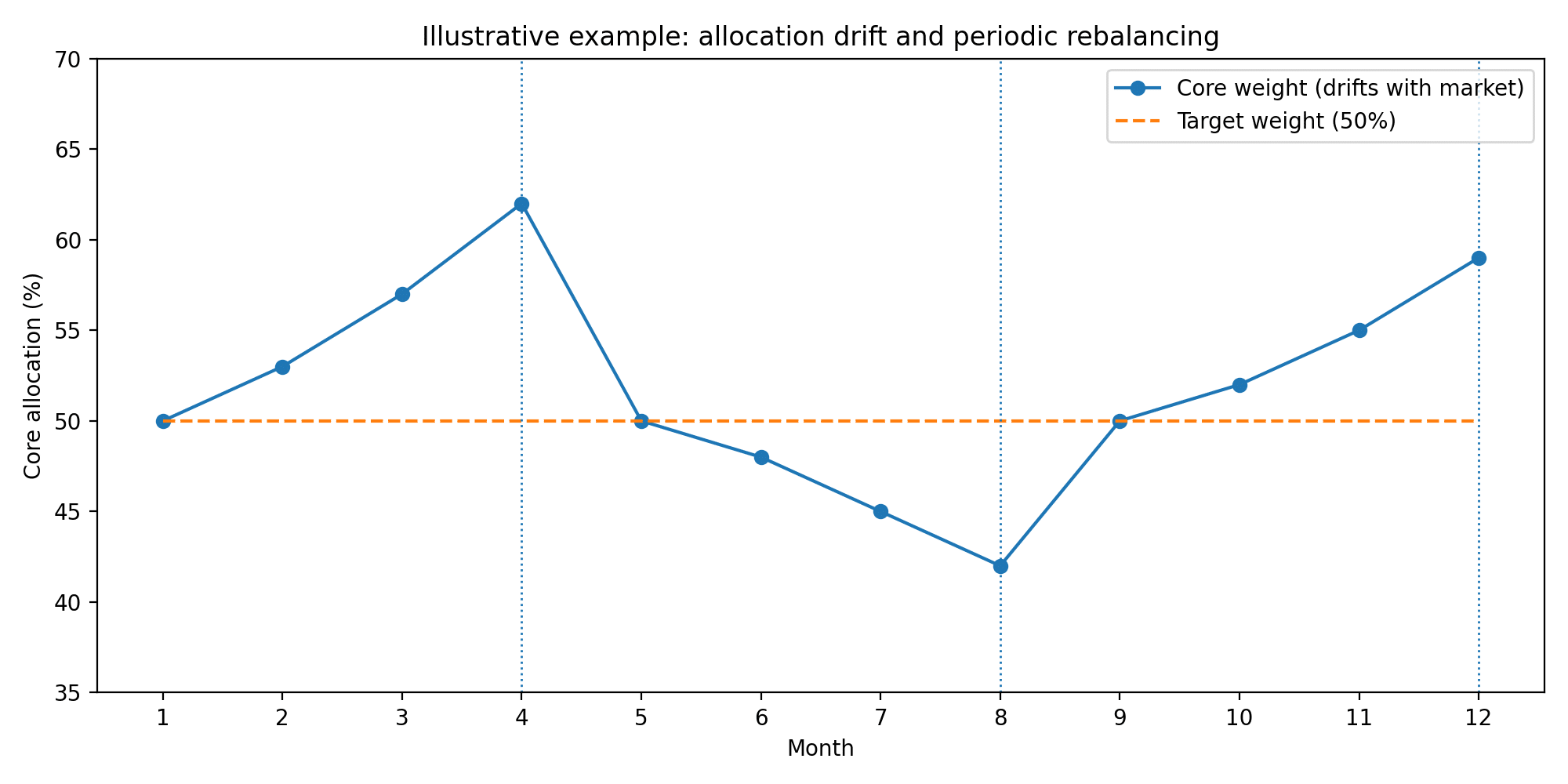
Rebalancing is the practice of returning weights to targets after moves. It helps keep a crypto portfolio aligned with its original risk budget. Many investors rebalance monthly or quarterly, and they also adjust when a holding drifts materially from its target, such as 25% above. Taxes and fees should be considered, because frequent trades create friction.
Treat custody as part of diversification
Diversification is not only about assets. It is also about operational risk. Keeping everything in one place creates a single point of failure.
Many long-term holders keep smaller balances on exchanges for trading and move longer-term holdings into self-custody. Hardware wallets, securely stored seed phrases, and careful account hygiene reduce the chance of catastrophic loss.
Prepare for news shocks without living in headline mode
Policy headlines can move crypto quickly because they affect access and liquidity. A balanced investor watches the big themes but avoids constant switching.
When a headline arrives, the investor can ask: does this change access, liquidity, or long-term fundamentals? If the answer is no, the best action may be no action. If the answer is yes, the investor can adjust within the plan rather than rebuilding the crypto portfolio from scratch.
Keep the plan simple enough to follow
Complexity is a hidden risk. Too many assets, too many platforms, and too many strategies increase operational errors and emotional fatigue.
A manageable crypto portfolio is one that can be reviewed in a short monthly check. It has clear targets, clear risk limits, and a short research list. It is designed to survive being wrong about a few picks.
Conclusion
A balanced crypto portfolio is built like a well-packed suitcase: there is room for essentials, room for a few optional items, and no room for chaos. With a clear cap inside the broader financial plan, a three-bucket structure, research focused on liquidity, supply, usage, and security, and a rebalancing routine that keeps emotions out of the process, an investor can stay exposed to crypto upside while keeping downside survivable.
This article is educational and does not provide personal financial advice.
Frequently Asked Questions
Should an investor hold only 1 or 2 coins?
Concentration can work for specialists, but it increases risk for most people. A diversified structure can reduce single-asset failure risk while staying manageable.
What is a reasonable number of holdings?
Many investors find that 5 to 12 positions is enough to cover core exposure and a few researched themes without creating confusion.
Is yield a good reason to buy a token?
Yield can be meaningful, but it can also be subsidy, leverage, or hidden counterparty risk. The investor should understand the source of yield and the downside scenarios.
How should performance be tracked?
A simple journal that records entries, exits, fees, and the thesis for each holding improves learning and supports tax recordkeeping.
Glossary of key terms
Correlation: The tendency of assets to move together, often rising during stress.
Liquidity: The ease of trading without moving price significantly.
Unlock schedule: A timetable that releases previously locked tokens into circulation.
Emissions: New token issuance over time, which can dilute holders.
Protocol fees: Fees generated by network or application usage.
Rebalancing: Returning holdings to target weights after price moves.
Seed phrase: Words that restore a self-custody wallet.
Slippage: The difference between expected and executed trade price.
References
Bank for International Settlements