To get in to a crypto market, price often behaves like a temperamental river: unpredictable current, sudden rapids, surprises around bends. Technical analysis offers a way to read the flow. It does not predict with certainty. What it does is help frame expectations, manage risk, and make decisions feel less like guesses.
Technical analysis rests on a few core ideas. First: price action reflects everything, sentiment, news, expectations, fear, and greed. Second: trends tend to persist until something shifts them. Third: history does not repeat, but it often rhymes; patterns tend to recur because traders’ behavior repeats. And volume often acts like a confirmation tool, moves backed by strong volume carry more weight.


In crypto, these ideas are more fragile, because markets are hypervolatile, influenced by news, and run 24/7. But the structure still matters. Technical analysis gives traders a grammar to interpret what the market is saying.
Building Blocks: Charts, Timeframes & Price Structure
Before indicators come into play, the trader must first understand how to “see” the market.
Candlesticks & Price Action
Candlestick charts remain the backbone. Each candlestick shows four data points: open, high, low, close. Combinations of candlesticks can reveal sentiment shifts, a hammer after a drop may hint at reversal; a long upper wick may show rejection.


Beyond individual candlesticks, traders look for patterns over time: double top or bottom, head and shoulders, flags, triangles, wedges. Often, the setup lies in how price organizes itself.
Support & Resistance
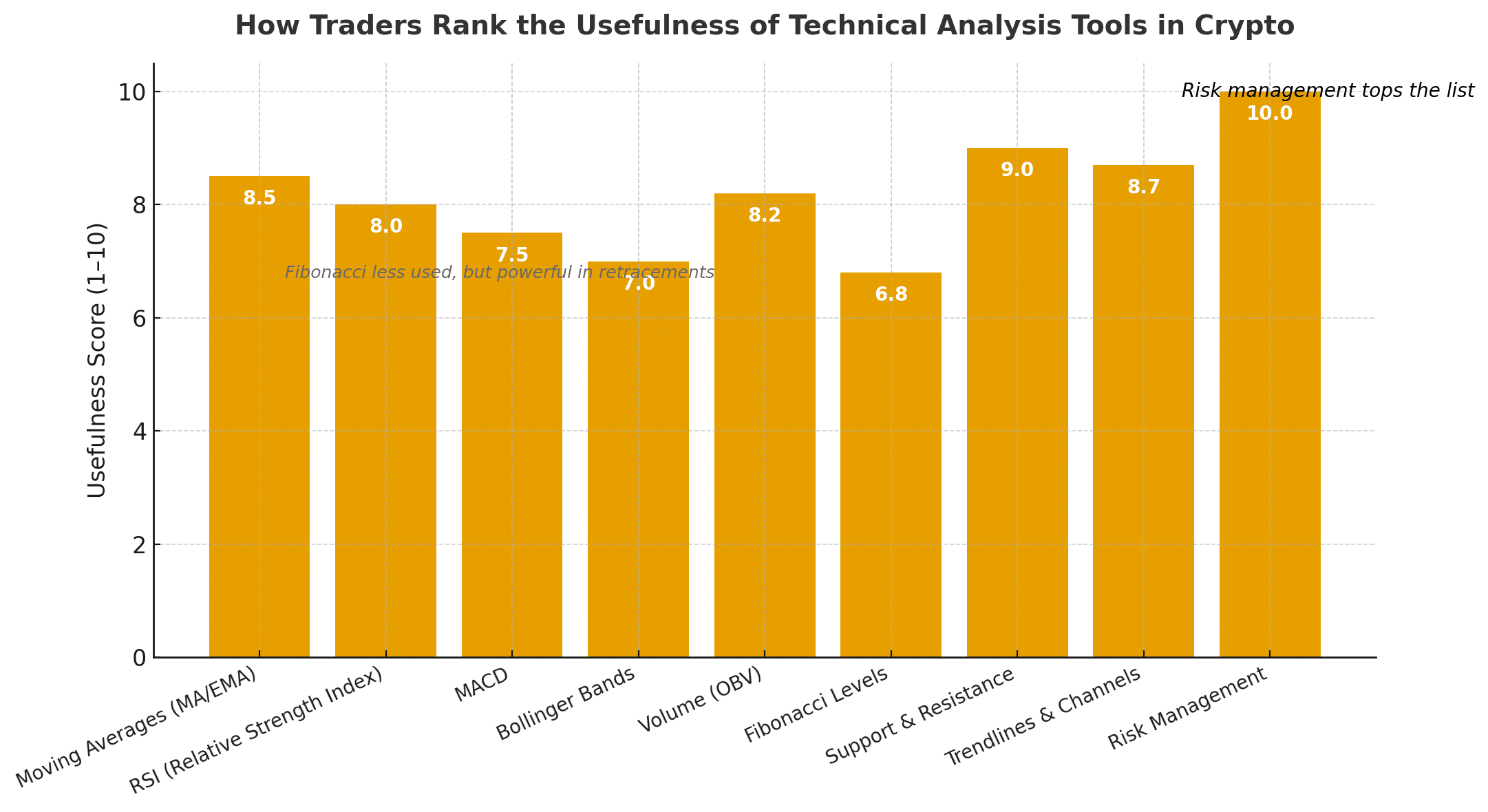
These are horizontal (or gently sloping) zones where price historically paused or turned. Support is a zone where demand tends to emerge; resistance is where supply often takes over. Price tests these lines frequently. A breakout above resistance or a bounce off support forms potential setups.
Trendlines & Channels
Connecting successive highs or lows with lines helps visualize direction. In an uptrend, the price makes higher lows; in a downtrend, the price makes lower highs. Channels, parallel lines above and below trends, create zones where reversals or continuations can be traded.
Multiple Time-Frame View
A 5-minute chart may show a hopeful trend, but if the daily chart is flat or bearish, that setup carries more risk. Smart traders always zoom out to see context. What looks bullish in the micro view may be a countertrend move in the macro view.
Vital Indicators: What They Do & How to Use Them
Once the foundation of the structure is understood, indicators become tools for confirming, timing, and filtering. Let’s go through the ones that matter most in crypto trading.
Moving Averages (MA / EMA)
These smooth price over time. Simple moving averages (SMA) treat each data point equally; exponential moving averages (EMA) weight recent data more heavily. Common settings in crypto include 9, 21, 50, 100, 200.
When a shorter MA crosses above a longer one (say 21 crossing 50), that can hint at a trend start, the reverse can hint at trend loss. Also, a price above a moving average often signals bullish bias; below, bearish.
Relative Strength Index (RSI)
RSI measures recent price gains vs losses over a given period (often 14). It ranges from 0 to 100. Readings above ~70 suggest overbought zones; below ~30 oversold zones. Yet in strong trends, RSI can stay in overbought/oversold territory for extended stretches.
One powerful use is divergence: when price forms new highs but RSI does not, it may warn the trend is weakening.
MACD (Moving Average Convergence Divergence)
MACD takes the difference of two EMAs (commonly 12 and 26) and plots a signal line (often the 9-period EMA of that difference). When MACD crosses above the signal line, that is often seen as bullish; a cross below is bearish. The histogram shows the difference between MACD and its signal, useful for momentum.
Divergences between MACD and price (e.g. price rising but MACD failing to follow) often warn of trend fatigue. Because MACD is a lagging tool, confirmation from price or volume is prudent.
Bollinger Bands
Bands are drawn at a specified number of standard deviations above and below a moving average. When bands squeeze (they come closer together), it often precedes a strong move (expansion). Price walking the upper band suggests strength; bouncing off the lower band suggests weakness or support.
Volume and On-Balance Volume (OBV)
Volume is a vital confirmation tool. Moves without volume are suspect. OBV accumulates (adds) volume on up days and subtracts volume on down days. If OBV rises while price lags, that may signal hidden strength.
Other volume-based tools include the accumulation/distribution line, which weights volume by where in the bar price closed relative to its range.
Fibonacci Retracements and Extensions
Traders use Fibonacci ratios, 23.6 %, 38.2 %, 61.8 %, to project areas where price might pull back (retracement) or push out (extension). After a strong move, price often revisits these zones before continuing or reversing.
Additional Tools (Less Common but Useful)
-
Parabolic SAR (dots above/below price showing trend direction)
-
Detrended Price Oscillator (removes longer trend to highlight cycles)
-
Moving Average Envelopes (fixed bands around a moving average)
They can help in niche setups or confirmation, but relying too heavily on many indicators is dangerous.
Stitching It Together: A Realistic Setup Blueprint
Knowing indicators is step one. Executing a trade is step two. Here is how an informed trader might bring them together.
-
Define trend direction on the higher time frame
If the daily chart is trending up, biases favor longs. If trending down, short setups carry higher probability. -
Spot potential structure (pattern, support/resistance, channel boundaries)
For example, price may be hitting the upper edge of a rising channel or a known resistance zone. -
Look for indicator alignment
Perhaps RSI is near overbought but not extreme, MACD shows a flattening or slight reversal signal, and volume is tapering. That combination suggests caution. -
Confirm entry
Wait for price confirmation: a strong candle that closes beyond a boundary (e.g., a breakout) or rejects a level with conviction. -
Set stop and target
Use structure to place stop-loss (beyond swing highs/lows) and target (often using Fibonacci or next structure). Decide how much capital is at risk before entering. -
Manage trade
If price moves favorably, consider adjusting the stop or scaling out. If the price violates the structure or your hypothesis, accept the loss early.
What Makes Crypto Special (and Riskier)
Crypto behaves differently from stocks, and these quirks must inform how one applies technical analysis:
-
Fast, chaotic volatility
Prices can jump or crash rapidly, making false breakouts more frequent. -
News and sentiment dominate
A single tweet or regulatory announcement can override patterns. -
Always-on markets
There is no “market close.” Trends can evolve out of off-hours. -
Thin liquidity in smaller coins
Small- and mid-cap tokens may show erratic volume, wider spreads, and slippage.
Because of this, technical analysis in crypto must be tempered with awareness. It is not enough to see a “perfect” indicator alignment; one must also consider news, on-chain flows, and sentiment.
Blending On-Chain & Sentiment with Technicals
One edge crypto offers is transparency: on-chain metrics (wallet flows, transaction counts, active addresses) and sentiment indices (social media, fear/greed gauges) can be overlaid on classic technical signals. Studies suggest that combining technical indicators with on-chain and sentiment data often improves predictive power beyond TA alone.
Imagine a bullish chart setup aligning with rising inflows into exchanges and growing social chatter. One would feel more confident in that combination than relying on chart alone.
Common Pitfalls and Tips from Traders
Traders (experienced and rookie) often stumble in familiar ways. Here are some tips to avoid their traps:
-
Too many indicators = confusion
Limit yourself to a few complementary tools (trend + momentum + volume). More does not equal better. -
Jumping in late
Chasing a move after half the run is over often leads to regret. -
Crowding out context
Ignoring the bigger picture (higher timeframe, fundamentals, news) is risky. -
Emotional trading
Fear or greed cloud judgment. Stick to your rules. -
Wrong timeframe for indicator
Using an indicator built for daily charts on a 5-minute chart can yield noise, not a signal. -
Repainting/lagging illusions
Some indicators look nice after the fact but signal late, always demand confirmation.
Example Walkthrough (Hypothetical)
Suppose Ethereum is trending upward on the daily chart. On the 4-hour chart, the price approaches a resistance zone around $2,500. The RSI is drifting below overbought (say 65), MACD is flattening, and volume is tapering. A divergence forms: price makes a new high, MACD fails to follow. The trader waits. A bearish candle closes just below resistance, rejecting it.
They enter a short (or exit longs), placing stop just above the swing high. The target is the 38.2 % Fibonacci retracement. If volume surges downward, the move is more likely to follow. If price instead breaks resistance with strength, the trade idea is invalidated. The trader shifts to a breakout bias.
Final Thoughts
Technical analysis, when done well, is not about finding perfect signals. It is about tilting the odds in your favor. In crypto, where change is the only constant, TA is a guide, not a guardrail.
Charts whisper their stories. Over time, a trader learns to detect the tone, the cracks, the hesitations. But that takes practice, reflection, and humility. Use TA to organize chaos. Let it help you decide, not dictate.
Always pair indicators with structure, volume, risk rules, context, and awareness. The best trades often come not from fairy-tale signals, but from setups that respect what the market is doing, not what one hopes it will do.
Frequently Asked Questions
Q: Does technical analysis guarantee profits in crypto?
A: No. It provides structure, not certainties. Profits come from managing risk, adapting to market changes, and consistent discipline.
Q: Which time frame is best?
A: There is no one-size-fits-all. Day traders tend to use 5-minute to 1-hour charts. Swing traders use 4-hour or daily. Always observe a higher timeframe to confirm.
Q: Can I use many indicators at once?
A: You can, but that often results in conflicting signals. Two or three complementary ones (trend, momentum, volume) usually suffice.
Q: How to reduce false breakouts?
A: Wait for confirmation (e.g., candle close, volume surge). Avoid entering right at the level. Use filters or buffers.
Q: How do I combine on-chain metrics with TA?
A: Use them to validate or invalidate technical setups. For example, if a bullish setup aligns with wallet inflows, it’s more credible than one without.
Glossary of Key Terms
Candlestick: A visual bar showing open, high, low, and close in a specific time period.
Moving Average (MA / EMA): A smoothed trend line averaging past price data.
Relative Strength Index (RSI): Measures momentum by comparing recent gains and losses.
MACD (Moving Average Convergence Divergence): Signals trend changes via two EMAs and a signal line.
Bollinger Bands: Upper and lower bands around a moving average, based on standard deviation.
On-Balance Volume (OBV): Accumulates volume flows to capture buying/selling pressure.
Support / Resistance: Price zones where market participants historically push back.
Trendline / Channel: Lines connecting sequential highs or lows to define direction and zones.
Fibonacci Retracements / Extensions: Levels based on Fibonacci ratios used to project pullbacks or targets.