This article was first published on TurkishNYRadio
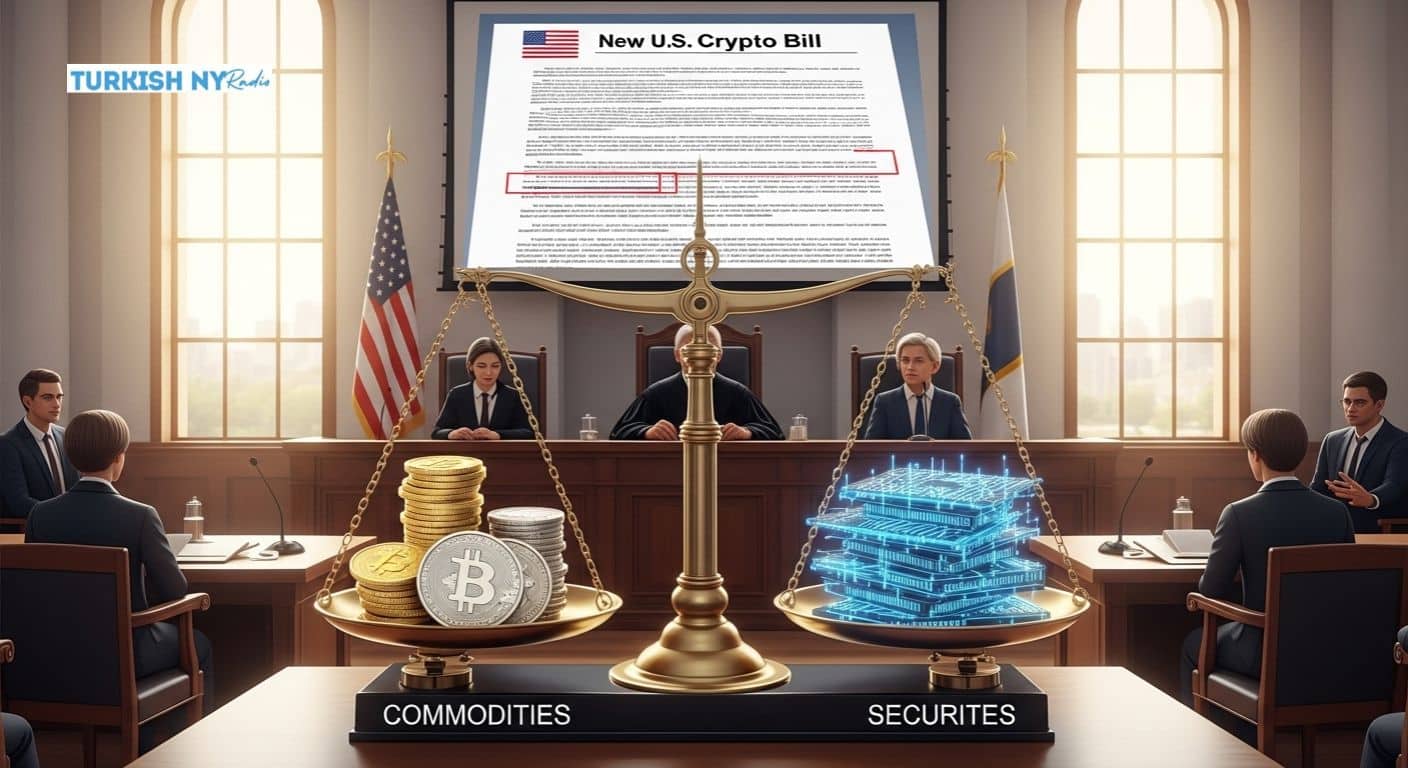
Congress is mulling over a new US crypto bill, which would put to rest years of regulatory uncertainty by explicitly defining digital assets as either commodities or securities. Both the House-passed CLARITY Act and the Senate’s bipartisan draft (the Digital Commodities Consumer Protection Act) offer clear definitions.


If passed, the law would clearly explain to companies and even investors whether a cryptocurrency should be treated for regulatory purposes like a commodity or security.
Background: Crypto Regulatory Tug-of-War
For years, American regulators have been at odds over whose authority extends to cryptocurrencies. The Securities and Exchange Commission (SEC) took a stance that most tokens were securities, using the Supreme Court’s Howey Test to define many coin offerings as investment contracts.
On the other hand, the Commodity Futures Trading Commission (CFTC) claimed that decentralized cryptocurrency networks (including Bitcoin) are commodities. In the absence of clear regulations, this division created a gray market.
Some crypto firms fretted about potentially violating securities law while others had policy ramifications from both CFTC enforcement targeting fraud.
The new US crypto bill aims to resolve that dispute. The House approved the Digital Asset Market Clarity Act (CLARITY Act) in July 2025, and then Senators Boozman and Booker introduced a Senate draft in November 2025.
Both seek to categorize digital assets and slot them into the proper regulators. Most significantly, the legislation would put what coins qualify as “commodities” or “securities” into black and white, an issue that has paralyzed the industry for years.
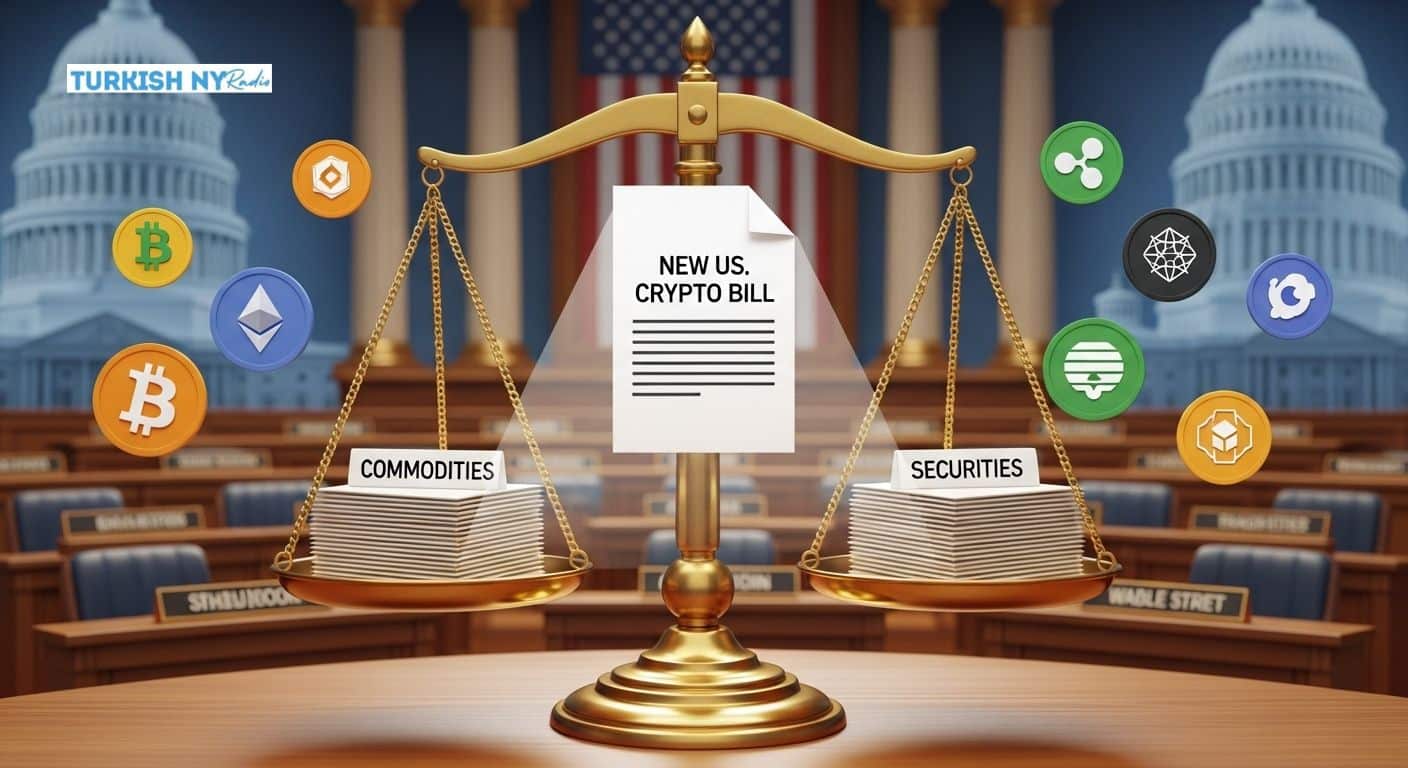
What are Digital Commodities and Securities?
The heart of the US crypto bill is a three-part categorization for digital assets:
Digital Commodities: The bill defines a digital commodity as a digital asset “intimately linked to a blockchain system,” with its value derived from the functionality of that blockchain. In other words, commodities are tokens that fuel or belong to a network (used for payments, governance, access and mining rewards etc.).
The legislation expressly excludes all securities from this definition, meaning any token meeting the commodity criteria cannot be a security under the law. For instance, Bitcoin and Ether (both open, distributed medium of exchange or platform ATPs) are obvious digital commodities.
Investment Contract Assets (Crypto Securities): The legislation effectively coins a new term for cryptos sold in fundraising, as an investment contract asset. This applies to any digital asset that is offered or sold in a way that resembles an investment contract (an example would be an ICO) during the distribution process.
Ultimately, if one purchases a token through something like a capital-raising scheme in which A gives money to B and gets tokens from B as part of the same transaction, that token is a security for that transaction.
Yet, crucially, once the initial sale is done with, the token becomes a digital commodity again when it’s being traded further down the line. This staged development affords project issuers certainty; they are compliant with securities laws only when first raising funds, but after that tokens trade like a commodity on exchanges.
Permitted Payment Stablecoins: The bill also includes stablecoins (referred to as “permitted payment stablecoins”) that are used as cash substitutes. These are regulated differently (by banking regulators) so they’re carved out of the commodity definition.
Both bills see no such stablecoins as digital commodities. Such that a new law, the GENIUS Act of 2025 now prescribes how many stablecoins should work.
By framing it this way, the new US crypto bill is making it clear that digital assets serving as money or network tokens are under the purview of the CFTC, while token sales for investment purposes are under the jurisdiction of the SEC.
This clarity has been celebrated as the bill’s greatest success. As Reuters points out, the CLARITY Act would put to rest a longstanding debate by establishing what a digital token is and when it is a security versus a commodity.
Shifting Oversight: CFTC’s Expanded Role
Under the new law, commodity tokens would be primarily under CFTC’s jurisdiction. The House and Senate versions consolidate regulation of the market for crypto in the C.F.T.C., undercutting a bit of the S.E.C.’s turf.
The Senate draft, for instance, explicitly gives the CFTC self-executing authority to regulate spot markets in digital commodities. “The CFTC is the right agency to regulate spot digital commodity trading,” Sen. Boozman said, adding that clear rules are necessary to protect consumers.
The draft would require that all digital-commodity exchanges, brokers and dealers register with the CFTC and adhere to new rules around custody, capital and disclosure.
That doesn’t relegate the SEC to the sidelines. The SEC would retain authority over securities assets (crypto securities) sold under an investment contract and general fraud enforcement.
The SEC would become the sole regulator of token sales by issuers, including registration and reporting required under the CLARITY Act. At the same time, both bills specifically maintain the SEC’s authority to police fraud and manipulation.
In the Senate draft, fraud investigations of digital assets (including even commodities) would still allow for SEC involvement under certain circumstances. The draft even requires agencies to jointly write rules for “mixed” products, those that are less clear-cut in falling under one category or another.
In sum, the US crypto bill shifts primary responsibility but does keep both agencies coordinating.
Senators Boozman and Booker highlight these points in their press release. The draft provides a tight definition of digital commodities as well as an Implementation of a clear regulatory regime for spot market digital commodities under the supervision of CFTC, strengthened Investor Protections (segregated funds, disclosure, anti-conflict rules), and required collaboration between the SEC and CFTC.
Boozman stressed that broadening the CFTC’s authority to provide oversight of trading in digital assets that are commodities will enhance consumer safety and promote innovation.
Industry Perspectives and Expert Analysis
A few industry groups in the crypto space have advocated moving primary oversight to the CFTC. This is consistent with President Trump and many Republican policymakers more generally, since the CFTC has a far more innovation-friendly mission than the SEC or other regulatory bodies.
Meanwhile, Democrats such as Sen. Booker emphasize consumer protections. In a statement, his office says the draft will grant the CFTC new resources to police the digital commodity spot markets, erecting new guardrails for retail customers and ensuring that agency has adequate people and funding.
Legal experts on the bill’s definitions. Arnold & Porter notes that the House bill’s categories carve out investment offerings from future sales.
Faegre Drinker’s review of the Senate draft arrives at the same conclusion. It defines a digital commodity as any fungible token that is transferable on its native blockchain and directly excludes securities.
Importantly, it specifically states that simply conferring token voting rights or even the possible appreciation in its price does not alone make something a security. This legal precision is aimed at keeping regulators from pointing to those features and tangentially reclassifying a network token as a security.
Chairman Paul Atkins also leans in somewhat the same direction from the SEC side, taking the viewpoint that native tokens on crypto networks are not securities. SEC Chair Atkins repeated intentions on issuing a “token taxonomy” intimating, “digital assets are not securities.”



This is not a formal position, but it’s consistent with the bill as written. This dual approach (regulatory rulemaking and Congress) is indicative, some say, of bipartisan agreement when it comes to separating the wheat from the chaff with respect to true commodity tokens versus investment contracts.
That said, experts are wary on other details. For example, the CFTC is not familiar with regulating retail brokerages or exchanges, and it’s also currently understaffed (one commissioner plus vacancies). Senators are aware of this.
Boozman promised to work with the Treasury to make sure the CFTC has adequate funding and staff in place so that it can execute its new crypto mission. There’s also disagreement over the one-year sunset or transition mechanisms called for in the Senate draft, such as how long token issuers remain subject to SEC oversight. Those conversations are ongoing in the committees.
Even if there are open questions, one theme comes through: clarity. Bloomberg reports that the proposal would classify most cryptocurrencies as digital commodities and put oversight under the purview of the CFTC.
Some in crypto see this as a good thing. The US crypto bill might actually provide some clarity to the crypto sphere for exchanges, institutions, developers et al. A more defined regulatory picture could stimulate market liquidity and encourage institutional participation, analysts say.
Summary of the New US Crypto Bill (CLARITY Act & Senate Draft)
| Category | Description |
| House Bill (CLARITY Act – Passed July 2025) | Defines which crypto assets are commodities vs. securities; introduces the term Investment Contract Asset; gives the SEC control over token sales and the CFTC control over commodity tokens. |
| Senate Draft (Digital Commodities Consumer Protection Act – Introduced Nov. 2025) | Bipartisan bill (Boozman–Booker). Expands CFTC oversight; gives CFTC self-executing authority over spot digital commodity markets; requires exchange registration and consumer protections. |
| Digital Commodity (as defined in the bills) | A fungible token tied to its native blockchain; value arises from the blockchain’s utility (payments, governance, mining rewards). Cannot be a security. Examples: Bitcoin, Ethereum. |
| Investment Contract Asset (Crypto Security) | A token sold through an investment contract (ICO-style fundraise). Treated as a security only at the initial sale. Afterward, it trades as a commodity. |
| Permitted Payment Stablecoins | Stablecoins used for payments; excluded from the commodity definition and regulated by banking regulators (per the GENIUS Act of 2025). |
| Primary Regulator for Digital Commodities | CFTC gains authority over spot markets, exchanges, brokers, custodians; must register and follow custody, capital, and disclosure rules. |
| Primary Regulator for Crypto Securities | SEC retains authority over token issuances, investment contracts, registration rules, and anti-fraud enforcement—including for mixed cases with CFTC. |
| Expected Impact | Greater clarity for exchanges, developers, institutions; resolves years-long SEC-CFTC dispute; may boost market liquidity and investor confidence. |
Conclusion
This US crypto bill legislation is a first of its kind in digital asset policy. By defining digital assets and securities clearly, it settles a longstanding dispute over how the laws apply.
If enacted, the legislation would delegate to CFTC, broad jurisdiction over cryptocurrency spot markets (i.e., treating tokens such as Bitcoin or Ethereum as commodities), while the SEC would concentrate on crypto sold as investment contracts.
This change offers exchanges clearer rules, for an enforcement that is more consistent and, in the end, gives more confidence for investors and innovators.
Glossary
Digital Commodity: A cryptocurrency or token that derives value from its native blockchain (Effectively used as a currency, a governance mechanism, or a network incentive). Under the new bill, that means things like Bitcoin and other tokens of a decentralized network.
Security (Investment Contract): A stock, a bond etc., or, in crypto: any token which is sold as an investment. Under U.S. law, most token sales are considered “investment contracts” if buyers anticipate profits from others’ efforts.
Investment Contract Asset: A CLARITY Act term for a digital asset sold via an investment contract (ICOs are a prime example). It’s a security when it is implied for the first time, but not a second.
CFTC: The United States Commodity Futures Trading Commission, which is a regulator for commodity derivatives markets. The bill would authorize the CFTC to oversee the crypto spot markets for digital commodities.
SEC: U.S. Securities and Exchange Commission. The SEC would regulate token sales (investment contract assets) under the bill and would still be able to enforce fraud rules.
Frequently Asked Questions About the New US Crypto Bill
What is the US crypto bill?
This applies to proposed laws like the House’s CLARITY Act and a companion Senate draft that seek to regulate crypto. The bill would specify which digital assets are “commodities” (CFTC oversight) and which are “securities” (SEC oversight), create new regulations for crypto exchanges and token issuers.
What does the bill say about digital commodities?
A digital commodity is “natively associated with a blockchain,” the value of which arises from the transaction in the network built on such blockchain” (e.g. networks) or that exert control over the use of a blockchain (e.g. mining rewards). Securities and stablecoins are not digital commodities. The bill defines commodities as limited to straight payment/network tokens (such as Bitcoin).
What is an investment contract asset?
This is a new category within the CLARITY Act. An investment contract asset is a digital good that is sold or distributed via an investment contract (e.g., a coin offered in an ICO). At the point of that first sale, it is considered a security under securities laws. But once the token is sold it becomes a digital good again and can be traded.
Which regulator is now under the aegis of the new bill?
The CFTC would have jurisdiction of digital commodities in spot transactions, such as new rules for crypto exchanges, brokers and custodians. The SEC, meanwhile would take carriage of the issuance and enforcement regarding fraud. Both agencies would also work together on “mixed” cases.
When would the bill become law?
As of November 2025, the CLARITY Act is approved by the House and has a Senate equivalent. It remains to be approved by the Senate and reconciled with the House version. Discussion continues into early 2026. The specific timeline is unclear and will be subject to congressional negotiations and committee votes.