Crypto has often seemed like a distant frontier, exciting, speculative, volatile, but alien to mainstream finance. Stablecoins change that story. They serve kind of like a tether between two lands: the world of fiat money we know and the fast-evolving arena of digital assets.
In this piece, we trace how stablecoins make that bridge real, what challenges lie beneath the surface, and what the future may hold. The goal: to demystify, inform, and persuade skeptics that stablecoins are more than a fad.


What Are Stablecoins, and Why Do They Matter?
Stablecoins are crypto tokens whose value is pegged to a reference, usually a fiat currency (like the U.S. dollar), sometimes a basket of assets, or less commonly a commodity or algorithm. They aim to combine two things: stability (so you do not have wild swings like with Bitcoin) and digital asset benefits (speed, transparency, programmability).
In many crypto markets, stablecoins are the plumbing. They let traders move in and out of volatile assets without exiting into fiat. When someone wants to capture gains or hedge risks, they can shift into stablecoins rather than cash out to a bank.
Chainalysis calls them a “critical liquidity provider,” noting that much of DeFi, centralized exchanges, and cross-border trading depend on stablecoins to function.
So stablecoins do more than hold value: they reduce friction between traditional and crypto finance.
The Role of Stablecoins in TradFi–Crypto Convergence
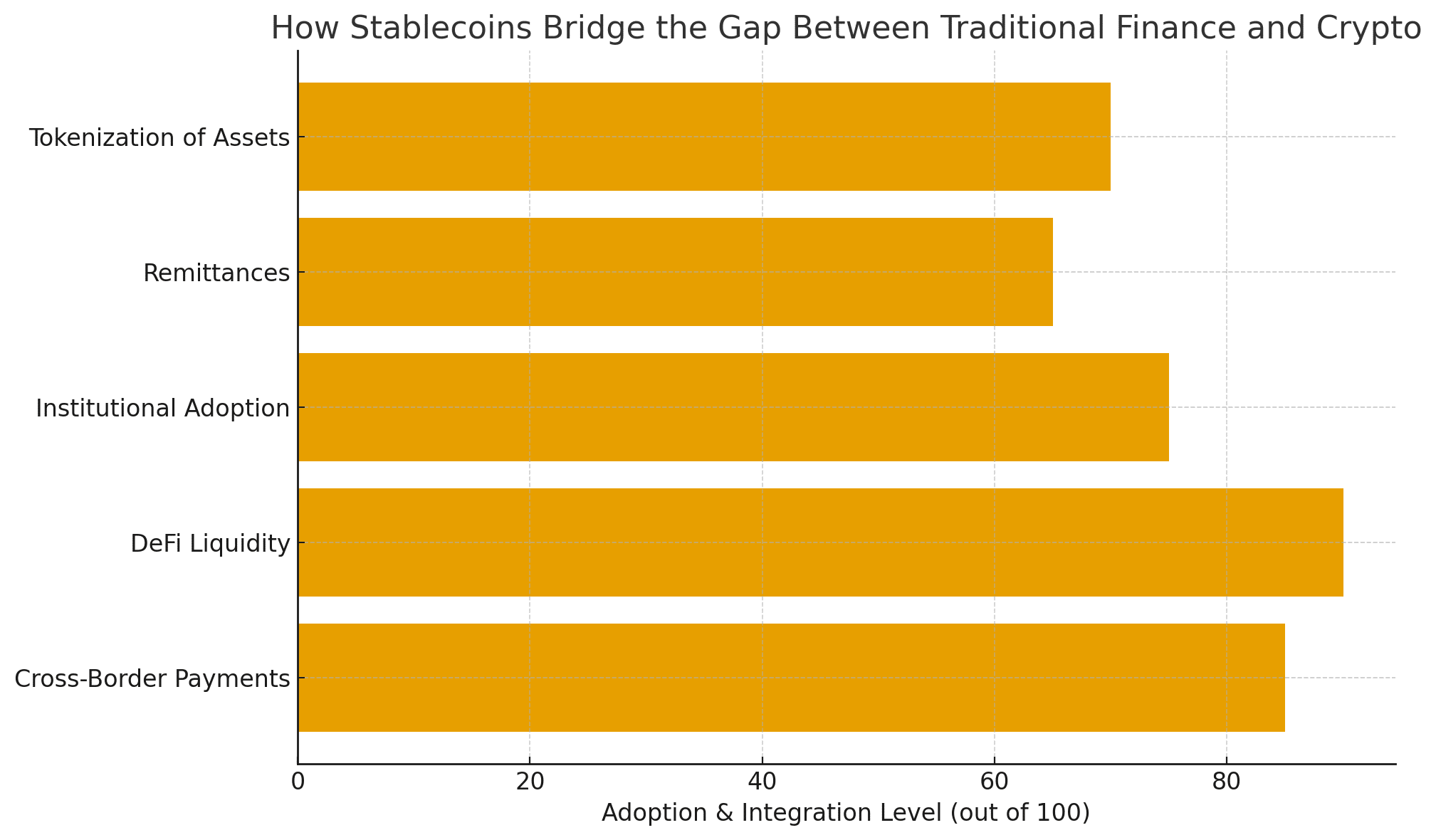
1. Instant On-Ramps from Fiat to Crypto
Traditional banking systems can be slow, encumbered by compliance, settlement times, and regional restrictions. Stablecoins let users convert fiat to an equivalent digital token and enter the crypto sphere in minutes.
Instead of waiting days for interbank transfers, a user can onboard via a stablecoin, trade, lend, pay or carry assets across borders instantly. That ease closes one major gap.
2. Low-Cost, Cross-Border Settlements
One of the persistent pain points in traditional finance is cross-border payments: high fees, slow rails, correspondent banks, and layers of intermediaries. Stablecoins bypass many of these.
A payment in stablecoins is settled on a blockchain. Verify the transaction, confirm the ledger, no middleman required. McKinsey reports that stablecoins can settle between wallet addresses nearly instantly and at minimal cost, depending on the blockchain used.
To illustrate: sending money via SWIFT might take a day or more. Using a stablecoin, you can move value across chains or jurisdictions in seconds.
3. Anchor for DeFi, Lending, and Yield Protocols
In decentralized finance, balance and predictability matter. Liquidity pools, margin trading, lending and borrowing platforms require an anchor. Volatile tokens introduce too much risk.
Stablecoins play that role. Users can deposit or borrow using stablecoins as collateral or a medium of exchange. That makes more sophisticated financial contracts possible, bridging crypto’s innovation with traditional financial concepts like interest rates, credit, and arbitrage.
4. Tokenization of Traditional Assets
One vision for the future is that traditional assets, stocks, bonds, and real estate become tokenized, so they can live on blockchains. But you need a reliable digital medium to express value in that world.
Stablecoins serve as that medium. Whether it is tokenized debt or shares, you need a stable digital “numeraire” to price and exchange them. Without stablecoins, every tokenized asset becomes volatile by default.
5. Institutional Adoption and Bank-Backed Stablecoin Projects
What’s especially interesting is that major banks are no longer merely observers. Earlier this month, ten leading banks, including Goldman Sachs, UBS, Bank of America, Citi, and Deutsche Bank, announced a joint effort to explore issuing stablecoins pegged to G7 currencies.
That move signals traditional finance wants in. They see stablecoins not as crypto’s fringe products, but as infrastructure that could blend into regulated systems. If banks issue stablecoins, the boundary between crypto and TradFi blurs even further.
Key Indicators for Evaluating Stablecoin Strength
To judge which stablecoins are credible bridges (and which are risky), one must check several indicators:
-
Reserve Transparency & Quality
A stablecoin must hold real assets backing its tokens. Are those assets liquid? Are they in cash or U.S. Treasuries (or safe equivalents)? How often are they audited? Without credible backing, the peg is vulnerable. -
Redemption Mechanism
Can token holders redeem the stablecoin for fiat easily and reliably? The more seamless the redemption (even at scale), the stronger the peg. -
Regulatory Compliance & Oversight
A truly bridgeable stablecoin must operate within legal frameworks: licensing, KYC/AML, audits, insurance, stress testing. If it exists only in gray zones, it risks being shut down. -
Blockchain & Network Efficiency
A stablecoin lives on a blockchain (or multiple chains). Fast finality, low fees, robust throughput all matter. If the chain is congested or expensive, usability declines. -
Peg Stability / Historic Depegging Events
How well did it hold its peg during market stress? Any past depegging episodes can expose flaws. The history reveals resilience. -
Market Depth and Liquidity
If the coin is widely used, available on many exchanges, and is used in trading pairs with other assets, that is a strength. Thin volume makes maintenance fragile. -
Governance and Risk Management
Who makes decisions about reserves, upgrades, failures? Are there safeguards for black swan events?
Monitor these and one can assess which stablecoins are bridges, not illusions.

Challenges and Risks on the Bridge
Bridging is dangerous. There are structural, regulatory, and economic challenges.
Reserve Instability and Bank Runs
If many holders redeem at once, the issuer must have the liquidity to fulfill demands. If reserves are illiquid or opaque, that risks a “run.” The TerraUST collapse (2022) is a cautionary tale.
Regulatory Uncertainty and Fragmented Oversight
Different jurisdictions treat stablecoins differently. Some call them securities, others treat them as payments, and others ban or restrict them. That fragmentation creates legal risk for issuers and users alike.
Hong Kong passed a Stablecoins Bill to regulate stablecoin issuance. But in many places, regulation lags behind the technology.
Competition from CBDCs or Tokenized Deposits
Central banks are developing their own digital currencies (CBDCs). Meanwhile, tokenized bank deposits, essentially digital versions of traditional deposits, may serve similar purposes. In some scenarios, tokenized deposits could compete or even supplant privately issued stablecoins.
Systemic Risks and Concentration
When stablecoins become large parts of the financial system, their failure can ripple. If one issuer faces trouble, the shock could cascade. Some critics, including the Bank for International Settlements, argue stablecoins “perform poorly as money” and carry systemic dangers.
Technical & Smart Contract Vulnerabilities
These are still software. Bugs, hacks, misconfigurations, or oracle failures can disrupt the peg or expose reserves. Bridge protocols themselves (inter-chain movement) can be attacked.


Recent Moves That Show the Bridge in Action
One example: PayPal launched PYUSD, a U.S. dollar–backed stablecoin. That is a payments company stepping into crypto rails.
Another: in recent months, Payoneer and Coinbase used stablecoins to pay EY invoices. Payments Dive That shows real-world payables settling via stablecoins, not wire transfers.
Also, Mastercard recently began integrating a stablecoin (FIUSD) into its payment network so that wide merchant acceptance is possible.
These aren’t experiments anymore. They are first steps in weaving stablecoins into everyday finance.
What the Future Might Look Like
If stablecoins evolve into reliable, regulated bridges, what changes?
-
Hybrid monetary systems could emerge, mixing CBDCs and private stablecoins in layered systems. A paper on “Hybrid Monetary Ecosystems” argues for a future where private stablecoins are backed by central bank reserves to unify trust and innovation.
-
Programmable finance could take off, with money that knows rules (automated tax, compliance, conditional transfers).
-
Fragmentation gives way to standards, interoperability protocols, common reserve structures, cross-chain pegging.
-
Bank-issued stablecoins may gradually replace many privately issued ones, reducing fragmentation but also introducing centralization risks.
Still, the path is tricky. Issuers must prove credibility. Regulators must avoid stifling innovation. Users must demand real transparency.
Conclusion
Stablecoins are not a panacea. They cannot magically fix every friction between finance and crypto. But they are one of the most tangible, working tools that do real heavy lifting in that junction.
They are the rails allowing fiat to enter crypto, the settlement layer for global payments, the anchor for DeFi, and the foundation for tokenized finance. Yet for stablecoins to fully bridge the gap, they must survive stress, operate transparently, and win trust from both regulators and institutions.
If the balance holds, stablecoins could mark the point where crypto stops being an “alternate universe” and becomes part of the financial mainstream. And bridges, when built well, last.
Frequently Asked Questions
Why not just use bank accounts or wire transfers?
They are slower, costlier, cross-border limited, and often constrained by intermediaries. Stablecoins let users move value instantly without those middlemen.
Do stablecoins always stay exactly at $1 (or peg)?
No. Some deviate under stress (depeg). Their stability depends on reserves, market conditions, and redemption mechanisms.
Can regulators shut down stablecoins?
Possibly, especially if they are unlicensed or noncompliant. That is why many projects aim for full regulatory alignment.
Will CBDCs make stablecoins obsolete?
Not necessarily. Private stablecoins offer flexibility, programmability, and innovation. But CBDCs may compete or subsume some use cases.
Are stablecoins peaks of safety?
They can be safer than pure crypto, but not risk-free. Counterparty risk, smart contract risk, regulatory risk, and reserve risk remain.
Glossary of Key Terms
Pegging / Peg
The mechanism by which a stablecoin maintains its value relative to a reference (e.g., 1 stablecoin = 1 USD).
Reserve Assets
Assets held to back stablecoins (e.g. cash, U.S. Treasuries, short-term securities).
Redemption
The process allowing token holders to exchange stablecoins back into fiat currency.
Depegging
When a stablecoin’s market price drifts away from the pegged value (e.g., falls below or rises above the target).
CBDC (Central Bank Digital Currency)
A digital form of a country’s fiat currency issued and regulated by the central bank.
Tokenized Deposits
Digital representations of real bank deposits on a blockchain, typically controlled by the bank itself.
DeFi (Decentralized Finance)
Financial applications built on blockchain protocols operate without traditional intermediaries.