This article was first published on TurkishNYRadio.
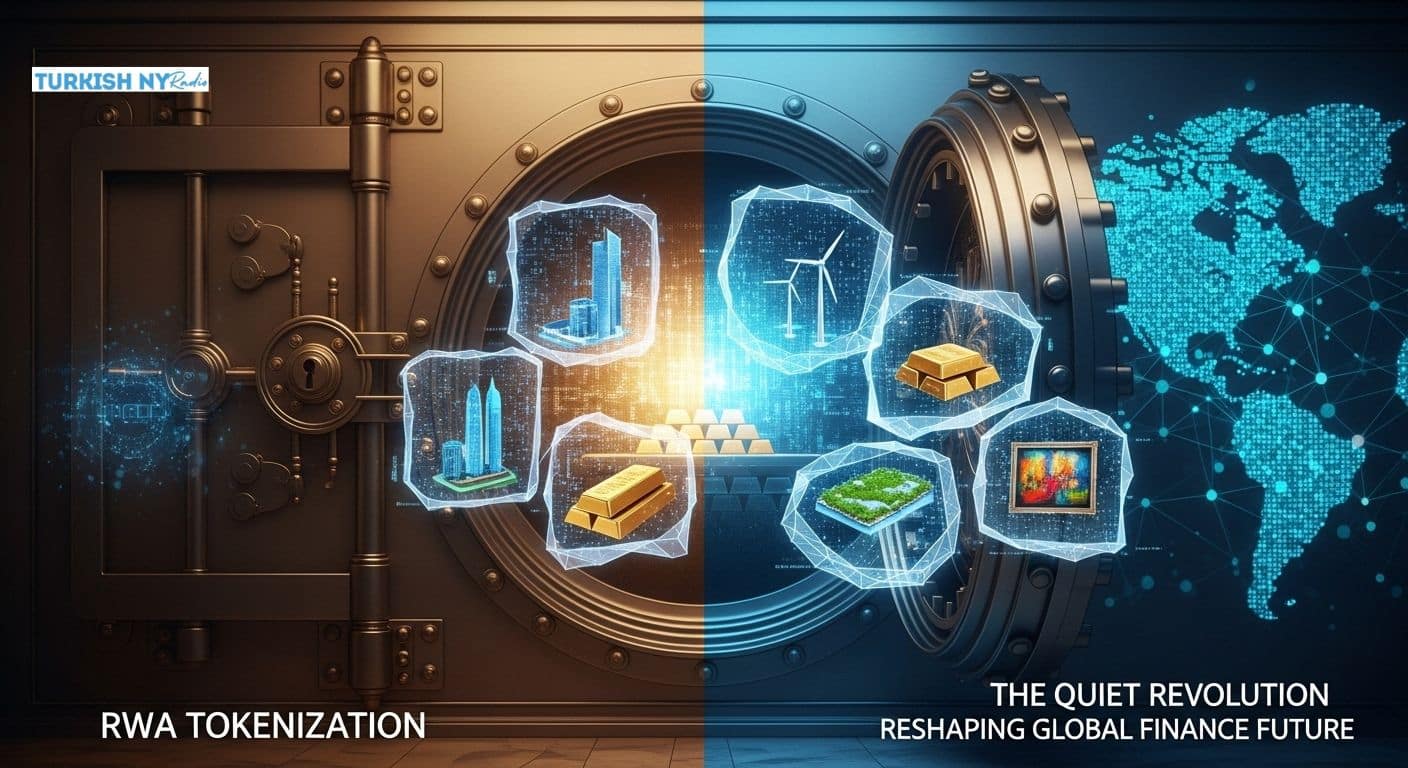
Real-world asset (RWA) tokenization is the process of converting physical assets like real estate, bonds or funds into digital tokens on a blockchain.


Proponents say RWA tokenization can speed up settlements, enable fractional ownership and open global investment. Critics argue that it is complex, redundant or risky. However, recent progress suggests tokenized assets are building the foundation for the future of finance.
Stablecoins alone (fiat-backed tokens) are now over $300 billion, showing the demand for on-chain asset tokens. Worldwide, regulators and institutions are moving from skepticism to structured support.
Institutional Momentum and Market Growth in RWA Tokenization
RWA tokenization is growing fast. Early-year reports estimated that about $50 billion of real-world assets are already tokenized on blockchains, with projections reaching $500 billion by 2025 end (excluding stablecoins).
This is driven by institutional demand. Big players like BlackRock and Franklin Templeton are launching tokenized funds, and banks are piloting on-chain asset services. A good example is BlackRock’s $260 million RWA fund already on Ethereum.
The biggest category is private credit, but tokenized U.S. Treasury bonds are catching up. Some forecasts expect tokenized Treasuries to surpass $28 billion in token value as inefficiencies are addressed.
Real estate is another big sector: on-chain real-estate transactions now total about $30 billion in value. By allowing fractional ownership of high-value assets (e.g. property or commercial loans), tokenization can open up investment to everyone and reduce costs.
Boston Consulting Group predicts tokenized fund assets under management could grow from $2 billion currently to over $600 billion by 2030 due to lower transaction costs, faster settlement and more liquidity.
In reality, tokenized assets have already enabled on-chain securitization of home equity lines and instant peer-to-peer bond trading, hinting at bigger efficiency gains for capital markets.
| Tokenized Asset Category | Current Market | Projected Trend |
| Stablecoins (fiat-backed) | $307 billion market cap | Expected to grow with regulatory clarity |
| Private Credit Funds | $12-16 billion tokenized private credit | Growth as illiquidity and lockups ease |
| U.S. Treasuries | $8.7 billion tokenized Treasuries | Could surge toward ~$28 billion market |
| Real Estate | $20-30 billion tokenized value (real-estate tokenization estimated around ~$20B) | Rising as tokenized RE becomes mainstream |
| Commodities (gold, etc.) | $1.9 billion tokenized commodities | Growing via gold- and oil-backed tokens |
Stablecoins like USDC and USDT now handle hundreds of billions on-chain, acting as digital cash bridges. Their success proves the appetite for tokenized assets.
RWA Tokenization and Finance
When fully built out, RWA tokenization brings many benefits by marrying traditional finance (TradFi) with blockchain’s efficiency. Tokenized assets can settle in seconds (via smart contracts) instead of days, reducing counterparty risk.
This on-chain settlement also reduces errors; for instance, eliminating separate messaging, reconciliation and batch processing that plague today’s markets.
As BIS’s Agustín Carstens said, blockchain can unify all financial processes; just as smartphones combined multiple devices into one, a tokenized system could let payments, securities and data flow through a single digital infrastructure.
Another benefit is democratization. By breaking assets into fine-grained tokens, RWA tokenization allows fractional ownership. A small investor could own a slice of a commercial property or a box of wine (via a wine-backed token) without huge capital outlay.
Liquidity is increased as these tokens can trade on secondary markets 24/7.
Traditional investors also benefit. Big banks and funds can deploy capital in new ways (e.g. programmable bonds, digital fund shares) with built-in compliance. As one exper said, every asset will eventually be tokenized because all assets will be digital.
In short, RWA tokenization removes borders in finance. A German investor can buy a slice of a U.S. Treasury or Brazilian farmland in seconds. Coinbase’s Fred Ehrsam said “Everything will be tokenized and connected by a blockchain one day.
Regulatory Clarity: Global Frameworks for RWA Tokenization
A big reason RWA tokenization is taking off now is regulatory clarity. Policymakers worldwide are writing rules to safely integrate tokens into finance. In the United States, the GENIUS Act of July 2025; created the first federal stablecoin law.
It requires 100% reserve backing and regular audits for payment stablecoins, and harmonizes state and federal oversight. This clear framework; focused on consumer protection and AML compliance, will set institutional investment in on-chain assets.
As the U.S. administration said, requiring Treasuries in reserves will increase demand and solidify the dollar’s global status.
In Europe, the Markets in Crypto-Assets (MiCA) Regulation provides a single rulebook for issuers and exchanges across all 27 EU countries.
MiCA came into force at end-2024; phased with implementation through 2025 and sets out clear criteria for asset-backed tokens and “e-money” stablecoins.
This harmonization means financial hubs like Paris, Frankfurt and Amsterdam can support RWA products.
Asia-Pacific regulators are also moving. Singapore’s central bank (MAS) launched Project Guardian to test tokenization. Led by MAS alongside DBS Bank and J.P. Morgan, these pilots tokenize government bonds and loans in a permissioned DeFi setting.
Meanwhile; Hong Kong passed its Stablecoins Ordinance (effective Aug. 2025) which requires any fiat-stablecoin issuer to get a license. Japan has also been rewriting its laws.
Expert Insights and Industry Voices
BIS head Agustín Carstens said, “tokenization can really be the future of a financial system with a sophistication that today we cannot imagine”. He believes by solving inefficiencies like messy payments, tokenized finance can create seamless processes; if fully realized.
Keyrock CEO Kevin de Patoul said: “All assets will eventually be tokenized because all assets will be digital”. He sees RWA tokenization as a switch up in how value moves globally, not just a small improvement.
Others note institutional readiness is essential. Franklin Templeton’s leadership compared tokenization to “securitization on steroids”, saying it can multiply market efficiency if done right.
Coinbase co-founder Fred Ehrsam put it simply: “everything will be tokenized and connected by a blockchain one day”.
Despite past doubts, big money is now betting on this. A consensus is emerging that RWA tokenization is not a fad or an experiment. The World Economic Forum and IMF have talked about tokenization unlocking trillions under compliant frameworks.
Leading crypto and finance thinkers agree that with clear rules and robust infrastructure, on-chain real assets can coexist alongside, and eventually integrate with, traditional markets.
Conclusion
RWA tokenization is creating a new standard for finance. Rather than a standalone “crypto-only” solution, it offers a bridge; requiring institutional thinking at every step.
The market expansion from billions today to potentially hundreds of billions in coming years; means tokenized assets are moving beyond pilots.
Meanwhile, regulators globally are providing the legal basis, and technical platforms are maturing. Criticisms around complexity and trust have driven fixes; like on-chain identity and standardized contracts.
The result is a more resilient framework, where tokenizing assets is supported by the very institutions it seeks to modernize.
Glossary
RWA (Real-World Asset): A physical or financial asset outside of blockchain (e.g. real estate; bonds, commodities). When tokenized; these become on-chain tokens.
Tokenization: Converting an asset’s ownership into digital tokens on a blockchain. Each token typically represents a fraction of the asset.


Stablecoin: A cryptocurrency pegged to a stable asset (like USD or gold). Stablecoins are the most popular type of tokenized assets today.
Smart Contract: A self-executing program on blockchain; that enforces rules (e.g. for a token sale or dividend payment) automatically.
MiCA: Markets in Crypto-Assets Regulation; EU’s law for crypto-assets; including asset-backed tokens and stablecoins.
Frequently Asked Questions About RWA Tokenization
What is RWA tokenization?
The process of converting ownership rights of real-world assets (RWA) such as real estate; bonds or funds; into digital tokens on a blockchain. This makes assets programmable and tradable on decentralized networks. In other words; a car title or a piece of artwork can be represented by tokens.
How does tokenization improve financial markets?
Tokenization can reduce costs and delays by replacing paper-based processes with instant blockchain settlement. It can also increase liquidity through fractional ownership and global access; e.g. a $1 million property can be sliced into many token shares. It can improve transparency since blockchain records are immutable.
Why is RWA tokenization gaining traction now?
Several reasons; big institutions are launching token projects like banks tokenizing bonds; and global laws are clarifying the rules (the U.S. GENIUS Act and EU’s MiCA provide regulatory clarity).
What are the main challenges of RWA tokenization?
Technical complexity, regulatory uncertainty; and security risks. If assets are illiquid, tokens may be thinly traded. Ongoing developments; like on-chain identity (KYC), custody standards and new laws are addressing these issues.
Can anyone invest in tokenized assets?
In theory yes; but regulations often require investors to meet certain criteria. Many tokenized securities follow traditional market rules: accredited investor status; AML/KYC checks or securities registration.